

When you're a 1099 contractor, you’re not just the talent—you’re the entire HR department. Finding the right health insurance is suddenly one of your biggest responsibilities, and it can feel like a maze. The best routes to good coverage usually lead to the ACA Marketplace (hello, potential subsidies!), private plans for more network choices, or even group plans through professional associations. This guide will help you navigate it all with confidence.
Why Finding the Right Health Insurance Matters
Stepping into the world of contracting is all about freedom. But it also means waving goodbye to employer-sponsored health benefits. All at once, you’re in charge of a decision that impacts your health and your bank account. Without a company plan, it’s on you to research, compare, and pay for your own coverage.
This isn't just about checking a box or avoiding a penalty. It’s about building a real safety net. The right health insurance protects your most valuable asset—your ability to work—from an unexpected injury or illness that could sideline your career and drain your savings.
Understanding the Contractor's Challenge
The real challenge for independent pros is managing inconsistency. Your income can swing from month to month, and your work hours probably don't fit a neat 9-to-5 box. That's why finding a plan that’s both affordable and flexible is so important. The good news? The insurance world has more options for people like you than ever before. This guide will walk you through:
- Your main coverage options: From government marketplaces to private insurers.
- How to save money: Finding subsidies and tax deductions to lower your costs.
- The enrollment process: A clear, step-by-step approach to getting covered.
This need is clear in the market trends. The U.S. makes up about two-thirds of the global health insurance market, which saw its premium income grow by 7% in 2024. This growth shows just how many self-employed individuals and contractors are relying on these plans for their peace of mind.
As a contractor, your health coverage isn’t just another bill—it’s a core business investment. It gives you the security to focus on your clients and grow your career, knowing you’re protected from life’s curveballs.
Ultimately, getting the right plan is more than just an administrative task. It's about giving yourself the freedom to thrive as an independent professional. Whether you’re a freelancer, consultant, or skilled tradesperson, understanding your options is the first step toward making a smart choice. For a deeper look into a variety of coverage types, check out our complete guide on insurance for independent contractors.
Decoding Your Health Insurance Options as a Contractor
When you’re a contractor, you’re not just the CEO—you’re the HR department, too. That freedom is incredible, but it also means you’re in the driver's seat for finding your own health insurance. It sounds daunting, but you’ve got several solid paths to choose from. Each one is built for different financial situations and health needs.
Let’s break down the five main routes you can take to get covered.
Think of this as your decision map. It helps you see the big picture and figure out where to start looking.
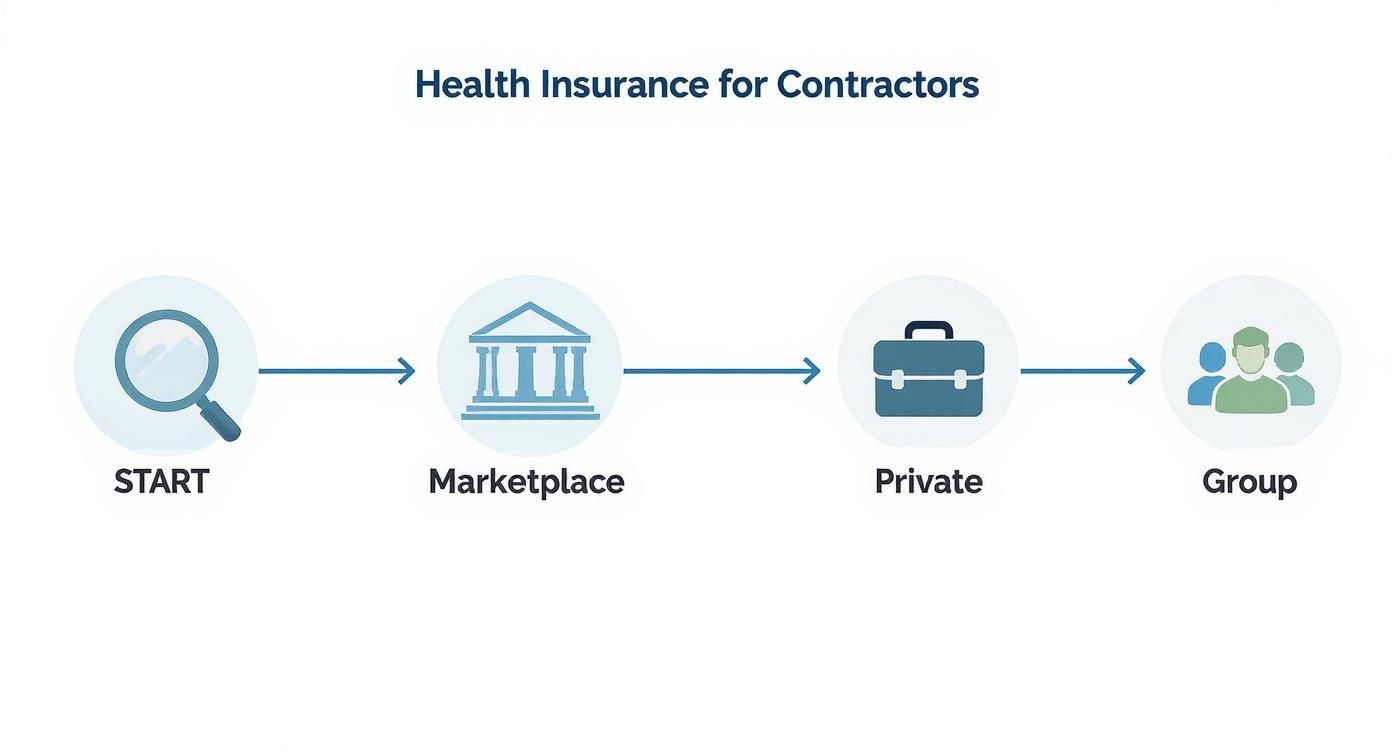
As you can see, your first step is a quick self-assessment. Are you looking for savings? The Marketplace is your best bet. More choices? Private plans might be the answer. Or maybe you can tap into the power of a group? Let’s dig in.
The ACA Marketplace: Your Gateway to Savings
For most self-employed people, the Affordable Care Act (ACA) Marketplace is the first and best place to look. Think of it as a centralized online mall for health insurance, but with one game-changing feature: financial help. Its biggest draw is the income-based subsidies that can dramatically lower your costs.
These subsidies come in two flavors:
- Premium Tax Credits: These are the most common. They directly reduce what you pay for your monthly premium. The amount you get is tied to your estimated household income for the year.
- Cost-Sharing Reductions: If your income falls below a certain level, these kick in to lower your out-of-pocket costs—things like deductibles and copayments—but only if you pick a Silver plan.
The Marketplace is a lifesaver for contractors with unpredictable income. If a big project ends and your earnings dip, you can update your application mid-year. You might just qualify for more financial aid, making coverage affordable even during slower months.
Private Insurance Plans: Going Straight to the Source
You can also buy a plan directly from an insurance company like Blue Cross Blue Shield or a local carrier. This is often called going "off-exchange" because it happens outside the government-run Marketplace.
So, why would you go this route? If your income is too high to get any ACA subsidies, shopping privately can sometimes unlock a wider variety of plans. You might find different doctor networks or plan designs that aren't listed on the Marketplace.
The Bottom Line: If your income makes you eligible for a subsidy, the ACA Marketplace is almost always your most affordable option. If not, it’s smart to compare both on-exchange and off-exchange plans to see who offers the best value for your situation.
Going direct gives you more selection, but it means you have to do the legwork yourself or team up with an insurance broker. You’ll want to carefully check each plan's network of doctors and list of covered drugs before signing up.
Group Plans: Power in Numbers
Many contractors are members of professional organizations, trade groups, or even their local chamber of commerce. Some of these groups offer their members access to group health insurance plans. This can be a fantastic option because you get to tap into the buying power of a huge group, which can mean better rates and stronger benefits than you could ever find on your own.
It's like joining a big company's health plan, but for a community of freelancers. These plans are often designed with the needs of a specific profession in mind. A writers' guild, for example, might offer plans with great mental health coverage.
Just know that availability can vary a lot depending on your industry and where you live. You'll need to check with organizations in your field and usually pay membership dues to get in.
Short-Term Plans: The Temporary Fix
What if you’re between big contracts or just left a W-2 job and need coverage for just a few months? That's where short-term health insurance comes in. These plans are designed as a temporary safety net to protect you from a catastrophic medical event. Coverage typically lasts from a few months up to a year.
But it's crucial to understand the trade-offs:
- Lower Premiums: They are almost always much cheaper than ACA-compliant plans.
- Limited Coverage: They don't have to cover the ten essential health benefits. That means no coverage for things like maternity care, mental health services, or pre-existing conditions.
- Medical Underwriting: You can be turned down based on your health history.
These plans are not a long-term solution. Think of them as a bridge to fill a specific, temporary gap while you line up more permanent, comprehensive coverage.
COBRA: Keeping Your Old Plan (For a Price)
If you recently left a traditional job to launch your contracting business, you might be eligible for COBRA. This law lets you continue the exact same health plan you had with your old employer for up to 18 months.
The biggest advantage is continuity. You keep your doctors, your network, and any progress you’ve made toward your deductible. The huge downside? The cost. You're now on the hook for paying the full premium—including the part your employer used to cover—plus a small administrative fee.
This usually makes COBRA the most expensive option by a long shot. But if you’re in the middle of medical treatment or just really want to keep your doctor for a while longer, it can be a worthwhile, if pricey, choice.
To help you visualize these pathways, here's a quick side-by-side comparison.
Comparing Health Insurance Pathways for Contractors
This table breaks down the main options, helping you weigh the pros and cons based on what matters most to you as a contractor.
| Coverage Option | Best For | Potential for Subsidies | Typical Cost Level | Key Consideration |
|---|---|---|---|---|
| ACA Marketplace | Contractors with variable or moderate income who want comprehensive coverage. | Yes, Premium Tax Credits and Cost-Sharing Reductions are available based on income. | Moderate (can be very low with subsidies) | The only place to get income-based financial assistance. |
| Private Insurance | High-income contractors who don't qualify for subsidies and want the widest plan selection. | No, subsidies are not available for off-exchange plans. | High | May offer more plan variety and network options than the Marketplace. |
| Group/Association | Contractors in industries with strong professional organizations offering member benefits. | No, these are group plans, not eligible for individual subsidies. | Moderate to High | Plan quality and availability vary greatly by association. |
| Short-Term Plans | Filling a temporary coverage gap, like between jobs or waiting for open enrollment. | No, these plans are not ACA-compliant and have no subsidies. | Low | Does not cover pre-existing conditions and has limited benefits. |
| COBRA | Recently departed W-2 employees who need to continue specific medical care without interruption. | No, but you may be able to deduct premiums. | Very High | You pay the full plan cost plus an administrative fee. |
Each path has a purpose. The key is to match your personal health needs and financial reality with the right type of plan.
Navigating Healthcare Costs and Finding Savings
Let's be honest: trying to figure out the cost of health insurance as a contractor can feel like you're decoding a secret language. You'll see words like "premiums," "deductibles," and "copayments" thrown around. But they all really just answer one question: How much will you actually pay for your health coverage?
Getting a handle on these terms is the first step to building a healthcare budget that doesn't break the bank.
Think of your premium like a monthly subscription fee. It's the fixed amount you pay the insurance company just to keep your plan active, whether you go to the doctor or not. This is your most predictable health expense.
The deductible is the amount you have to pay out-of-pocket for medical services before your insurance starts to chip in. If your plan has a $3,000 deductible, for example, you're responsible for the first $3,000 of your medical bills. Once you hit that number, your insurer starts sharing the load.

Unlocking ACA Subsidies: Your Secret Weapon
For most 1099 workers, the single best tool for making insurance affordable is the Affordable Care Act (ACA) Marketplace. This is where your estimated income for the year can unlock some serious savings through two key programs.
Your income as a contractor isn't a barrier to getting affordable health insurance—it's the key that unlocks it. By accurately estimating your earnings, you can access subsidies that make comprehensive coverage attainable.
These subsidies were practically made for the contractor lifestyle, since they're designed for people with fluctuating incomes. Here’s how they work.
- Premium Tax Credits (PTCs): This is the big one. It's a discount applied directly to your monthly premium. The less you estimate you'll make, the bigger your tax credit, which can make even top-tier plans feel much more manageable.
- Cost-Sharing Reductions (CSRs): If your income falls below a certain level (up to 250% of the Federal Poverty Level), you get even more help. CSRs lower your out-of-pocket costs like deductibles and copayments. You have to pick a Silver plan to get them, but they can slash a $5,000 deductible down to $500 or less.
Predicting your income is the most important part. If you guess too high, you’ll pay more than you need to each month. If you guess too low, you might have to pay some of the credit back at tax time. The trick is to give your best, most honest estimate and remember to update it in the Marketplace if a big project comes through or work slows down.
Putting It All Together: A Practical Example
Let's imagine a freelance graphic designer who estimates they'll bring in a net income of $45,000 for the year.
Without any help, a solid Silver plan on the ACA Marketplace might cost $550 a month. That’s a hefty bill. But based on that $45,000 income, they qualify for a Premium Tax Credit of $300 per month.
Just like that, their monthly payment drops to $250. On top of that, their income also makes them eligible for Cost-Sharing Reductions, so the plan’s $6,000 deductible is knocked down to just $1,000. The savings are huge, making quality health insurance a reality, not a luxury. For more tips on trimming your costs, check out our guide on how to find cheap health insurance.
This is exactly why the Marketplace should be the first place every contractor looks. You simply won't find these kinds of savings anywhere else. It’s a system built for the financial realities of being your own boss.
And managing these costs is more important than ever. Projections from WTW show that global medical benefit costs are climbing, with expected hikes of 10% in 2025 and another 10.3% in 2026. That trend makes it essential to grab every subsidy and savings opportunity you can. When you understand the system, you can protect your health and your bottom line at the same time.
Unlocking Tax Deductions for 1099 Contractors
https://www.youtube.com/embed/lVI9ZjbNeio
When you're your own boss, you're also in charge of your own health insurance. It's one of the biggest responsibilities you take on. But the tax code throws independent professionals a serious lifeline: the power to deduct your health insurance premiums.
This isn't some tiny write-off. It’s a game-changing financial strategy that can dramatically lower what you owe the IRS.
Think about it. A traditional employee usually pays for their share of health insurance with after-tax money. But as a 1099 contractor, you can treat those premiums like any other business expense. This move directly shrinks your taxable income, leaving more of your hard-earned money right where it belongs—in your pocket.
This amazing tool is called the Self-Employed Health Insurance Deduction. It lets you subtract every dollar you paid for medical, dental, and even qualified long-term care insurance premiums from your gross income. The end result? A lower Adjusted Gross Income (AGI), which is the magic number the government uses to figure out your tax bill.
The Self-Employed Health Insurance Deduction Explained
So, how do you qualify for this sweet deal? A few simple rules apply. First, your business has to turn a profit—you can’t deduct more in premiums than you actually earned. Easy enough.
Second, you can't be eligible to get health insurance from an employer. That means you don't have a part-time W-2 job offering a plan, and you can't hop onto a spouse's employer-sponsored plan.
If you check those boxes, you’re in. You can deduct the premiums for yourself, your spouse, and your dependents. Best of all, this is an "above-the-line" deduction, which is huge. It means you don't have to itemize your deductions to claim it; it lowers your AGI right on the front page of your tax return.
The Self-Employed Health Insurance Deduction isn't just a healthcare perk; it's a core business finance strategy. By treating your premiums as a deductible business expense, you're directly reducing your tax liability and improving your business's bottom line.
This deduction feels even more essential when you see how fast healthcare costs are climbing. In the U.S., the average annual premium for a family plan through an employer shot up to $26,993 in 2025—a 6% increase from the year before. While you're buying your own plan, those numbers show a clear trend. Costs are rising for everyone, making every tax advantage you can find a must-have.
Harnessing the Power of a Health Savings Account
Want to take your savings to the next level? Beyond just deducting your premiums, there’s another tool that offers a triple tax advantage: the Health Savings Account (HSA).
An HSA is a special savings account you can open if you're enrolled in a high-deductible health plan (HDHP). For contractors, it's one of the smartest ways to handle medical costs.
The benefits are just unbeatable:
- Contributions are tax-deductible: The money you put in lowers your taxable income for the year, just like contributing to a traditional IRA.
- The money grows tax-free: Any interest or investment gains your HSA funds make are completely free from taxes.
- Withdrawals are tax-free: You can pull money out anytime to pay for qualified medical expenses without owing a dime in taxes.
This powerful combo makes an HSA a fantastic account for both healthcare costs and long-term retirement savings. And unlike a "use-it-or-lose-it" Flexible Spending Account (FSA), your HSA funds roll over year after year. The money is yours. Forever.
Smart tax planning is the key to keeping more of what you earn as a contractor. Getting familiar with tax tips for traders and subcontractors can make a real difference in your bottom line. By using tools like the health insurance deduction and HSAs, you turn a major expense into a savvy financial win. For a deeper dive, check out our complete guide to the self-employed health insurance deduction.
Your Step-By-Step Enrollment Checklist

You've done the research. Now it's time to turn that knowledge into action and get yourself covered. The whole enrollment process can feel like a maze, but breaking it down into a simple checklist makes it totally manageable.
This is your roadmap from start to finish, making sure you don't miss a single detail.
Step 1: Gather Your Essential Information
Think of this as your prep work. Getting all your documents in one place before you start shopping will make everything go smoother and faster. Trust me, it prevents a lot of headaches later.
Here’s what you’ll need for yourself and anyone else on your application:
- Proof of Income: Grab your recent pay stubs, 1099 forms, profit and loss statements, and last year’s tax return. This helps nail down an accurate income estimate for subsidies.
- Household Details: Have the names, birthdates, and Social Security numbers for everyone you’re covering.
- Current Insurance Info: If you have coverage now, keep those policy documents handy. You'll need them to make sure your new plan starts right when the old one ends, avoiding any gaps.
- Immigration Documents: If this applies to you, you'll need documents like your Permanent Resident Card ("Green Card") or other immigration records.
Once you’ve got your paperwork organized, the next big thing is timing.
Step 2: Understand Your Enrollment Window
When it comes to health insurance, timing is everything. You can't just sign up whenever you feel like it. There are specific periods when the doors are open for enrollment.
The main event is Open Enrollment. This is a set time each fall when anyone can sign up for a plan for the coming year. It's your golden ticket to getting covered. To get the full scoop, check out our guide on what Open Enrollment is and why it matters.
Your other shot is a Special Enrollment Period (SEP). You might get one of these if you go through a major life change, like:
- Losing your old health coverage (like a COBRA plan ending)
- Getting married or divorced
- Having a baby or adopting a child
- Moving to a new ZIP code
Missing your enrollment window is a big deal. You could be stuck without insurance until the next Open Enrollment rolls around. For a contractor, understanding these timelines isn't just important—it's essential for staying protected.
Step 3: Compare Plans Holistically
Okay, your info is ready and you know when to enroll. Now for the fun part: shopping for a plan. The monthly premium is the first thing everyone looks at, but it's only one piece of the puzzle. A cheap plan can get real expensive, real fast if it doesn't actually cover what you need.
To make a smart choice, look beyond the price tag and compare these key features:
- Doctor and Hospital Network: Is your favorite doctor or local hospital in the plan’s network? Going out-of-network can lead to massive, unexpected bills.
- Prescription Formulary: If you take medications regularly, check the plan’s formulary (its list of covered drugs) to make sure your prescriptions are on it—and at a price you can handle.
- Total Out-of-Pocket Costs: Compare the deductible, copayments, and the out-of-pocket maximum. That maximum is your financial safety net; it’s the absolute most you’d have to pay for covered care in a single year.
- Plan Type (HMO vs. PPO): Do you want lower costs but are okay with needing referrals to see specialists (HMO)? Or would you rather have the flexibility to see any doctor you want without a referral, even out-of-network (PPO)?
Once you've picked your plan, it's time to submit your application. Double-check every detail for accuracy—especially your income estimate—before you hit submit. Make that first premium payment, and you're officially covered. By following these steps, you can confidently go from an uninsured contractor to a protected professional.
Choosing the Right Plan for Your Contractor Lifestyle
The best health insurance for a contractor isn’t about chasing the lowest premium. It’s about finding a plan that fits your life like a glove. Your real-world circumstances—from your health and family size to how comfortable you are with financial risk—should be your guide.
Let’s connect the dots and walk through a few common scenarios. By matching your situation to the right plan, you move from just having coverage to having genuine peace of mind.
Scenarios for Selecting Contractor Health Insurance
Your needs as a young, healthy freelancer are completely different from a contractor supporting a family of four. Understanding that difference is everything.
Scenario 1: The Healthy Solo Freelancer
If you're young, generally healthy, and flying solo, your main goal is simple: protect yourself from a catastrophic accident while keeping monthly costs down.
- Best Bet: A High-Deductible Health Plan (HDHP) paired with a Health Savings Account (HSA).
- Why it Works: Your premiums will be much lower, and every dollar you put into your HSA is tax-deductible. You're essentially building a medical emergency fund that you own, which is perfect for covering that high deductible if a major injury ever happens.
Scenario 2: The Contractor Supporting a Family
When you’ve got a spouse and kids on your plan, life is a mix of routine doctor visits, surprise fevers, and prescription refills. Predictability becomes way more important than just the lowest possible premium.
- Best Bet: An ACA Marketplace Silver or Gold plan.
- Why it Works: These plans come with lower deductibles and predictable copayments for the care you use most. And here's the key: if you qualify for Cost-Sharing Reductions on a Silver plan, your out-of-pocket costs can drop dramatically, making family healthcare truly affordable.
Scenario 3: The Contractor Nearing Retirement
As you get closer to your pre-Medicare years, you might have more health concerns and a greater need to see specific doctors. Your priority shifts from low cost to solid network access and comprehensive coverage for whatever might come up.
- Best Bet: A PPO plan from the Marketplace or a private insurer.
- Why it Works: A PPO gives you the freedom to see specialists without needing a referral and even offers some coverage if you go out-of-network. This ensures you can stick with the trusted doctors who know your history as you manage your health more proactively.
The right plan is always a balance. It’s not just about the monthly bill, but the total amount you could possibly face in a year. Always look at the out-of-pocket maximum as your true financial line in the sand.
Ultimately, picking the right health insurance is a personal calculation. You have to weigh your monthly budget against your potential medical needs and what you're willing to risk. By aligning your plan choice with your life stage, you can confidently invest in coverage that lets you get back to focusing on your work, knowing you’re protected.
Common Questions from Contractors, Answered
Jumping into the world of health insurance when you're self-employed can feel like a maze. Let's clear up some of the most common questions contractors have, so you can move forward with confidence.
Can I Get Health Insurance if My Income Is All Over the Place?
Yes, you absolutely can. The ACA Marketplace was built for people just like you, with fluctuating incomes. When you apply, you just give your best guess for your total annual income to see what plans and subsidies you qualify for.
The best part? It's flexible. If you land a huge project or have a slow month, you can log in and update your income anytime. Keeping it current means your financial help stays accurate, and you won’t get a nasty surprise come tax season.
What’s a Special Enrollment Period? Do I Get One?
Think of a Special Enrollment Period (SEP) as a personal sign-up window that opens up just for you, outside of the standard fall Open Enrollment. As a contractor, certain big life changes can trigger an SEP, letting you get coverage when you need it most.
These “qualifying life events” include things like:
- Losing other health coverage (like a plan from a former job)
- Getting married or divorced
- Having a baby or adopting a child
- Moving to a new zip code with different insurance options
Is It Better to Buy a Plan on the Marketplace or Straight From an Insurer?
This one comes down to subsidies. If your income makes you eligible for financial help, the Marketplace is almost always your best bet. Those Premium Tax Credits that slash your monthly payments are only available through the official Marketplace.
But what if your income is too high for subsidies? In that case, it’s worth shopping directly with an insurer or through a broker. You might find a wider variety of plans that aren't listed on the Marketplace. The smart move is to check both places to make sure you’re getting the perfect fit for your needs and wallet.
Finding the right plan when you're your own boss can be a headache, but you don’t have to figure it all out alone. The friendly experts at My Policy Quote are here to help you compare plans and find coverage that works for your contracting career. Start your free quote today.