

Getting a thick envelope from your health insurance company can be a little stressful. But learning how to read an Explanation of Benefits (EOB) is one of the best things you can do for your financial peace of mind.
This document is basically a breakdown of a recent medical claim. Think of it as a detailed receipt—not a bill—that shows what your doctor charged, what your insurance paid, and what you’ll likely owe when the actual bill arrives.
Why Your EOB Is Not a Bill
Let's get this out of the way first: An EOB is just a report, not a demand for payment. It almost always shows up before you get a bill from the hospital or clinic. Its whole purpose is to give you a transparent look at the numbers behind your medical care, so you can check everything for accuracy and know what to expect.
This little piece of paper is more powerful than you think. It's designed to put you in the driver's seat of your own healthcare costs.
Your Personal Financial Audit Tool
I always tell my clients to treat their EOB like a personal audit tool. It’s your chance to match the services you actually received with what your provider billed to your insurance. A quick check can uncover mistakes like duplicate charges or billing for a service you never had. Finding those errors can save you a surprising amount of money.
Even the Centers for Medicare & Medicaid Services (CMS) points out that reading EOBs helps people catch these issues, understand why a claim might be denied, and budget for what’s coming next. It's a key part of controlling your healthcare spending. You can learn more about your rights by checking out their medical bill rights guide.
A Preview of Your Financial Responsibility
The EOB gives you a sneak peek at what your share of the cost will probably be. This is where you’ll see how much was applied to your annual out-of-pocket costs, and it’s usually broken down into a few categories.
Most of the time, you'll see charges applied to your deductible or coinsurance. These are the numbers that directly affect how much you pay before your insurance plan really kicks in and starts covering the lion's share of your bills.
Here’s a quick look at how these financial terms work.
Quick Guide to EOB Financial Terms
This table breaks down the key terms on your EOB to quickly show you what your insurance covered and what you might owe.
| Term | What It Means for You |
|---|---|
| Billed Amount | The full, undiscounted price your doctor charged for the service. |
| Allowed Amount | The maximum amount your insurance plan will pay for that service. |
| Paid by Insurance | The portion of the allowed amount your insurer actually paid. |
| Patient Responsibility | This is your estimated share, including deductibles, copays, and coinsurance. |
Mastering these terms turns your EOB from a confusing document into a clear financial statement. Here's a little more on the most common ones you'll see:
- Deductible: This is the amount you have to pay for covered services before your insurance plan starts paying.
- Copayment (Copay): A flat fee you pay for a specific service, like a doctor's visit, after your deductible is met.
- Coinsurance: The percentage of costs you're responsible for after you've paid your deductible.
If you want to get a better handle on these concepts, our guide on what a deductible in insurance is is a great place to start. Once you get the hang of the language, you'll feel much more confident managing your healthcare journey.
Decoding the Key Sections of Your EOB
At first glance, an Explanation of Benefits can look like a wall of confusing numbers and insurance jargon. It’s easy to feel overwhelmed. But once you know what you’re looking at, you’ll see it’s just your insurance company showing its work—like a math problem, but for your healthcare.
Getting the hang of this document is a game-changer. This flowchart breaks down how the whole process works: your doctor sends a claim, the insurance company chews on the numbers, and then you get the EOB explaining their decision.
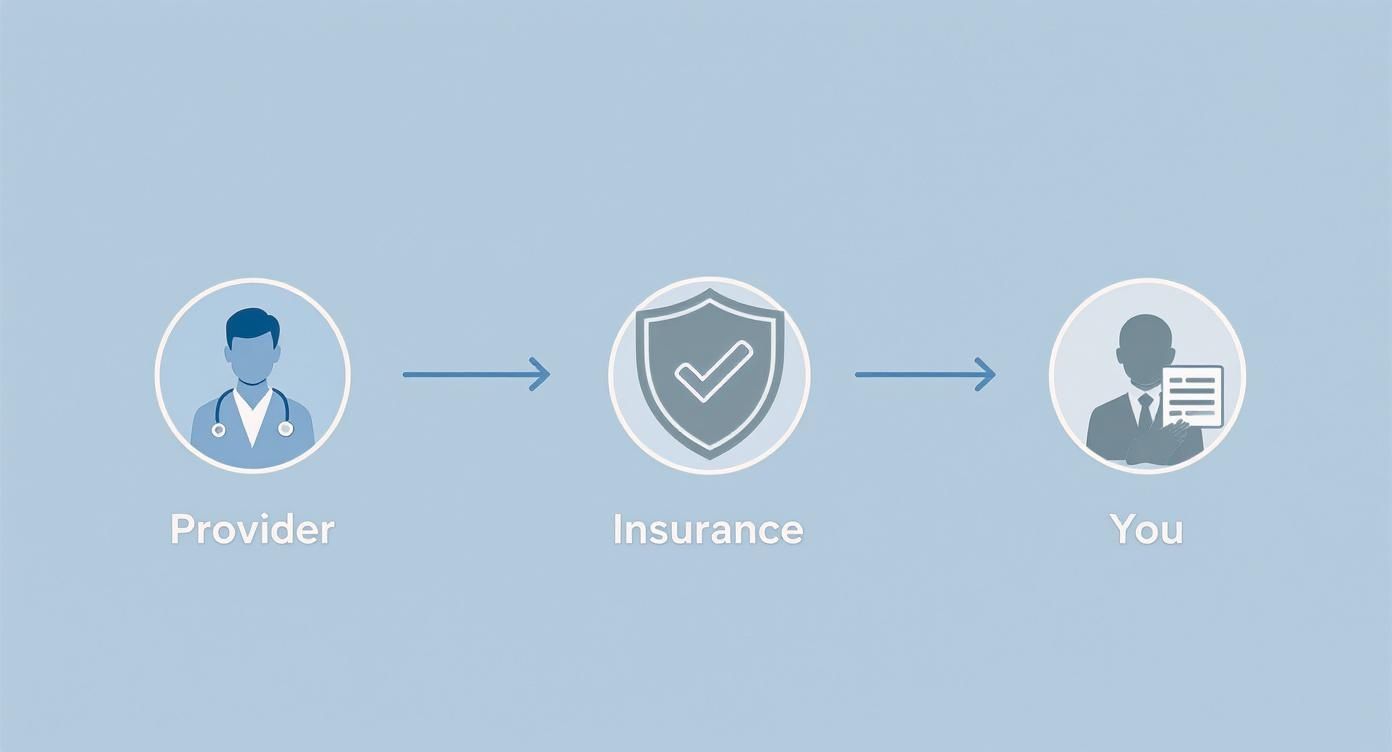
Think of the EOB as the final word from your insurer on that specific visit. It’s the official record, which is why it’s so important to understand.
Essential Identifying Information
The top of every EOB has all the basic details that tie the document to you, your doctor, and your visit. This isn’t just filler text; it’s crucial if you ever need to call and ask questions.
You’ll always find:
- Patient and Policyholder Info: Your name, policy number, and group ID. The first thing you should do is confirm it’s all correct.
- Provider Information: The name and address of the doctor, clinic, or hospital you visited.
- Claim Number: This is the unique tracking number for this specific service. If you have to call your insurer, this is the number they’ll ask for.
- Dates of Service: The exact day (or days) you received care. It’s a good idea to check this against your own calendar to make sure it lines up.
This section is the foundation for everything else on the page. A simple typo in your policy number can snowball into a massive headache, so give it a quick scan every time. To see how this info kicks off the whole process, check out our guide on what a health insurance claim is.
The Financial Breakdown
Here we go—this is the heart of the EOB. It’s where all the numbers live, telling the story of what was charged, what was discounted, what insurance paid, and what’s left for you.
- Amount Billed: This is the starting price—what the doctor or hospital charges before any insurance discounts. Think of it as the "sticker price."
- Allowed Amount: This is the discounted rate your insurer has negotiated with in-network providers. It's the maximum amount your plan will even consider for a covered service.
- Amount Paid by Insurance: This is the portion of the allowed amount that your insurance plan paid directly to your doctor.
- Patient Responsibility: This is your number. It’s the final amount you’re on the hook for, which is a combination of your deductible, copay, and coinsurance.
Always, always, always compare the bill you get from your doctor’s office to the Patient Responsibility number on your EOB. They should match perfectly. If they don’t, it’s time to pick up the phone.
Cracking the Code: Understanding EOB Remarks
The numbers on your EOB tell you the what and how much. But the real story—the why—is tucked away in the remark codes. These are short, alphanumeric notes from your insurance company explaining why they did what they did.
Think of them as the insurer's footnotes. They clarify why a charge was adjusted, why a payment was smaller than expected, or why a claim was denied entirely.
Learning to read these codes is a game-changer. A simple two-digit code can be the difference between owing nothing and getting hit with a surprise bill. For instance, seeing a code that points to an "out-of-network provider" is often the first red flag that you might be on the hook for more than you thought.

While these codes are mostly standardized, they can look a little different depending on your insurance carrier. The key is to find the "remarks" or "comments" section on your EOB. It will almost always have a legend that defines each code used on your claim.
Common Remark Codes and What They Mean
You don't need to memorize hundreds of codes. A handful of them show up over and over again. Getting familiar with the most common ones will help you size up most claims in a matter of seconds.
Here are a few you’re almost guaranteed to encounter:
- Applied to Deductible: This is probably the most common code you'll see. It simply means the service was covered, but you haven't paid your full annual deductible yet. The cost shifts over to your "Patient Responsibility" column.
- Not a Covered Benefit: This one is a gut punch. It means the service you received isn't included in your specific health plan at all, and you’ll likely have to pay the full billed amount.
- Service Exceeds Plan Limitation/Maximum: Your plan might cap certain services, like setting a maximum number of physical therapy visits per year. This code pops up when you've gone over that limit.
- Requires Prior Authorization: This means the service needed a green light from your insurer before you had it done. Since that step was missed, the claim was denied.
Knowing what these codes mean is the first step. What you do next is what really counts. For a deeper dive into these and other insurance terms, our health insurance glossary is an incredibly helpful resource to keep handy.
Common Remark Codes and What to Do Next
An EOB remark code isn't just a piece of information; it's your cue. It tells you whether you should pay the bill, call your doctor's office, or start preparing to fight a denial. To make it easier, here's a quick guide to some of the most common codes and the immediate next step you should take.
| Remark Code Example | Plain English Explanation | Recommended Next Step |
|---|---|---|
| Applied to Deductible | The cost was counted toward the amount you must pay before insurance starts paying its share. | No action needed. Just wait for the bill from your provider and pay the amount listed under "Patient Responsibility." |
| Duplicate Claim | Your provider accidentally billed for the same exact service more than once. | Call your provider’s billing office. Confirm they see the error and ask them to resubmit a corrected claim. |
| Not Medically Necessary | Your insurer has decided the service wasn't essential for your diagnosis or treatment. | This is a major reason for appeals. Contact your doctor to get supporting medical records and file an appeal with your insurer. |
This table doesn't cover every scenario, of course, but it handles the big ones. The key is to never just assume the EOB is correct. Always read the codes and be ready to ask questions.
How to Spot Costly Errors on Your EOB

Think of your EOB as the final receipt for your medical care—and it’s always worth a second look. While most insurance claims get processed correctly, errors happen way more often than you'd think. A quick review can stop you from overpaying and catch little issues before they snowball into major headaches.
Don't just glance at it and file it away. Take five minutes. Seriously, just five minutes to compare your EOB against the bill from your doctor or hospital. This simple check is your best defense against common but costly mistakes that can sneakily inflate what you owe.
Your Quick EOB Audit Checklist
Let's start with the basics. It’s just like checking a restaurant receipt for an extra drink you didn't order. You need to make sure the fundamental details on your EOB are right. Even a small typo can lead to a big problem.
Here’s exactly what to look for first:
- Patient and Policy Details: Is your name spelled right? Is the policy number accurate? A simple mix-up here can get a claim flat-out denied.
- Provider Information: Does it list the correct doctor's office or hospital? If you saw a few different specialists, make sure the services are matched to the right one.
- Dates of Service: Grab your calendar. Does the date on the EOB match the actual day of your appointment? It’s a common and easy-to-fix mistake.
This initial once-over catches most of the simple administrative errors. Once that's done, you can dig into the numbers and look for the more subtle red flags that could be costing you.
Identifying Red Flags and Billing Mistakes
Okay, the basic info checks out. Now it's time to get a little closer to the services and charges. This is where you can spot the issues that directly hit your wallet. Getting this right is crucial, especially when medical costs are tangled up in broader legal issues, like personal injury claims.
A really common red flag is seeing a charge for a more complex or expensive procedure than what you actually had done. It’s a practice called upcoding, and while it can be an honest mistake, it's something to watch. Always trust your gut—if a service listed on there doesn't ring a bell, question it.
Here are a few other potential errors to keep an eye out for:
- Duplicate Charges: Getting billed twice for a single service or visit. It happens.
- Incorrect Quantities: You were billed for two lab tests but only had one done.
- Unbundled Services: This is when they charge separately for services that are normally grouped together under a single, cheaper code.
These statements are powerful tools for your financial health. Globally, the World Health Organization reported that in 2021, around 2 billion people faced financial hardship from health costs. Verifying your EOB is a small but mighty step toward protecting your own bottom line.
Your Action Plan for EOB Errors and Denials
Finding a mistake or a denied claim on your Explanation of Benefits is frustrating. It’s that sinking feeling in your stomach. But take a deep breath—it's not the end of the road.
With a clear plan, you can tackle these issues head-on. The key is knowing who to call, what to say, and when to escalate.
Who Should You Call First?
Your first move depends entirely on what kind of error you’ve found. Not all mistakes are a full-blown battle with your insurance company. Many are just simple clerical issues that a single phone call can fix.
Before you dial your insurer and prepare for a long hold time, figure out where the problem likely started. This one step can save you hours.
- Call Your Provider's Billing Office For: Simple slip-ups like a misspelled name, the wrong date of service, or a potential billing code mistake. Your doctor’s office can often correct these errors and just resubmit the claim. Problem solved.
- Call Your Insurance Company For: The bigger stuff. Think disagreements over what your plan covers, denials for services you believe are medically necessary, or confusion about why a charge wasn't applied to your deductible. These are coverage decisions, and only your insurer can address them.
When you call, have your EOB and member ID card right in front of you. Being prepared makes the whole conversation smoother and much more productive.
Document Everything. Seriously.
From the moment you decide to question a charge, start a paper trail. This is your most powerful tool, especially if the issue gets complicated.
Get a notebook or start a digital file just for this claim. Write down the date and time of every call, the name of the person you spoke with, and a quick summary of what was said. This documentation is gold if you end up needing to file a formal appeal.
This isn't just about being organized. It's about creating a clear, factual record of your efforts. It shows you’ve done your part and gives you a timeline to reference in every future email or phone call.
Navigating the Appeals Process
What if your phone calls don't solve the problem? Your next step is a formal appeal. This is simply a written request asking your insurance company to take another look at its decision. The process can sound intimidating, but it's a right you have as a policyholder.
The first stage is an internal appeal, where you ask the insurer to conduct a full and fair review of its own decision. If they still say no, you can request an external review, where an independent third party who doesn't work for the insurance company evaluates your case.
For a detailed walkthrough, our guide on how to appeal an insurance claim denial gives you a step-by-step action plan. Don't be afraid to use the system—it's there to protect you.
Common Questions About Your EOB
Even after you get the hang of reading an EOB, some situations can still make you pause. Let's walk through a few of the most common questions that come up.
Think of this as your quick-reference guide for those tricky "what if" moments. A little clarity here can make a huge difference in managing your medical bills and staying on top of your finances.
How Long Should I Keep My Explanation of Benefits?
A good rule of thumb is to hold onto your EOBs for at least one full year. This gives you plenty of time to match them up with bills from your doctor and make sure everything is paid and settled.
But some situations call for keeping them longer. I'd recommend storing them for three to five years if the EOB is related to:
- An ongoing or chronic health condition.
- Medical expenses you might claim as a tax deduction.
- A workplace injury or a disability claim.
A simple solution is to go digital. Most insurance portals let you download and save your EOBs as PDFs. It's an easy way to keep a long-term record without all the paper clutter.
What Is the Difference Between an EOB and a Superbill?
This one trips a lot of people up, but the difference is actually pretty simple.
An EOB comes from your insurance company. It's their way of explaining how they processed a claim for you.
A superbill, on the other hand, comes from your doctor's office. It’s basically a detailed, itemized receipt listing all the services you received, complete with the proper medical codes. You'd typically use a superbill to file a claim yourself, especially if you saw an out-of-network provider. The EOB is the insurance company's official response to that claim.
My EOB Status Says 'Pending.' What Does That Mean?
Seeing a "pending" or "in process" status just means your insurer has the claim but hasn't finished reviewing it. They might be waiting on more information from your doctor or just confirming your coverage details.
Don't do anything just yet. It's really important to wait for the final, processed EOB before paying any bill from your provider. The amount you actually owe could change once the claim is finalized.
Can I Go Paperless and Get My EOBs Online?
Absolutely! Almost every major insurer offers electronic EOBs through their online member portal. Going digital is a great way to cut down on mail, keep your records organized, and access your claim history whenever you need it. For those who manage healthcare for a loved one, a legal document like a Durable Power of Attorney can be essential for gaining access to these online records. You can usually switch your delivery preference right in your account settings on the insurer's website.
At My Policy Quote, we believe that understanding your healthcare finances shouldn't be a struggle. We're here to help you find the right insurance coverage that provides clarity and peace of mind. Explore your options with us at https://mypolicyquote.com.