
When people start looking into term life insurance, one of the first questions is always about cost. The good news? It’s often more affordable than you think. A healthy 30-year-old can often lock in a $500,000 policy for 20 years for just $25-$35 a month.
But that's just a ballpark figure. Your final price is deeply personal, shaped by your age, health, how much coverage you want, and for how long.
How Much Does Term Life Insurance Really Cost

While there’s no one-size-fits-all price, the way insurers calculate your premium—the amount you pay to keep the policy active—is anything but random. Think of it as the insurer weighing the risk they’re taking on.
Understanding what drives that calculation is the key to finding a great deal. It really boils down to four main things:
- Your Age and Health: This is the big one. Younger, healthier people almost always get lower rates.
- Your Coverage Amount: The more coverage you buy, the higher the premium. Simple as that.
- Your Term Length: A 30-year policy will cost more per month than a 10-year one because the insurance company is on the hook for a longer time.
- Your Lifestyle: Things like smoking, having high-risk hobbies, or working a dangerous job can push your rates up.
Core Factors That Shape Your Premium
To really get how this works, you have to understand how insurers see risk. They group applicants into different health classes. A non-smoker in great shape might get a "Preferred Plus" rating, which comes with the lowest prices. Someone with a minor health issue that's well-managed might land in a "Standard" category and pay a bit more.
This is why you see such a huge range in quotes. Prices can swing from just a few dollars a month for a young person with minimal coverage to over $1,500 for an older individual needing a large policy. As a rule of thumb, rates tend to tick up every five years as you move into a new age bracket.
A true cost comparison isn't just about finding the rock-bottom price. It’s about finding the best value—getting the right coverage from a company you can trust, at a price that actually fits your life.
If you're a federal employee, it’s smart to see what your employer offers first. But don't stop there—comparing it to private options is essential. This federal employee life insurance guide is a great resource for getting that context.
To make things even clearer, I’ve put together a quick summary of the main factors that influence what you’ll pay. For a deeper dive, our guide on how much life insurance costs breaks it all down.
Key Factors Influencing Your Monthly Premium
This table shows the primary variables insurance companies look at when setting your term life insurance premium and how much each one typically moves the needle on your final cost.
| Factor | Impact on Cost | Example |
|---|---|---|
| Age | High | A 40-year-old may pay 50-70% more than a 30-year-old for the same policy. |
| Health Status | High | A non-smoker in excellent health pays significantly less than a smoker with a chronic condition. |
| Coverage Amount | Medium | A $1 million policy will cost more than a $250,000 policy, but not necessarily four times as much. |
| Term Length | Medium | A 30-year term is more expensive monthly than a 10-year term due to the extended risk period. |
At the end of the day, these factors work together to create a premium that's unique to you. By understanding them, you're already one step closer to making a smart, confident decision.
Decoding What Drives Your Premium
When an insurance company gives you a quote, that number isn't pulled out of thin air. It’s the result of a careful risk assessment process called underwriting, where insurers use decades of data to figure out life expectancy. Your what an insurance premium is is basically a reflection of the risk they take on by covering you.
A few key factors do most of the heavy lifting in this calculation. Getting a handle on them is the first step to making a smart comparison and finding the right policy for your budget.
Your Age and Gender
Age is easily the biggest player. The younger you are, the lower your statistical risk, which means lower rates. It's that simple. As you get older, premiums start to climb, and you'll often see noticeable jumps every five to ten years.
This is exactly why so many experts recommend locking in a policy when you're young. A healthy 30-year-old will pay a fraction of what a healthy 50-year-old would for the same coverage, and they get to keep that low rate for the entire term.
Gender matters, too. Statistically, women live longer than men, and this is reflected in their premiums. It isn't personal; it's just what the long-term data shows, which generally gives women a slight edge on pricing.
Health Classification: The Underwriting Tiers
This is where your personal health story comes into play. Insurers look at your current health and medical history to assign you a health class, and this decision has a massive impact on your final cost. While the names can vary slightly between companies, the tiers are pretty standard.
- Preferred Plus: The gold standard. Reserved for people in truly excellent health with a spotless family medical history and zero risky habits. This gets you the absolute best rates available.
- Preferred: For those in great shape but maybe with a minor, well-managed issue like slightly high cholesterol. Rates are still fantastic.
- Standard Plus: This is for people with above-average health who might have a few more moderate health or lifestyle flags.
- Standard: A common tier for people with average health, perhaps with more significant (but controlled) health conditions or a family history with some concerns.
Your health profile is built from your application and often a medical exam, including blood work. For a deeper dive, understanding inflammatory markers in blood work can give you a better sense of how insurers view your internal health.
The gap between a Preferred Plus and a Standard rating can be huge. We're talking about paying 50% to 100% more for the exact same policy. It shows just how much improving your health before applying can pay off.
The High Cost of Tobacco
Nothing sends your premium soaring faster than tobacco use. Insurers see it as a major red flag directly tied to a shorter life expectancy.
Smokers should expect to pay anywhere from two to five times more than non-smokers. It’s a massive difference. Even occasional cigar use or vaping can land you in the more expensive "smoker" category. The good news? If you quit for at least 12-24 months, most insurers will be willing to re-evaluate and lower your rates.
The Policy You Build
Finally, the choices you make have a direct impact on the bottom line. These are the levers you can pull to design a policy that fits your needs and your wallet.
- Coverage Amount: This is the death benefit—the money your family receives. A $1,000,000 policy will cost more than a $250,000 one because the insurer's potential payout is four times larger.
- Term Length: This is how long your coverage lasts, usually for 10, 20, or 30 years. A 30-year term costs more than a 10-year term because you’re locking in that rate for a much longer time, which increases the odds the insurer will have to pay a claim.
All these pieces come together to create your final quote. By tweaking the coverage amount and term length, you can find the perfect balance between the protection your family needs and a price you can feel good about.
Term Life Insurance Cost Comparison Tables
Theory is helpful, but nothing tells the story like seeing the numbers in black and white. To give you a real sense of what term life insurance costs, I've put together a few comparison tables. These will show you exactly how your monthly premium can shift based on your age, how much coverage you choose, and how long you want the policy to last.
To keep things simple and clear, all the sample rates below are for non-smokers in a 'Preferred' health class. This is a pretty common rating for people who are in good overall health, even with minor, well-managed conditions. Your actual quote will be unique to you, but these tables are a fantastic starting point to see what's possible.
At its core, your premium boils down to three main drivers: your age, your health, and the coverage amount you select.
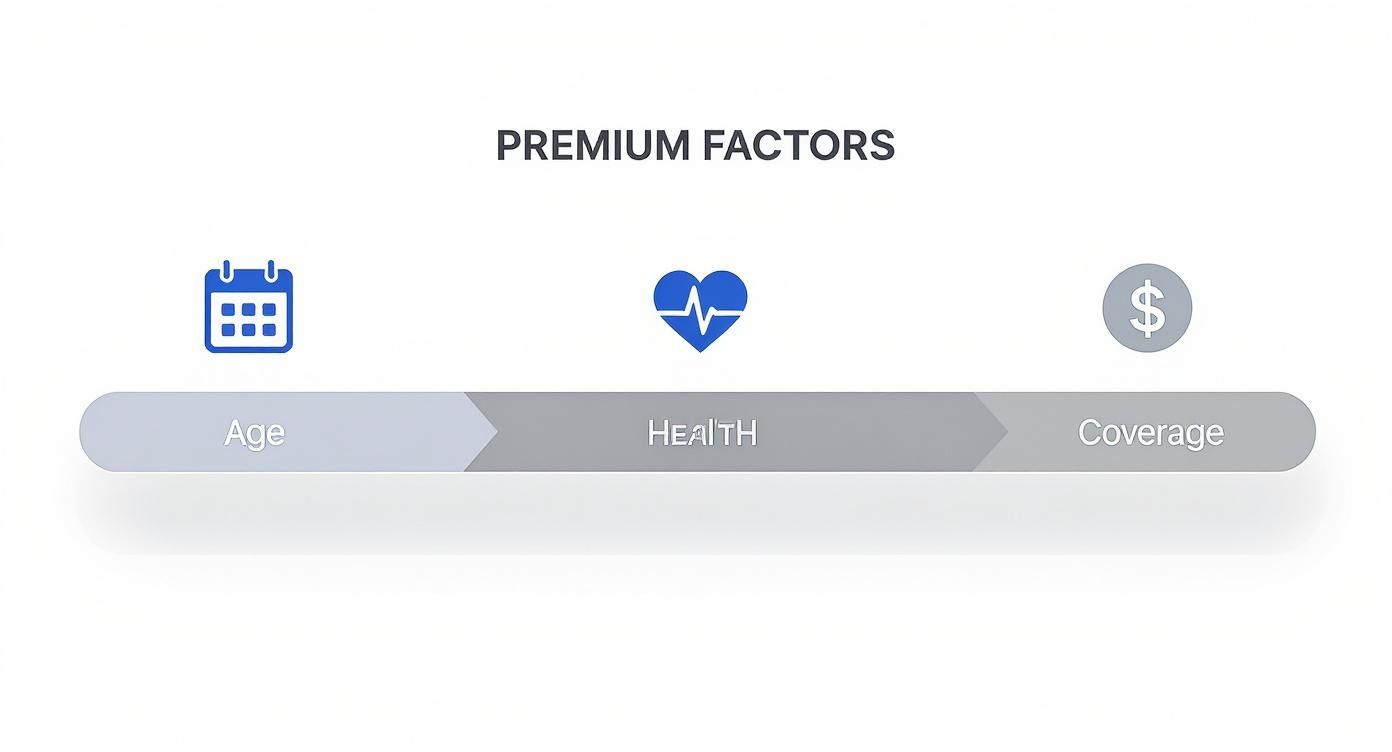
Think of these as the building blocks insurers use to calculate your final cost. That's why getting a personalized quote is the only way to know for sure what you'll pay.
Comparing Costs by Age and Gender
When it comes to your premium, age is easily the biggest factor. As you’ll see in a moment, locking in a rate while you're in your 30s can lead to massive savings compared to waiting until you're in your 40s or 50s. Gender also plays a part; women often get slightly lower rates because they tend to have a longer life expectancy.
This first table breaks down the estimated monthly costs for a 20-year term policy, which is a very popular choice, especially for families with young kids or a new mortgage.
Sample Monthly Premiums for a 20-Year Term Life Policy
Take a look at how dramatically the premiums can change with age for a standard 20-year policy.
| Age | Gender | $250,000 Coverage | $500,000 Coverage | $1,000,000 Coverage |
|---|---|---|---|---|
| 30 | Female | $14 | $21 | $35 |
| 30 | Male | $16 | $24 | $42 |
| 40 | Female | $20 | $32 | $58 |
| 40 | Male | $23 | $37 | $65 |
| 50 | Female | $45 | $82 | $155 |
| 50 | Male | $58 | $105 | $200 |
The jump between age 40 and 50 is stunning. A 50-year-old man might pay more than double what a 40-year-old man pays for the exact same $1 million policy. It's a powerful reminder of how much you can save by getting covered sooner rather than later.
On average, a standard $500,000, 20-year policy for a healthy 30-year-old costs about $26 a month. Of course, that number moves around based on your specific health and the insurance company you choose.
Comparing Costs by Term Length
The length of your policy also has a direct impact on your monthly bill. A longer term means the insurance company is on the hook for a longer period of time, which naturally leads to a higher premium. But the price difference might not be as steep as you'd imagine, often making a longer term a much better value.
Let's imagine a scenario for a 40-year-old man looking for $500,000 in coverage.
Impact of Term Length on Premiums (40-Year-Old Male, $500,000 Coverage)
| Term Length | Estimated Monthly Premium |
|---|---|
| 10-Year Term | $25 |
| 20-Year Term | $37 |
| 30-Year Term | $62 |
Notice that doubling the term from 10 to 20 years doesn't come close to doubling the price. For just $12 more per month, he can lock in protection for another ten years—covering his family through crucial milestones like college tuition or paying off the house. Choosing the right term length is a huge part of any smart term life insurance cost comparison.
Real-World Scenarios and Recommendations
Tables are great, but let's connect these numbers to real life. Seeing how these policies fit different situations helps you figure out what might be the right move for you.
-
Scenario 1: The New Homeowner
- Profile: A 35-year-old couple just took on a 30-year mortgage for $400,000.
- Need: They need coverage to last as long as their mortgage, making sure their home is safe if one of them were to pass away.
- Recommendation: A 30-year term policy with at least $500,000 in coverage for each of them. This pays off the mortgage and leaves extra funds for other expenses. A healthy 30-year-old man could expect to pay around $45-$55 per month for that kind of peace of mind.
-
Scenario 2: The Growing Family
- Profile: A 40-year-old single parent with two kids, ages 8 and 10.
- Need: Income replacement to cover everything from groceries and childcare to future college bills, at least until the youngest is financially independent.
- Recommendation: A 20-year term policy with $1,000,000 in coverage. This protects her family until the youngest child is 28. The larger death benefit ensures there’s enough to replace her income and fund her kids' education. For a healthy 40-year-old woman, this might cost around $58 per month.
These examples show that a good term life insurance cost comparison is about more than just chasing the lowest price. It’s about matching the right amount of coverage and the right term length to your life's obligations.
For a deeper dive into this process, check out our complete guide on term life insurance comparison. When you line up your policy with your actual needs, you make sure your family is truly protected without paying for coverage you don't need.
How to Get an Accurate Quote for Your Needs
Getting the best deal on term life insurance isn't about finding the cheapest price—it's about finding the right price. The only way to do that is to compare quotes. This is your single most powerful tool to make sure you're not overpaying.
It’s a simple process, but getting a truly accurate quote means you need to do a little homework first. The initial number you see online is just an estimate; the real price only gets locked in after the insurance company has a chance to look at the details.
Gather Your Essential Information
Before you even think about visiting a quote website, take five minutes to get your facts straight. This prep work makes everything faster and, more importantly, makes the quotes you receive far more reliable.
Insurers need a clear snapshot of your life to figure out their risk, which is what determines your premium. Having this info ready means no guesswork and a true apples-to-apples comparison.
Here’s what you’ll want to have on hand:
- The Basics: Your date of birth, height, weight, and gender.
- Your Health Story: Jot down any current or past health issues, surgeries you've had, and any medications you take. Be ready with dates and details.
- Family Health History: Insurers will ask about your parents and siblings, specifically if they’ve had major conditions like cancer, heart disease, or diabetes.
- Lifestyle Details: Be ready to talk about tobacco use (this includes vaping and marijuana), how much you drink, your driving record (especially DUIs or major tickets), and if you have any high-risk hobbies like flying planes or scuba diving.
Honesty is everything here. Trying to hide something about your health or lifestyle can get your application denied. Even worse, it could lead to the insurance company refusing to pay a claim down the road. It’s always better to be upfront and find an insurer who understands your situation.
Understand Where to Compare Quotes
With your info in hand, you're ready to shop. But not all quote sources are created equal. Using a mix of them will give you the clearest picture of what's out there.
You have three main options for comparing term life insurance costs:
- Direct from the Insurer: You can go straight to the websites of big names like Banner Life or Protective. This is great for seeing what one company offers, but comparing policies one by one can be a real time-drain.
- Captive Agents: Think of agents who work for a single company, like State Farm or Allstate. They’ll know their company’s products inside and out, but they can’t show you what competitors are offering.
- Independent Brokers and Agencies: This is usually the most efficient way to go. Independent agents and online marketplaces work with dozens of insurance companies. You fill out one application, and they shop it across the entire market to find you the best rate for your specific life.
Making a True Apples-to-Apples Comparison
Once the quotes start rolling in, you have to make sure you're comparing the same things. A lower price might catch your eye, but it could be for a policy with less coverage, a shorter term, or fewer perks.
To compare your options fairly, make sure these key details match up on every quote:
- Policy Type: Is it a level term policy? This is critical. It means your premium and your death benefit are locked in and won't change for the entire term.
- Coverage Amount: The death benefit should be exactly the same for each quote (e.g., $500,000).
- Term Length: Make sure the term is identical (e.g., 20 years).
- Health Class: Look at the health rating the quote is based on (like "Preferred" or "Standard"). A quote based on a "Preferred" rating isn't comparable to one based on "Standard."
When you follow these steps, you’re no longer just guessing. You’re making a smart, informed decision that will protect your family with the best possible coverage at the most competitive price you can get.
Actionable Strategies to Lower Your Insurance Costs

While your age and health set the stage for your premium, you have more say in the final price than you might realize. A smart term life insurance cost comparison is about more than just grabbing quotes—it’s about actively managing the factors that drive those numbers.
With a few thoughtful moves, you can seriously reduce what you pay. These aren’t industry secrets, just practical steps that can lock in big savings for years to come.
Fine-Tune Your Health Before Applying
Insurance companies love healthy habits, and they show it with lower premiums. If you can wait a few months before getting coverage, improving key health numbers can land you a better health class and a lower monthly payment for decades.
Focus on the metrics that insurers really look at. That means working on your cholesterol, blood pressure, and weight. Even small steps forward can change how an underwriter sees your application.
Quitting smoking is the single biggest health move you can make. A non-smoker can pay two to five times less than a smoker for the exact same policy. Insurers usually want to see you tobacco-free for at least 12-24 months to get non-smoker rates, so the sooner you start, the better.
Align Your Term Length with Your Needs
Going for a 30-year term feels safe, but it can also mean you’re over-insured and paying for coverage you don’t need down the road. The real goal is to match your policy’s term to your longest financial responsibility, not your entire life.
Think for a minute about why you’re buying insurance.
- Protecting a Mortgage: Got 22 years left on the house? A 20-year term probably has you covered.
- Covering Young Children: If your youngest is five, a 20-year term will see them through college and into their own careers.
- Replacing Income Until Retirement: Planning to hang it up in 15 years? A 15-year term could be a perfect match.
Choosing a shorter term—say, 20 years instead of 30—can slash your premium while still protecting your family when they need it most. For a deeper dive, our guide on how to reduce insurance premiums offers more smart tips.
Pay Annually to Secure a Discount
This is one of the easiest ways to save. Most insurance companies will give you a discount if you pay your premium once a year instead of monthly. Why? It just saves them time and administrative work.
While one larger payment might feel like a bigger hit upfront, the savings are real, typically ranging from 3% to 8%. Over a 20- or 30-year policy, that really adds up. If you can work the annual payment into your budget, it's a simple win.
Re-evaluate Your Coverage After Life Changes
Life insurance isn't a "set it and forget it" kind of thing. Your needs change, and your policy should, too. It’s a good idea to review your coverage every few years, especially after a big life event.
Have you paid off the mortgage? Are the kids financially independent? Maybe your savings have grown significantly. If so, you might not need as much coverage as you once did.
While you can’t change your current policy’s death benefit, you can always shop for a new, smaller policy that fits your new reality and then cancel the old one. This can lead to a much more affordable premium that makes sense for where you are today.
Still Have Questions About Costs? Let's Clear Them Up.
Even after you've compared quotes, a few nagging questions can pop up. It's totally normal. Let's tackle some of the most common ones so you can move forward with confidence.
Does My Premium Stay the Same for the Entire Term?
Yes, it does. With a standard level term life policy, the price you lock in on day one is the price you'll pay for the whole term. That’s one of its biggest perks—predictable costs you can budget for over 10, 20, or even 30 years.
Once that initial term is over, you might be able to renew your policy each year. Just be ready for a shock. Those renewal premiums will jump significantly because they're based on your new, older age.
What Happens If I Need to Cancel My Policy?
You can walk away anytime. There are no cancellation fees or penalties. All you have to do is stop paying the premiums.
It’s that simple. Since term life is pure insurance protection and doesn't build up a cash value like whole life, you won't get any money back. Your coverage just stops. The most important thing? If you still need coverage, make sure you have a new policy fully in place before you let the old one go.
Will a Past Health Issue Jack Up My Rates?
Not necessarily. A past health issue can definitely influence your rates, but it’s not an automatic deal-breaker. Insurers look at the whole picture: what the condition was, how long ago it happened, and how well you're managing it today.
Every company weighs health history differently. For instance, high blood pressure that’s well-controlled with medication might not stop you from getting a great rate. The key is to be upfront and honest on your application.
This is where an independent agent becomes your best friend. They can take your specific health profile and quietly shop it with different insurance companies to see who will give you the most favorable view—and the best price.
Is a Medical Exam Always Required for Term Life Insurance?
Nope. A medical exam isn't always part of the deal anymore. Many insurers now offer "no-exam" or "accelerated underwriting" policies, and they've become incredibly popular. These are great options for younger, healthier people looking for coverage amounts up to $1 million or more.
Instead of an exam, insurers use data from your prescription history, driving record, and other databases to make a quick decision.
While it’s super convenient, a no-exam policy can sometimes cost a bit more. If you’re in good health, it's always smart to get quotes for both types to see which one gives you the most bang for your buck.
The life insurance world is constantly changing to better fit how we live. Sales actually hit a 40-year high in 2021, and the market has stayed strong thanks to competitive prices and easy digital options. Experts think term life premiums will probably hold steady through 2024 before we see any small increases. You can discover more insights about these life insurance market trends and see what’s ahead for 2025.
Ready to see just how affordable your coverage can be? At My Policy Quote, we make it easy to compare quotes from top-rated insurance companies in minutes. Find the right protection for your family at the right price today at https://mypolicyquote.com.