

You’ve probably heard a number for the "average cost" of life insurance thrown around. Maybe you saw $26 per month and wondered what that even means. The truth is, that number is just a starting point, not the whole story.
For a perfectly healthy 30-year-old, a solid policy might actually cost less than that. But for someone older or with a few health bumps, the price tag could look very different. Your final cost is always personal.
Your Quick Guide to Life Insurance Costs
Think of buying life insurance like buying a car. You wouldn’t ask, "How much does a car cost?" without more details, right? The final price depends on the model (your policy type), its condition (your health), and the features you add (your coverage amount).
This guide will help you see past the myths that life insurance is always out of reach. We're going to give you a real, practical baseline for what you can expect to pay.
A First Look at Monthly Premiums
So, what drives the price? More than anything else, it's your age. The younger you are when you buy a policy, the lower your rate will be. It's that simple.
Insurers see younger applicants as a lower risk, and they lock in those lower prices for you. It's the number one reason financial advisors are always telling people to get coverage sooner rather than later.
At its core, life insurance pricing is all about risk. Younger, healthier people pay less because the odds are in their favor. As of 2025, that often-quoted average of $26 per month is a good ballpark, but your own rate will hinge on your age, health, and the type of policy you choose.
That average figure can be a bit misleading, though. For example, a man in his 30s might find a 20-year term policy for around $215 a month, but a 40-year-old could be looking at closer to $331 for the same coverage. Wait until 50, and that same policy could jump to roughly $815 monthly. If you want to dive deeper into the data, you can check out some detailed life insurance rate studies on NerdWallet.com.
To make this super clear, let’s look at some real-world numbers for one of the most common types of policies out there.
Estimated Monthly Life Insurance Premiums by Age
The table below gives you a snapshot of sample monthly costs for a $500,000, 20-year term life insurance policy. This is a popular setup for families who want to make sure the mortgage is covered and their income is replaced while their kids are growing up. These numbers are for healthy, non-smoking applicants.
| Age Group | Average Monthly Cost for Men | Average Monthly Cost for Women |
|---|---|---|
| 30-39 | $29 – $38 | $25 – $32 |
| 40-49 | $45 – $72 | $38 – $58 |
| 50-59 | $120 – $225 | $95 – $170 |
You’ll notice that women tend to pay less than men. That's not a marketing gimmick; it's based on statistics. Actuarial data shows women live longer on average, making them a lower statistical risk to insure.
Seeing these baseline figures helps you get a feel for where you might land. From here, we can start digging into the other factors that will shape your final premium.
Decoding the Key Factors That Drive Your Premium
Figuring out how much life insurance costs is a bit like baking. The final price tag—your premium—isn't just a random number. It's a carefully crafted recipe where every personal detail is a key ingredient.
Some of those ingredients, like your age, have a much bigger impact on the final "cake" than others. Once you understand how insurers mix these elements together, you can start to see your own risk profile from their perspective. That knowledge is power—it shows you exactly what you can influence to get a more affordable price.
This simple infographic breaks down how your personal factors and policy choices come together to create your final premium.
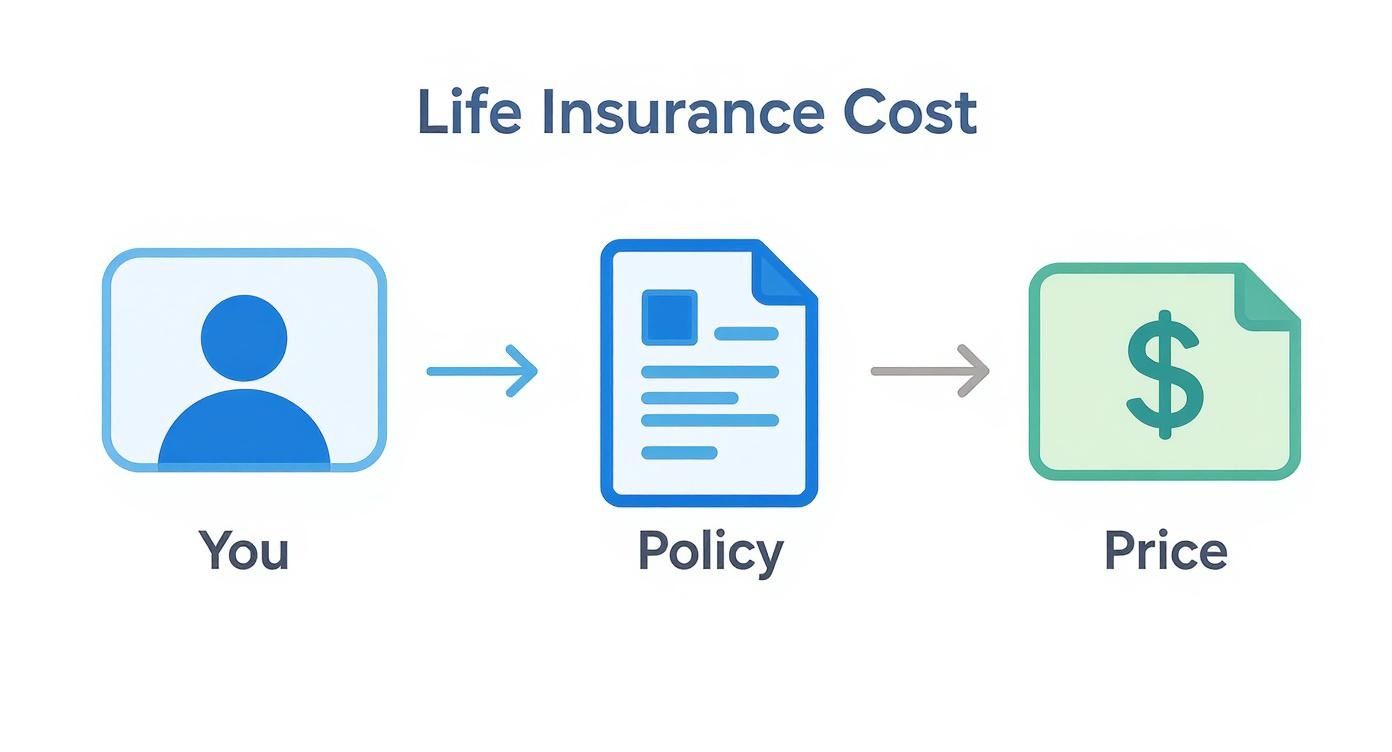
As you can see, the price you pay is a direct result of who you are and the policy you build. Let's dig into the most important ingredients.
Your Personal Risk Profile
Your personal details are the foundation of any life insurance quote. These factors give the insurer a snapshot of the statistical risk they’re taking on by covering you.
-
Age: This is the big one. Younger applicants almost always get lower rates because they're statistically further from their life expectancy and tend to have fewer health problems. Locking in a rate in your 30s can literally save you thousands over the life of a policy compared to waiting until your 50s.
-
Gender: Actuarial data has shown for decades that women, on average, live longer than men. Because of that simple statistical difference, women often pay slightly less for the same amount of coverage.
-
Health Status: Your medical history gets a close look during the underwriting process. Insurers review your height, weight, cholesterol, blood pressure, and any chronic conditions. Certain health issues, like high blood pressure, are major red flags that directly impact your perceived risk. To understand why, you can learn more about the profound impact of high blood pressure on health and longevity.
-
Family Medical History: It’s not just about you. Insurers also want to know about the health history of your immediate family (parents and siblings). A pattern of hereditary conditions like early-onset heart disease or certain cancers can sometimes lead to higher premiums.
Your Lifestyle and Policy Choices
After looking at your personal profile, insurers turn to your choices—both in how you live your day-to-day life and the specific policy you want. These are the final ingredients that complete your premium recipe.
A premium is simply the price an insurer charges to take on a calculated risk. Factors you can control, like quitting smoking or choosing a shorter term length, directly reduce that risk and, in turn, lower your cost.
For instance, smoking is one of the most significant lifestyle choices you can make. A smoker should expect to pay two to three times more for life insurance than a non-smoker of the same age and health. Why? Because smoking is directly linked to a huge range of serious health problems, dramatically increasing the insurer's risk.
Other key choices that move the needle on your rate include:
-
High-Risk Hobbies: Love skydiving, rock climbing, or piloting private planes? Any activity that increases your odds of accidental death will also increase your premium. Just be sure to be honest about them on your application.
-
Driving Record: A history of DUIs, reckless driving tickets, or a string of at-fault accidents signals risky behavior to an insurer, which can result in a higher cost for coverage.
-
Coverage Amount (Death Benefit): This one is pretty straightforward—the more coverage you buy, the more you’ll pay. A $1,000,000 policy is naturally going to cost more than a $250,000 policy, assuming everything else is the same.
-
Policy Type and Term Length: The kind of insurance you choose is a massive cost driver. As we’ll explore in a bit, permanent policies like whole life cost a great deal more than term policies. And for term life, a shorter 10-year term will always be cheaper than a 30-year term.
Comparing Term and Whole Life Insurance Costs
When you start digging into how much life insurance costs, you’ll quickly hit a major fork in the road: term or whole life? Think of it like this: term life is like renting an apartment, while whole life is like buying a house. Both give you a roof over your head, but they're built for entirely different purposes and come with wildly different price tags.
This one choice is the single biggest factor in what you'll pay each month. Getting a handle on the differences is key to finding a policy that actually fits your budget and what you want to accomplish for your family. One gives you pure, affordable protection for a set time, and the other offers lifelong coverage with an investment twist.
The cost gap between them isn't just a small hop—it's a massive leap.
Term Life Insurance The Affordable Option
Term life insurance is as straightforward as it gets, and it’s designed to be affordable. You pick a coverage amount—the death benefit—and a "term," which is just the number of years the policy is active. Most people choose 10, 20, or 30 years. If you pass away during that window, your family gets the payout. Simple.
Because it’s built to cover you for a specific timeframe—like while you’re paying down a mortgage or your kids are still at home—it's incredibly cost-effective. For a healthy 35-year-old, a $500,000, 20-year term policy can often cost less than your daily coffee.
This simplicity and low cost make it the go-to for the vast majority of families. You can dive deeper into the costs of term life insurance in our detailed guide.
Whole Life Insurance The Lifelong Commitment
Whole life insurance is a type of permanent coverage. That means as long as you keep paying the premiums, it lasts your entire life. It also has a cash value component, which is a kind of savings account that grows at a slow but guaranteed rate. This double-duty function is exactly why it’s so much more expensive.
That same 35-year-old looking for a $500,000 whole life policy would be looking at a monthly premium closer to a car payment. It’s often 5 to 15 times more expensive than the same amount of term coverage.
The real trade-off here is cost versus permanence. Term life gives you the most protection for the lowest price during the years you need it most. Whole life offers a smaller death benefit for a much higher premium, but it guarantees a payout and builds a little cash on the side.
It's also worth noting that premiums across the board are seeing some upward pressure. Costs have been inching up for a few years, pushed by things like rising healthcare expenses and new risk models. Insurers are getting smarter with their analytics, and that can change how they price policies. You can discover more insights about life insurance premium trends on nicrisinsurance.com.
Term vs Whole Life A Head-to-Head Comparison
To really see the difference, let's put them side-by-side. This table breaks down how each one stacks up on the features that matter most when you're deciding on a policy.
| Feature | Term Life Insurance | Whole Life Insurance |
|---|---|---|
| Primary Goal | Provides affordable protection for a specific period (e.g., 20 years). | Offers lifelong coverage with a guaranteed death benefit. |
| Typical Cost | Very low premiums, making large coverage amounts affordable. | Significantly higher premiums, often 5-15x more than term life. |
| Cash Value | No. It's pure insurance with no savings component. | Yes. A portion of your premium funds a cash value account. |
| Best For | Covering temporary needs like income replacement, mortgage debt, and children's education. | Complex estate planning, covering final expenses, or supplementing retirement savings. |
Ultimately, the right choice really boils down to your financial picture. For most people, the high cost of whole life makes it a pretty inefficient way to get protection. A common and very effective strategy is to buy a robust term life policy and simply invest the difference.
Real-World Cost Scenarios for Different Life Stages
Generic premium tables are a good starting point, but they don’t tell the whole story. The best way to really get a feel for how much life insurance costs is to see it in action, applied to real-life situations. Abstract numbers suddenly make a lot more sense when you connect them to people with goals, debts, and families you might recognize.
So, let's move beyond the raw data and meet three different people at key moments in their lives. Each one has unique needs, a different budget, and a very clear reason for wanting financial protection. By walking through their stories, you can see exactly how a policy is shaped to fit a real person.

The Young Professional In Their 30s
Meet Alex, a 32-year-old graphic designer. He just bought his first condo and is still chipping away at student loans. As a self-employed professional, Alex doesn’t have life insurance through an employer, so he’s on his own. His biggest worry? Making sure his co-signed student loan and new mortgage don't fall on his family if something were to happen to him.
- Financial Need: Cover a $180,000 mortgage and $40,000 in private student loans. The goal here is pure debt protection for a set amount of time.
- Policy Solution: A 20-year term life insurance policy is the perfect fit. It’s affordable and lasts long enough to see him through the riskiest years of his mortgage.
- Coverage Amount: Alex goes with a $250,000 death benefit. This easily covers his debts and leaves a little extra for final expenses.
- Estimated Monthly Cost: As a healthy non-smoker, Alex was able to lock in this coverage for just $18 to $25 per month.
This is a classic example of how term life insurance provides a huge amount of peace of mind for a very low cost, especially when you buy it young. It’s a simple, targeted solution for protecting against specific debts.
The Growing Family In Their 40s
Now, let's look at Maria and David. They're both 42, with two kids, ages 8 and 11. They have a $350,000 mortgage, and their top priority is making sure their kids' college dreams are secure. But even more than that, they need income replacement—a way to ensure the surviving spouse and children can maintain their lifestyle without financial chaos.
They need a policy that will stick around until their youngest is out of the house and the mortgage is mostly gone. The coverage amount is critical because it has to do a lot more than just pay off a loan.
For working-class families, life insurance often has two jobs: wipe out major debts like the mortgage and replace a primary earner's income for a number of years. This dual purpose means you need a much larger policy than a single person might.
- Financial Need: Cover the mortgage, replace at least one income for a decade or more, and set aside funds for future college tuition.
- Policy Solution: A 20-year term policy lines up perfectly with their timeline. In 20 years, the kids will be adults, and their mortgage balance will be tiny.
- Coverage Amount: They decide on a $1,000,000 policy. It sounds like a lot, but it’s designed to cover the mortgage, provide $50,000 a year for 10 years, and still leave a chunk for education.
- Estimated Monthly Cost: For two healthy 42-year-olds, a joint policy or two separate ones would run them about $80 to $110 per month combined.
Figuring out the right coverage amount is the most important step for families. If you're in a similar spot, a good tool can make all the difference. You can get a clearer picture of what your family needs by using our life insurance needs calculator to run the numbers yourself.
The Early Retiree In Their 50s
Finally, there’s Robert, a 58-year-old who is getting ready to retire. The house is paid off, and his kids are financially independent. The big term policy he bought in his 30s is about to expire, but his needs have totally changed. He’s not worried about replacing his income anymore; he just wants to make sure his final expenses are handled without taking a bite out of the inheritance he’s leaving behind.
- Financial Need: Cover funeral costs, final medical bills, and any outstanding taxes so these expenses don't become a burden for his spouse or children.
- Policy Solution: A small whole life insurance policy—often called final expense insurance—is the ideal choice. It provides a smaller, guaranteed death benefit that will never expire.
- Coverage Amount: Robert chooses a $25,000 policy, which is more than enough to cover typical final expenses.
- Estimated Monthly Cost: Because of his age and the fact that it's a permanent policy, the cost is higher, ranging from $95 to $140 per month.
These stories make one thing clear: there's no single "right" answer. The cost of life insurance is a direct reflection of where you are in life, what you're responsible for, and what you want to protect.
Actionable Strategies to Lower Your Life Insurance Premiums
Knowing what goes into your life insurance quote is one thing; taking control of it is another. While you can't turn back the clock on your age, there are plenty of other factors that are absolutely within your power to change. With a few smart moves, you can lower what you pay for coverage without compromising the protection your family deserves.
Think of it like tuning up your car—a few key adjustments can make everything run more smoothly and cost you less in the long run. The best part? Most of these strategies improve your overall well-being, making them a true win-win.

Focus on Health and Lifestyle Improvements
Your health is the biggest lever you can pull to get a better rate. Insurers love to see healthy habits, and they reward them with lower premiums because it means you're a lower risk. It’s that simple.
- Quit Smoking: This is, without a doubt, the single most impactful change you can make. Smokers often pay two to three times more for life insurance than non-smokers. Most companies will offer you non-smoker rates after you’ve been nicotine-free for at least a year, which could cut your premium in half.
- Improve Key Health Markers: Getting your blood pressure, cholesterol, and weight into a healthy range can literally move you into a better, cheaper rate class. Even small improvements show an insurer you’re serious about managing your health.
- Limit Risky Hobbies: If you're a regular skydiver or rock climber, you might see higher premiums. You don't have to give up your passions, but just know they're part of the overall risk profile that determines your cost.
Shop Smart and Compare Your Options
Whatever you do, don't just take the first quote you get. The life insurance market is incredibly competitive, and the price for the exact same coverage can swing wildly from one company to the next.
Shopping around isn't just a good idea; it's essential. Each insurer has its own underwriting rules and "sweet spots." One company might be tough on a specific health condition, while another might see it more favorably and offer you a much lower rate.
Working with an independent agent or using an online comparison tool like My Policy Quote lets you see offers from multiple carriers all at once. It's the fastest way to find the insurer that's the best match for you—saving you a ton of time and money. For a deeper dive, check out our guide on how to reduce insurance premiums.
Make Strategic Policy Adjustments
Sometimes, the simplest way to lower your bill is to tweak the policy itself. A few small changes to your coverage can make a big difference in your monthly payment.
Here are a few moves to consider:
- Choose the Right Term Length: Don't pay for more time than you actually need. If your biggest worry is covering a 20-year mortgage, then a 20-year term policy is going to be a lot more affordable than a 30-year one. Line up your term with your biggest financial responsibility.
- Pay Annually: Most insurers will give you a discount for paying your premium in one lump sum each year instead of monthly. It requires more cash upfront, but it can save you up to 8% over the year.
- Ladder Your Policies: Instead of buying one giant policy, you could "ladder" a few smaller ones. For example, you might get a 30-year policy for your long-term needs and a cheaper 15-year policy just to cover the years until your kids are out of college.
By combining these strategies, you can take an active role in what your life insurance costs, making sure this vital protection fits comfortably within your budget.
How to Get an Accurate Life Insurance Quote
While all the estimates and real-world examples are fantastic for getting a ballpark idea, the only way to know your actual cost is to get a personalized quote. This is where the rubber meets the road—moving from learning about life insurance to actually securing it.
The good news? It’s a lot simpler and faster than most people imagine. Getting a real quote transforms those general numbers into a concrete price tag based on your unique story. It's a free, no-obligation step that gives you the clarity to make a confident decision.
Getting Your Information Ready
Before you dive in, it helps to have a few key details on hand. This will make the process incredibly smooth, often taking just a few minutes. Don't stress if you don't have every single detail perfect; a basic overview is more than enough to get started.
You'll generally need:
- Personal Basics: Your age, height, weight, and gender.
- Health Snapshot: A quick summary of your health, including any major conditions or medications you take.
- Lifestyle Habits: Be ready to answer honestly about smoking, drinking, or any high-adventure hobbies you enjoy.
- Your Goal: Have a rough idea of the death benefit you want and how long you want the policy to last.
The life insurance market is huge, with global premiums valued at $3.1 trillion in 2024. That kind of competition is great for you, because it means insurers offer a wide range of prices. Shopping around is the single best way to find a rate that truly fits your budget. You can find more insights about life insurance industry statistics at feather-insurance.com.
Let a Comparison Tool Do the Heavy Lifting
Once you have your info, the smartest move you can make is to use an online comparison tool. Instead of spending hours visiting a dozen different insurer websites, a platform like My Policy Quote lets you see offers from multiple top-rated companies all in one place.
It's a massive time-saver.
Our guide on comparing life insurance quotes breaks down exactly how these tools find the most competitive rates for your specific situation. The goal is to make sure you don't overpay by matching you with the insurer that views your health and lifestyle most favorably.
After you submit your info, you'll likely connect with a licensed agent who can walk you through the formal application and answer any lingering questions. They’ll confirm your details and explain what comes next—which often includes a simple, free medical exam. A technician can even come to your home, making it super convenient.
This is the final step to locking in your best possible rate. It's that simple.
Still Have Questions About Life Insurance Costs?
Even after we've walked through the numbers, it's completely normal to have a few more questions pop up. Life insurance can feel like a complex puzzle, but once you get a few final pieces in place, you’ll have the confidence to make a great decision.
Let’s tackle some of the most common questions we hear about life insurance costs and how the policies actually work.
Do I Absolutely Have to Get a Medical Exam?
Not always. While a medical exam is the classic route to getting the best possible rates, a lot of companies now offer "no-exam" life insurance. These policies are all about convenience and speed, letting you get covered in days, not weeks.
But that convenience often comes with a trade-off. Because the insurer is working with less information, they're taking on more risk. That usually means no-exam policies come with higher premiums and might offer lower coverage amounts. They're a fantastic choice if you have a specific health concern or if you just want to get things done quickly and simply.
What Happens If I Can't Pay My Premiums Anymore?
This is a really important question. If you stop paying the premiums on a term life policy, it's pretty straightforward: the policy will eventually lapse, and your coverage ends. No more payments, no more protection.
But with a whole life policy, you have a few more cards to play because of its cash value. You could potentially surrender the policy and take the cash, use that cash value to cover your premiums for a while, or even convert it into a "paid-up" policy with a smaller death benefit. Your first step should always be to call your insurer—they’ll walk you through all the options available to you before you just stop paying.
As a quick rule of thumb, many experts suggest getting coverage that's 10-12 times your annual income. But remember, a truly personalized number needs to factor in your real-life debts, how much income your family needs to replace, future college tuition, and final expenses.
Can I Own More Than One Life Insurance Policy?
Yes, and it’s actually a really smart strategy for a lot of people. Having multiple policies is a technique called "laddering," and it lets you match your coverage to your life's changing needs without overpaying.
For example, you might get a big 20-year term policy to make sure the mortgage is covered while your kids are young, plus a smaller 30-year policy that runs until you plan to retire. This approach is often way more cost-effective than buying one gigantic policy meant to cover everything at once.
Ready to see what your real numbers look like? At My Policy Quote, we make it simple to compare personalized quotes from top-rated insurers in just a few minutes. It's time to get the clarity you need to protect your family's future. Get your free, no-obligation quote from My Policy Quote today!