

An insurance premium is the amount you pay, on a regular schedule, to keep your policy active. It's a lot like a subscription fee for financial protection. Just like you pay for a streaming service to get movies on demand, you pay a premium to get financial security when you need it.
What an Insurance Premium Really Is

At its heart, an insurance premium is the price you pay for peace of mind. It’s a formal agreement where you hand off the risk of a massive, unexpected financial loss to an insurance company. In return for your consistent payments—whether monthly, quarterly, or yearly—the insurer promises to step in and cover the costs if something covered by your policy happens, like a car wreck or a health emergency.
This simple idea is the engine that drives the entire insurance industry. Insurers pool together the premiums from thousands, or even millions, of policyholders to create a large financial reserve. This fund is then used to pay the claims of the few who actually experience a major loss. It's a shared-risk model that makes it possible to guard against catastrophic expenses most of us couldn't handle on our own.
The Scale of Insurance Premiums
Globally, these payments are a huge part of the economy. The worldwide insurance industry recently saw its total premium income hit an estimated EUR 7.0 trillion, growing by a staggering EUR 557 billion in just one year. That's an 8.6% growth rate, which shows just how vital this system of shared protection is across the world.
To get a better handle on what a premium actually covers, here's a quick breakdown:
Anatomy of an Insurance Premium
This table gives a quick summary of what an insurance premium represents and its core purpose.
| Component | Simple Explanation |
|---|---|
| Risk Cost | The money set aside to pay for future claims. |
| Operating Expenses | The cost of running the insurance company (salaries, rent, marketing). |
| Profit Margin | The amount the insurer adds to stay in business and grow. |
| Taxes & Fees | Government-mandated charges included in your payment. |
Together, these pieces form the final price you pay to stay protected.
Your premium isn't just another bill. It's your ticket to financial security. It turns a potentially devastating, unpredictable cost into a manageable, predictable expense.
Paying it ensures your coverage stays in force, ready to provide that safety net the moment you need it. To get the full picture of this system, check out our guide on how insurance works, which dives deeper into the relationship between premiums, policies, and claims. Once you understand what an insurance premium is, you can see exactly where your money is going and why it’s such a crucial part of managing your financial well-being.
How Insurers Calculate Your Premium
So, how does an insurance company land on that specific number for your premium? It’s not just pulled out of thin air. It’s the result of a detailed process called risk assessment, where the insurer’s main job is to predict the future—specifically, how likely you are to file a claim.
To do this, they dive into huge amounts of data and use statistical models to group you with other people who share a similar risk profile.
Think of it like a giant community fund. Everyone chips in, and that money is used to cover the claims of the few who need it. The insurer has to make sure there's enough cash in the pot to pay out claims, cover their own operating costs (like rent and salaries), and still have a little left over to stay in business. Your premium is simply your contribution to that pool, based on how much risk you bring to the group.
The Foundation of Shared Risk
The whole system is built on an idea called shared risk. By bringing millions of people together, the massive financial blow of a few large claims gets spread so thin that it’s manageable for everyone.
Without this model, the cost to protect yourself against a disaster would be sky-high—far too much for any single person to afford. This complex evaluation is at the heart of the insurance business. You can learn more about this detailed risk analysis in our guide on what is underwriting in insurance.
The infographic below breaks down the key factors that insurers look at when figuring out your risk for different kinds of policies.
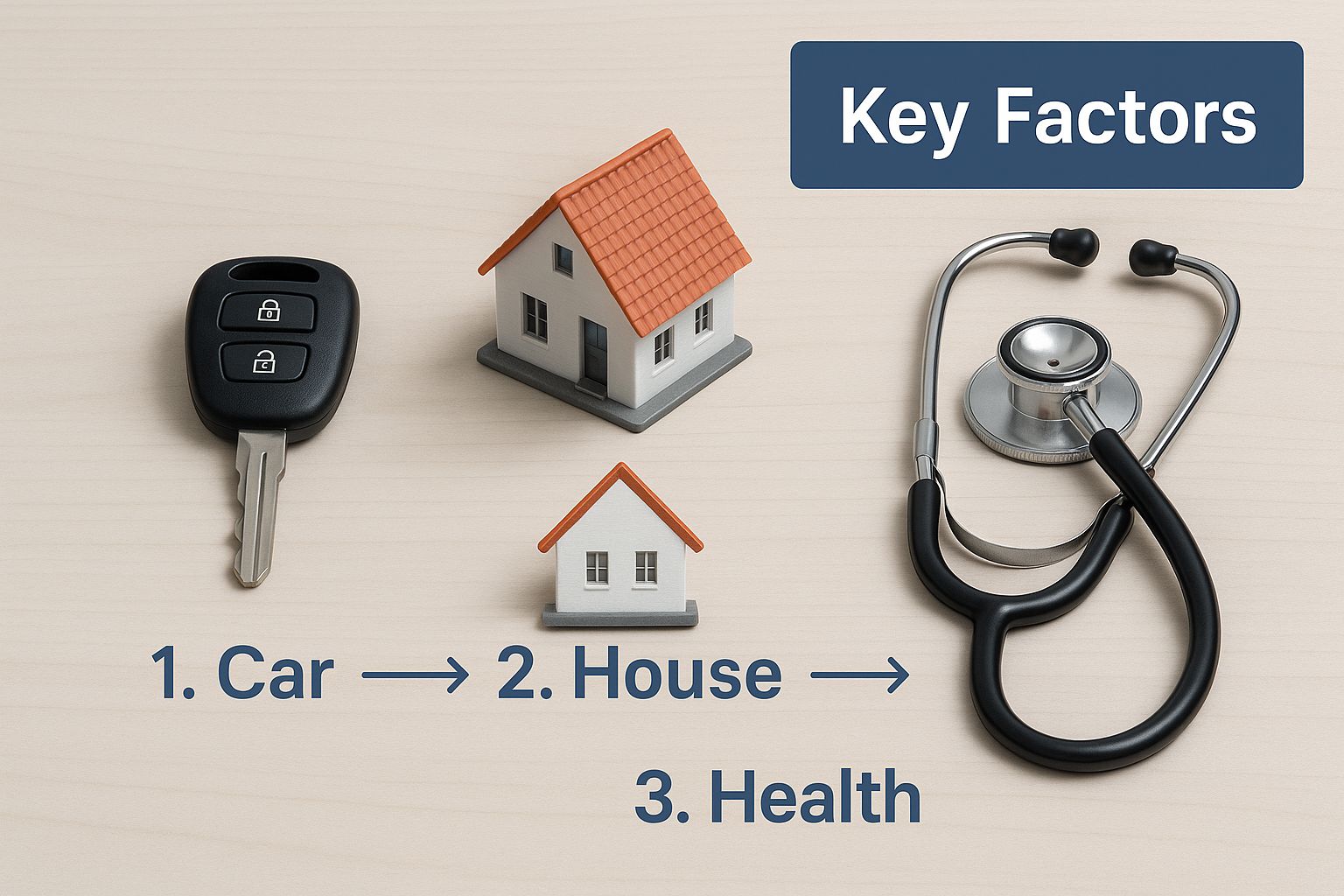
As you can see, symbols for auto, home, and health insurance show just how many different data points go into calculating that final premium number.
Putting It All Together
In the end, your premium is a blend of three main ingredients:
- Expected Claim Costs: This is what the insurer predicts it will need to pay out for claims filed by people in your risk group.
- Administrative Expenses: These are the insurer's overhead costs for things like marketing, customer service, and keeping the lights on.
- Profit: A small margin is built into the price to help the company grow and remain financially stable for years to come.
By mixing these elements, insurers come up with a premium that’s fair for your level of risk while making sure they can keep their promise to all their policyholders.
What Goes Into Your Premium Price Tag?
Your insurance premium isn’t some random number pulled out of thin air. Think of it as a price tag that reflects your unique risk profile. Insurers look at a whole range of factors—some about you, some about the world—to figure out how likely you are to file a claim.
The more risk they see, the higher your premium will be. It’s where the abstract idea of "risk" becomes a very real number on your bill.
A great example is auto insurance. The insurer will dig into your driving record. A history of accidents or a handful of speeding tickets? That signals a higher risk, which means a higher premium. The car you drive matters, too. A souped-up sports car is more expensive to fix and, statistically, gets into more accidents than a family minivan, so its premium will naturally be higher. Even your zip code can change the price, since some neighborhoods have more theft or accidents than others.
Different Policies, Different Factors
The specific things insurers look at change depending on the type of coverage you’re buying. Each policy is built to protect against different kinds of problems, so the risk factors are tailored to match.
- Home Insurance: For your home, they’ll look at its value, age, and what it’s made of. A house located in a flood zone or a wildfire-prone area is going to have a much higher premium. For a closer look at all the moving parts, you can explore the factors affecting the average cost of homeowners insurance.
- Health Insurance: Here, your age is a huge factor, since healthcare needs tend to go up as we get older. Lifestyle choices, like whether you smoke, and any pre-existing health conditions also play a big role because they point to a greater chance you'll need medical care.
Getting a handle on these elements is the first real step to taking control of your insurance costs. You can't change your age, but you can absolutely focus on the things you can influence. That's why it's so important to learn how to reduce insurance premiums by making smarter choices.
Key Takeaway: Your premium is a direct reflection of the risk you represent. Once you understand what factors insurers are looking at, you gain the power to lower your risk profile—and your costs along with it.
It’s also worth remembering that big-picture market trends can nudge your premium up or down. Global insurance markets feel the pressure of competition and regional claim events. For instance, Marsh's Global Insurance Market Index recently showed a 4% dip in overall rates. But at the same time, casualty insurance in the U.S. has been climbing because claims are getting more frequent and more expensive. These outside forces, combined with your personal details, shape the final price you pay.
The Link Between Your Deductible and Premium
https://www.youtube.com/embed/hcMDaMhJanM
When you’re looking at what goes into your insurance premium, two other key terms always show up: your deductible and your coverage limits. Think of them as the levers you can pull to dial in your final cost.
Your deductible is simply the amount you agree to pay out-of-pocket for a claim before your insurance coverage kicks in. It's your share of the initial cost. On the other hand, your coverage limit is the absolute maximum your insurer will pay for a covered loss.
A Financial Seesaw
Imagine your premium and deductible are sitting on opposite ends of a seesaw. It’s a simple analogy, but it perfectly captures their relationship—and it's the key to customizing your policy.
When one goes up, the other comes down. It's a trade-off.
- Higher Deductible: If you agree to take on more of the initial risk by choosing a higher deductible, your insurer rewards you with a lower premium. You’re basically telling them you'll handle the smaller issues yourself.
- Lower Deductible: On the flip side, if you want to pay as little as possible out-of-pocket after an incident, you’ll choose a lower deductible. This shifts more of the potential risk back to the insurer, which results in a higher premium.
Getting a handle on this trade-off is crucial. For a deeper dive into how this part of your policy works, you can explore our guide on what is a deductible in insurance.
This balance is all about managing your personal risk and your budget. Choosing a higher deductible can save you money every month, but you have to be financially prepared to cover that amount if you ever need to file a claim.
Let’s look at this in a more practical way.
Deductible vs. Premium Cost Trade-Off
This table breaks down how your choice of deductible directly impacts what you pay for your premium.
| Scenario | Your Deductible | Your Premium | Best For |
|---|---|---|---|
| Lower Risk | $1,000 | $75/month | Someone with a solid emergency fund who prefers lower monthly bills. |
| Higher Risk | $250 | $125/month | Someone who wants to minimize out-of-pocket costs after an incident and is comfortable with higher monthly payments. |
Ultimately, the goal is to find that sweet spot where your premium is affordable and your deductible is an amount you could comfortably pay tomorrow without causing financial chaos.
Why Does My Insurance Premium Keep Changing?

It can feel frustrating when you see your insurance premium go up or down, especially if nothing seems different on your end. But these adjustments are a totally normal part of how insurance works. Your premium isn’t a locked-in price because the risk it’s designed to cover is always shifting.
The reasons for these changes usually fall into two big buckets: things happening in your personal life and much bigger trends happening in the world.
On a personal level, major life events can directly change your risk profile, and your premium follows suit. Getting married, for instance, often means you’ll see lower car insurance rates. But add a teenage driver to that same policy, and you can bet your premium will jump up. Why? Because new drivers are statistically a higher risk.
Your Life vs. The World
Even if your life stays exactly the same, your premium can still change because of factors completely out of your control. These are market-wide forces that affect the entire insurance industry, not just you.
- Life Events: These are changes specific to you. Think moving to a new ZIP code, buying a different car, or even filing a claim after an accident.
- Market Forces: These are the big-picture economic trends, like inflation. When the cost of car parts, construction materials, and medical care goes up, it costs insurers more to pay out claims.
Your premium isn’t static because risk isn’t static. It's a dynamic price that adjusts to reflect the ever-changing probability of a claim, both for you and for the wider world.
Broader economic conditions play a huge role here. Things like global market risks or economic slowdowns can impact how premiums grow across the board. For example, when the global economy is shaky, it can slow down premium growth, especially in areas like marine insurance that are tied to international trade. You can learn more about this from the Swiss Re Institute’s research on how global trends affect insurance.
This is why your rate might go up even if you have a perfect driving record and haven’t filed a single claim. It’s not always personal—sometimes, it’s just the world changing around us.
Your Top Questions About Premiums, Answered
Alright, let's wrap this up by tackling the questions I hear most often about insurance premiums. Think of this as the practical, no-fluff breakdown you need to feel confident about how your policy really works.
What Happens If I Miss a Premium Payment?
Life happens, and sometimes a payment slips through the cracks. If you miss one, your insurer won’t pull the plug on your policy right away. You’ll typically get a grace period—usually a window of 10 to 30 days—to catch up.
But don't let it slide past that. If you don't pay within the grace period, your policy will most likely be canceled. That leaves you completely uninsured and can make it tougher (and more expensive) to get coverage later on, since a lapse in coverage looks like a red flag to insurers.
Can I Actually Lower My Insurance Premium?
Yes, you absolutely can. While you can't change your age or where you live, you have more control than you think. Here are a few smart moves to make:
- Shop Around: This is the big one. Get quotes from a few different companies. You’d be surprised how much prices can vary for the exact same coverage.
- Ask for Discounts: Insurers have discounts for almost everything—bundling home and auto, having a clean driving record, or even installing a smart home security system. Just ask.
- Raise Your Deductible: Remember how we talked about the trade-off? If you agree to pay a bit more out-of-pocket on a claim, your regular premium payments will almost always drop.
- Clean Up Your Risk Profile: Take simple steps to look like a safer bet. For car insurance, this could be a defensive driving course. For other types, it might mean working to improve your credit score.
Is the Cheapest Premium Always the Best Deal?
Honestly? Rarely. A rock-bottom premium is usually a sign of something else—either a sky-high deductible or coverage limits so low they won't help much in a real emergency. It might feel good to save a few bucks each month, but it could leave you facing a huge financial disaster if you ever need to file a serious claim.
The real goal isn’t finding the cheapest premium. It's finding the best value—a balance between a price you can afford and coverage that genuinely has your back.
What's the Difference Between a Premium and a Deductible?
This is a super important one to get right.
A premium is the fixed amount you pay on a regular schedule (like monthly or yearly) to keep your insurance active. It's like your subscription fee for peace of mind.
A deductible is what you pay out-of-pocket when you file a claim before your insurance company starts paying. You only deal with the deductible if you have a covered loss, while the premium is your ongoing cost of being protected.
Navigating the world of insurance doesn't have to be a headache. At My Policy Quote, we cut through the confusion to help you compare your options and find a policy that fits your life and your budget. Get your free, no-obligation quote today!