
Medicare Annual Notice of Change: what to check before renewing
Your Medicare Advantage or Part D plan may be continuing next year, but the details you rely on can change. Start with its Annual Notice of Change, usually called the ANOC. Compare next year's costs, prescription coverage and access to care against what you actually use. Then check the full plan documents for anything the notice leaves unanswered.
A review does not have to end with a switch. It can confirm that keeping your plan makes sense. The useful question is whether the coming year's coverage still fits you, rather than whether the envelope looks familiar.
First, check the plan and the year
The ANOC summarizes changes taking effect in January. Medicare.gov says plans send it each fall and advises contacting your plan if you do not receive it. Look in your mail, email or plan account, depending on how you receive documents.
For a review this fall, use the document describing changes for 2027. Match the exact plan name and identifying numbers to your coverage. A company may offer several plans with different benefits. If your notice says the plan is ending or your service area is changing, ask the plan or Medicare what that means for your options and timing.
Keep three kinds of information beside you
The notice is a comparison aid. It does not replace the complete terms or your own list of needs.
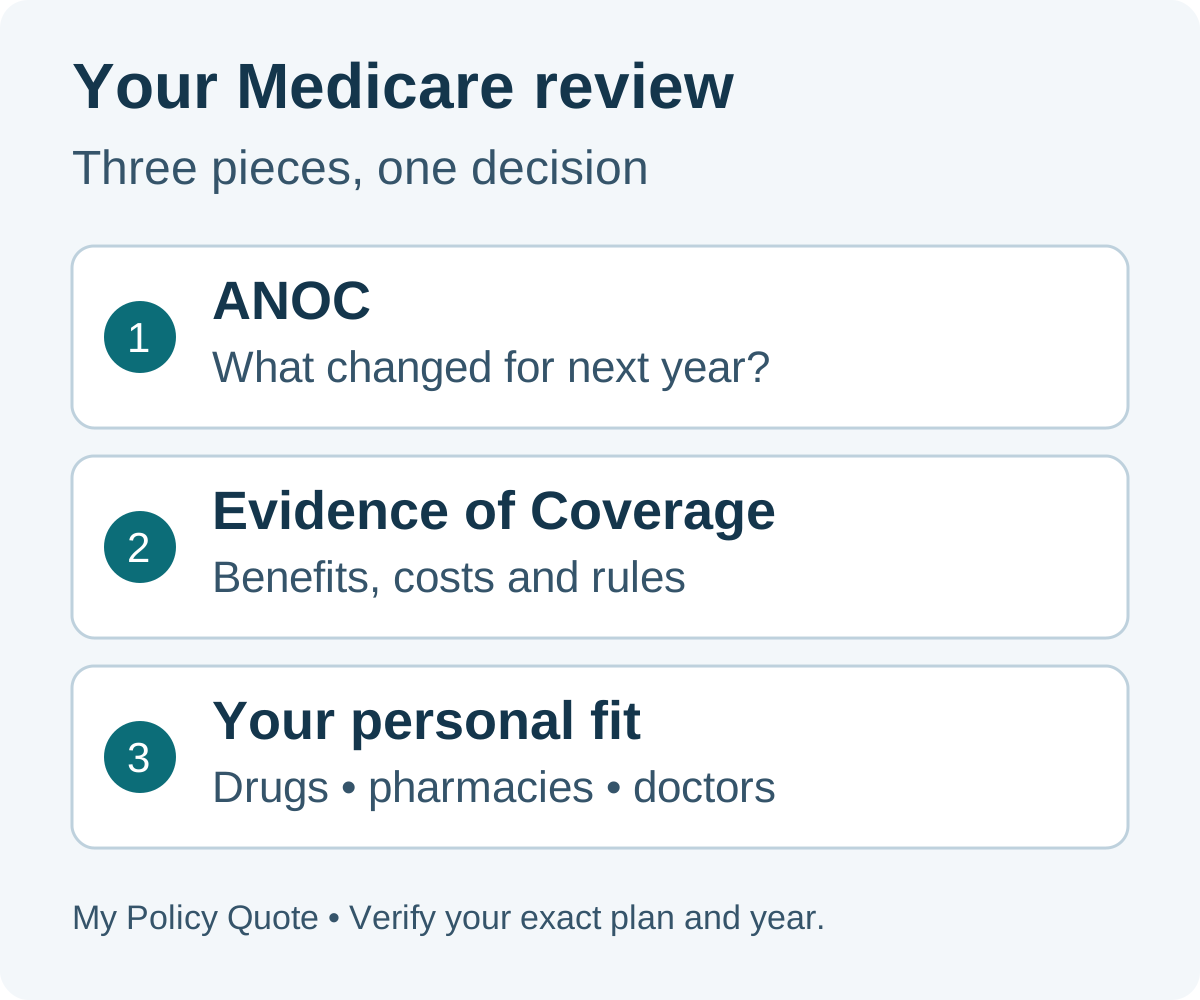
- ANOC: the changes from one coverage year to the next.
- Evidence of Coverage, or EOC: the detailed description of what the plan covers, what you pay and its rules. Medicare explains the EOC here.
- Current supporting resources: the coming year's drug list, pharmacy information and, for Medicare Advantage, provider directory. Keep your medication list and doctor locations next to them.
Five checks to make before deciding
1. Look beyond the plan premium
Compare premiums, deductibles and the amounts you pay when you receive care. For Medicare Advantage, check the plan's medical out-of-pocket limit and what counts toward it. Keep medical expenses and prescription expenses separate when reviewing their rules.
For drug coverage, your spending can include a premium, deductible, copayments or coinsurance. Medicare's explanation of drug costs is a useful reference. A premium that stays the same does not establish that every prescription or visit will cost the same.
2. Check each prescription, not just the drug benefit heading
List the exact medication names, strengths and how often you fill them. Check each one against the coming year's formulary, which is the plan's list of covered drugs. Each plan has its own list; Medicare explains that distinction.
Ask what you would pay and whether any coverage requirements apply to your prescriptions. If something appears missing or different, contact the plan and your prescriber's office before assuming that you must change a medicine or go without it. A general article cannot settle a particular prescription's coverage or your treatment.
3. Recheck the pharmacy you actually use
A pharmacy can participate in a plan without having its preferred cost sharing. Compare your usual pharmacy, other practical locations and any mail-order option using your own drug list. Medicare distinguishes in-network, preferred and mail-order pharmacies. Do not assume that the same chain or delivery arrangement has identical terms in every plan.
4. For Medicare Advantage, verify your care team
Check your doctors, hospitals and other important providers for the exact plan and coming year. Confirm the office location, not just the physician's name. Ask the insurer and the provider's office about participation, referral requirements and any rules affecting planned care.
Checking a specialist's name is only the start if you expect a procedure. Ask about the facility and other services involved, and whether the plan requires approval. A directory listing alone does not answer every coverage question. Medicare's plan-selection guidance recommends checking providers, pharmacies, prescriptions and costs together.
5. Match any extra benefits to their conditions
If a Medicare Advantage benefit matters to you, such as dental services or an allowance, find its detailed terms in the coming year's documents. Ask about participating providers, limits, eligibility and how to use it. Treat a headline benefit as a question to investigate, not a promise that your particular expense will be paid.
Turn the review into a short question list
For each issue, write down the document page, the change and the answer you still need. For example: “This prescription appears to have different cost sharing. What is the estimated annual cost at my pharmacy, and are there coverage requirements?” That gives a plan representative or advisor something specific to verify.
If you want the broader context, our Medicare planning guide explains the main coverage paths. Use current official sources and your actual plan documents for current-year figures and personal eligibility.
You can review the plan and still keep it
CMS advises reviewing the materials each year. If the plan is still offered and meets your needs, a change may be unnecessary. Keeping it should follow a review of next year's terms, not an assumption that automatic renewal means nothing changes.
For people considering a change, Medicare Open Enrollment runs October 15 through December 7, with accepted changes taking effect January 1. In this fall's review, that means January 1, 2027. Other enrollment rights depend on the situation.
This is a guide to Medicare Advantage and Part D plan review, not a Medigap switching rule. The annual fall period does not give everyone a new right to buy any Medicare Supplement policy without health questions. Medigap purchase rights have separate timing and state considerations.
Bring the changes that matter to your conversation
Have your ANOC, medication list, doctor locations and main questions ready. My Policy Quote can help you discuss your coverage options and the details that need a plan-specific answer. Call (855) 469-1883 or request a Medicare coverage review. Explain what changed and what care you want to keep.
You can also compare plans at Medicare.gov or contact Medicare directly. This article is general education; it does not establish a particular plan's availability, benefits or your enrollment eligibility. The publisher name is an MPQ editorial pen name, and no licensed review is claimed.