

You've got invoices waiting to be paid, a project that might renew, and a health insurance application asking what you'll earn for the whole year. You can estimate next month's revenue reasonably well. Predicting your household income through year-end feels much harder.
For self-employed health insurance in Massachusetts, that estimate is central to the decision. It helps determine which coverage route you're offered, what you pay each month, and whether your premium assistance needs adjusting when you file your taxes. The safest approach is to separate business revenue from household income, compare realistic income scenarios, and choose coverage you can maintain when work slows.
Massachusetts Coverage Routes Compared
Massachusetts coverage routes for self-employed buyers
| Route | Who usually qualifies | Premium and cost-sharing | How to apply |
|---|---|---|---|
| MassHealth | Low-income adults and families, income-tested | Little or no premium, based on income | Through the Health Connector application |
| ConnectorCare | Income-tested households within state limits | Reduced premiums and copays, no deductibles | Through the Health Connector |
| Commercial plans via Health Connector | People not eligible for assistance, or seeking standard individual plans | Full premium unless eligible assistance reduces it | Health Connector individual plans |
| Off-exchange commercial plans | Buyers choosing outside the state marketplace | Carrier-quoted premium and plan-specific cost-sharing; obtain a written quote | Directly with a carrier or licensed agent |
Working for yourself doesn't usually mean you need an employer group policy. If you're purchasing personal coverage, begin with the individual application and let the eligibility process identify the appropriate route.
Massachusetts built much of this system through its 2006 health reform law, Chapter 58, which expanded access through the Health Connector and combined individual responsibility with financial assistance, according to the Commonwealth Fund's evaluation of Massachusetts health reform. For a freelancer, the practical benefit is a centralized starting point rather than separate searches for every possible program.
What Each Route Means for Your Budget
MassHealth is worth checking when household income is low. Don't assume that owning a business disqualifies you. A business can generate substantial receipts while leaving its owner with modest net earnings after expenses.
ConnectorCare combines help with premiums and help when you receive care. The Massachusetts Connector program regulation describes income-tested eligibility extending to 500% of the federal poverty level for 2026, subject to citizenship or lawful-presence and other requirements, with reduced premiums and copayments and no deductibles. That cost structure can make care easier to budget for when customer payments arrive unevenly.
Commercial coverage through the Health Connector is the next comparison when you don't qualify for ConnectorCare or want to review standard individual plans. Don't interpret a displayed full premium as your final price until the application has evaluated available assistance.
The Connector is an established individual-market channel: its fiscal year 2025 annual report reports more than 377,000 individual members at fiscal year-end and approximately 87% of Massachusetts' non-group market, based on March enrollment data. Starting there lets you evaluate eligibility alongside coverage, rather than shopping on price alone.
Off-exchange coverage means buying outside the marketplace. Obtain the actual premium, benefits summary, and network information before comparing it with a Connector option. Don't assume that a cheaper-looking policy offers equivalent protection or the same access to financial assistance.
A Practical Decision Rule
Start with the Health Connector estimator. Consider outside options when the available marketplace plans don't fit your care needs, and compare equivalent coverage rather than advertisements.
A guide to marketplace health insurance can help clarify the shopping terminology. For every candidate plan, record:
- Monthly premium: Your payment after any approved assistance.
- Deductible: What you may owe before specified benefits begin paying.
- Out-of-pocket maximum: Your exposure for covered, in-network care under the plan's rules.
- Copays and coinsurance: The charges attached to services you use.
- Provider network: Whether your doctors, hospitals, and preferred facilities participate.
Income Rules and Subsidy Estimate Steps
A freelancer who earns $90,000 in sales but spends heavily on supplies, subcontractors, and software may have far less than $90,000 in business profit. For health coverage applications, start with expected net business profit, then account for other relevant household income and the adjustments used to determine modified adjusted gross income, or MAGI.
How to Estimate Household Income
ConnectorCare eligibility is income-tested against a percentage of the federal poverty level, with current dollar limits shown in the Health Connector estimator. Eligibility also depends on factors such as household circumstances and access to other coverage, so an income estimate alone does not confirm eligibility.
For a sole proprietor, owner draws are not necessarily the same as taxable profit. Use your business records to estimate profit rather than entering total sales or relying only on transfers to your personal account.
Build an Estimate You Can Update
Use last year's return as a reference. Note net business profit and other household income. Then adjust for changes, such as gaining or losing a major customer.
Project this year from your books. Separate revenue already earned from work you hope to win. Subtract expected allowable business expenses, and note assumptions that are uncertain.
Prepare strong-year and slow-year forecasts. In the slower forecast, reduce uncertain renewals and new projects, but keep expenses you expect to owe.
Check your tax household. Review your spouse and dependents, not only the people seeking coverage. Household details can affect the application.
Run the estimator for both forecasts. Save the date, household details, and income assumptions. Record the estimated premium and cost-sharing, not just the assistance amount.
Test whether the budget still works. Submit your best good-faith estimate. Separately consider whether you could keep paying for the plan if business slows or assistance changes.
Revisit the estimate after a major change. A lost contract, sustained increase in work, or household change may affect the estimate. A quarterly bookkeeping reminder can help you spot changes.
For help understanding how income affects assistance, see this guide to calculating a health insurance subsidy. The estimator helps you plan; the completed eligibility process determines the assistance available.
Worked Cost Example and Year-End Reconciliation
Consider a hypothetical freelancer, Alex, whose household circumstances stay the same but whose business outlook changes. Alex prepares a strong-year net-profit forecast of $70,000 and a slow-year forecast of $40,000. These are illustrative business assumptions, not eligibility thresholds or actual insurance quotes.
Alex uses the same household details and compares the same candidate plan under each forecast. Keeping those inputs consistent makes it easier to see the effect of income rather than accidentally comparing different coverage.
Turn Estimator Results Into a Budget
| Budget item | Strong-year scenario | Slow-year scenario |
|---|---|---|
| Expected net business profit, hypothetical | $70,000 | $40,000 |
| Household income input | Profit plus relevant household income and adjustments | Profit plus relevant household income and adjustments |
| Monthly premium | Record estimator result | Record estimator result |
| Expected cost-sharing | Estimate from likely services and plan benefits | Estimate from likely services and plan benefits |
| Annual planning cost | Monthly premium multiplied by covered months, plus expected cost-sharing | Monthly premium multiplied by covered months, plus expected cost-sharing |
Capture the actual results. Alex records each estimated premium and the copays for routine visits, specialist care, and prescriptions. There's no responsible substitute for those plan-specific figures.
Calculate the annual commitment. Multiply the monthly premium by the months of coverage, then add expected cost-sharing. Keep a separate worst-case check using the plan's out-of-pocket maximum, while recognizing that premiums and noncovered services sit outside that limit.
Test the slow-year cash flow. Alex checks whether the premium remains manageable after essential business and household bills. A lower annual cost isn't enough if the monthly payment would become impossible during a payment delay.
Leave Room for Tax-Time Adjustments
Advance premium tax credits are based on an estimate. If actual household income ends higher, Alex may have to repay assistance when filing; if it ends lower, reconciliation may produce additional credit, subject to eligibility rules.
Budget for the premium you owe now, and keep a separate cushion for a possible tax adjustment.
The premium deduction isn't a second subsidy. Alex must distinguish personally paid premiums from amounts covered by premium tax credits before calculating any deduction.
How to Enroll Through the Health Connector Step by Step
Before starting an application, confirm whether you can enroll now. Individual commercial coverage generally uses an open enrollment window or a special enrollment opportunity tied to a qualifying event; public-program enrollment can follow different rules.
Don't assume that submitting an application gives you immediate coverage. Check the effective date shown during enrollment, particularly if you're leaving another plan.
Complete the Application and Plan Selection
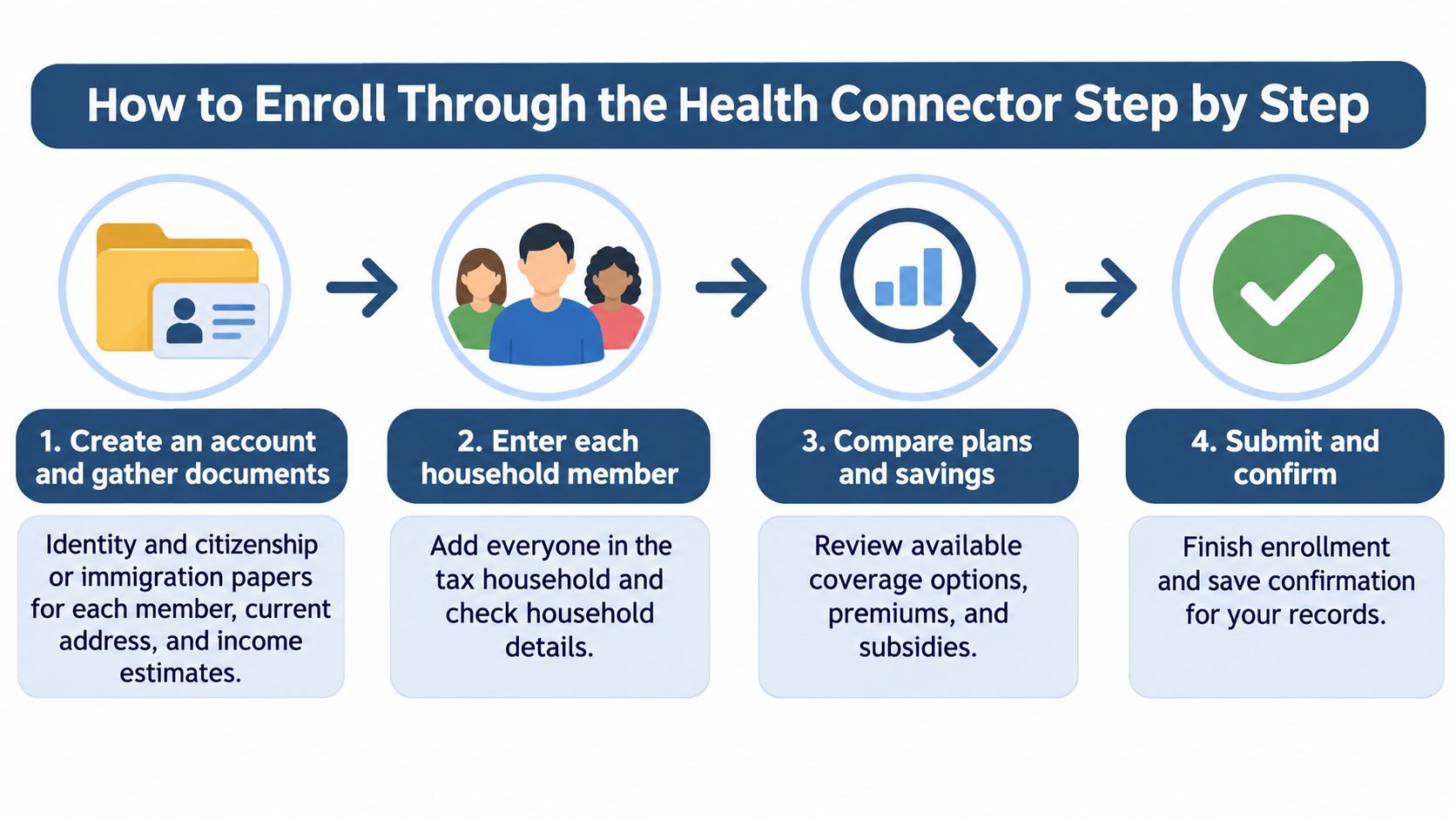
Create your account and gather documents. Have identity information, citizenship or immigration documentation where applicable, your current address, and your income worksheet available. Use an email account you check regularly, and save your login securely.
Enter household members carefully. Follow the application's instructions about who belongs in the household and who needs coverage. Check names, birth dates, and relationships before continuing, since a household-entry error can affect the eligibility result.
Review available plans and assistance. Compare the net premium with the benefits summary. Search for your exact prescriptions, preferred hospital, and individual clinicians rather than relying on a familiar insurer's name.
Select the plan and submit. Read the confirmation screen and save the application record. Warning: a saved draft or a completed estimator isn't the same as submitted enrollment.
Finish the Tasks That Activate Coverage
Respond to verification requests. Read notices promptly and provide the specific documents requested by the stated deadline. Keep upload confirmations. Missing verification can delay eligibility processing or change financial assistance.
Pay the first premium when required. Follow the payment instructions and confirm the due date and proposed coverage start. Warning: selecting a plan doesn't replace making a required payment, and paying doesn't let you choose an earlier effective date.
Confirm active enrollment. Save your member ID information, check the carrier account, and verify the effective date before scheduling care under the new policy. If you're replacing coverage, coordinate the transition rather than cancelling the old plan based only on an application receipt.
After enrollment, monitor both Connector notices and carrier bills. They serve different purposes: one may concern eligibility, while the other concerns premiums or plan administration.
Set a payment reminder or review automatic payments against your bank balance. A missed premium can put coverage at risk, and an automatic payment can still fail if your card expires or the account lacks funds.
Deducting Premiums on Your Federal Return
When premiums are deductible for self-employed buyers
| Situation | Deductible? | Rule or form |
|---|---|---|
| Sole proprietor, partner, or qualifying S-corporation shareholder | Yes, when eligible | Adjustment to income on Schedule 1 using Form 7206 |
| Months eligible for employer- or spouse-subsidized coverage | Generally no, even if declined | Premiums for those months are excluded |
| Premiums for a child under age 27 | Yes, in certain cases | Child coverage rules apply |
| Deduction above business earned income | No, capped | Limited to relevant earned income from the business |
| Itemized medical deduction | Not the route for this deduction | The self-employed deduction is an adjustment to income |
The IRS draft instructions for Form 7206 describe the Schedule 1 adjustment to income, eligible business owners and family coverage, the business-earned-income limitation, and the exclusion for months when subsidized employer coverage was available, including certain coverage for a child under age 27. Because the linked document is a draft, use the final instructions applicable to your return when filing.
Apply the Limits Before Claiming the Expense
Consider a hypothetical freelancer with $60,000 in net profit who personally pays $9,600 in annual premiums. If the coverage meets the applicable business and tax requirements, sufficient relevant earned income exists, and subsidized employer coverage wasn't available during the covered months, the personally paid premiums may qualify for the deduction.
That doesn't mean the freelancer receives the premium amount back. A deduction reduces income used to calculate tax; it isn't a dollar-for-dollar reimbursement. Its value depends on the taxpayer's overall return.
The employer-eligibility rule is easy to miss. A freelancer might prefer an individual plan because it includes a specialist, yet still be ineligible to deduct premiums for months when qualifying subsidized coverage was available through a spouse's job.
Premium tax credits create another coordination issue. Don't deduct the portion paid through those credits, and don't assume the carrier's total annual premium is your deductible amount. Have your tax preparer coordinate the final credit and deduction calculations.
Keep a Filing Folder Throughout the Year
- Marketplace tax form: Save Form 1095-A from the Health Connector when applicable, and check its household and coverage information.
- Premium records: Keep statements showing charges, assistance, and your payments.
- Eligibility timeline: Record when employer-sponsored coverage became available or ended.
- Business records: Retain the profit calculation supporting the earned-income limit.
For additional context, review the self-employed health insurance deduction before preparing your return. If you operate through an S corporation or partnership, confirm that the coverage arrangement and reporting satisfy the rules for that business structure.
Coverage Paths for Contractors, Early Retirees and Families
Different households can use the same application system and still face very different decisions. The useful question is not only which plan is cheapest, but which household detail could change the result.

Maya's Contract Work Arrives Unevenly
Maya is a self-employed designer with a recurring client and occasional large projects. She doesn't treat a signed proposal as money already earned, but she does include work she reasonably expects to complete in her good-faith forecast.
Her concern is staying insured between projects. She chooses a payment she can maintain during a dry spell and keeps her health reserve separate from money earmarked for business taxes.
Copyable action: Label uncertain projects in your income worksheet so you can revise the forecast quickly when a client confirms or cancels.
Daniel Needs a Bridge Into Retirement Coverage
Daniel has left employment and needs individual coverage before his Medicare transition. His application requires attention to household income even though he no longer receives wages.
Retirement-account withdrawals need careful treatment. Taxable traditional IRA withdrawals generally affect income, while qualified Roth withdrawals generally don't; not every withdrawal receives the same treatment. He confirms the tax consequences before choosing which account to draw from, rather than changing withdrawals solely to chase a lower premium.
Daniel also plans the coverage handoff instead of cancelling his individual policy as soon as he begins researching Medicare. A comparison of early-retiree health insurance options can help organize the bridge decision.
Copyable action: Put your anticipated Medicare effective date and the individual plan's cancellation instructions on the same calendar.
Elena and Sam Are Comparing Family Coverage
Elena is self-employed, and Sam works for an employer that offers health benefits. They have dependent children, so they compare the household's actual care needs rather than treating everyone as interchangeable.
They check pediatricians, ongoing prescriptions, and how individual and family deductibles operate. They also obtain Sam's employer coverage details, because access to that coverage can affect assistance and the treatment of Elena's premiums.
Copyable action: Bring the employer's premium information and eligibility dates to the comparison, not just a statement that family coverage is available.
Parents helping an adult child should confirm tax dependency and coverage eligibility separately. Paying someone's premium doesn't, by itself, establish how that person belongs on an application.
Your Next Step and Final Checklist
Choose a manageable task: prepare your household income worksheet and run the estimator this week. You don't need perfect certainty about future projects, but you do need a reasonable estimate and a habit of updating it.
Keep These Records Together
- Household documents: Identity information and requested citizenship or immigration records for each relevant member.
- Income baseline: Last year's net profit and other household income.
- Current forecast: Your best estimate, plus strong-year and slow-year planning versions.
- Household details: Tax-household size and information about other available coverage.
- Coverage records: Enrollment confirmation, premium statements, and Form 1095-A when issued.
- Calendar reminders: Verification deadlines, payment dates, and quarterly income reviews.
My Policy Quote provides quote comparisons and connects you with licensed insurance agents who can review benefits and premiums. We're a privately operated, non-government resource, and we don't sell policies or issue coverage directly.
Quotes are estimates based on the information you enter. We don't guarantee specific rates, coverage, or eligibility, and any purchase is subject to the respective carrier's terms.
Pick one coverage route to investigate and one date to act. If enrollment isn't available immediately, use that appointment to confirm your next enrollment opportunity and prepare the documents you'll need.
Visit My Policy Quote to compare health insurance quotes and connect with a licensed insurance agent about your Massachusetts coverage options. Bring your household income scenarios and provider list so you can discuss premiums, benefits, and a payment you can maintain when freelance work slows.