

You're quoting jobs, chasing invoices, and trying to guess what you'll earn this year. Then a health plan asks for one neat income number. That mismatch is where Self Employed Health Insurance Ohio gets confusing. Your income isn't a salary, so a good month, a slow winter, or one large expense can change your subsidy, your Medicaid eligibility, and what you owe at tax time. The goal isn't just finding the cheapest premium. It's choosing a coverage path that still fits when your income moves.
Which Coverage Path Fits Your Ohio Situation
Start with a simple decision rule. Your best path depends on projected household income, whether anyone in your household has an affordable job-based offer, and whether you have W-2 employees. Answer those three items before you compare plan names or monthly prices.
For most contractors, freelancers, farmers, and owners without job-based benefits, the ACA Marketplace is the main route. Ohio uses the federally facilitated Marketplace rather than operating its own state exchange, a structure the state chose in 2012 while retaining regulatory authority over participating insurers, according to KFF's overview of the Ohio health care landscape. That same history explains the gap the Marketplace filled. In 2012, only about 3% of Ohio's insured population had individual insurance, while 58% had employer-sponsored coverage.
Ohio Coverage Options for Self-Employed People
| Option | Who It Fits | Subsidy or Tax Benefit | Main Limit |
|---|---|---|---|
| ACA Marketplace plan | Self-employed with no affordable employer offer | Premium tax credit based on projected income | Subsidy cliff above 400% of the poverty level |
| Ohio Medicaid | Adults with income up to 138% of the poverty level | Full coverage with no monthly premium | About $1,769 monthly income limit for one adult in 2026 |
| Spouse or parent employer plan | Household member with job-based coverage | No premium credit if the offer is affordable | An affordable offer can block Marketplace credits for the whole household |
| QSEHRA | Businesses with W-2 employees and no group plan | Employer reimburses individual premiums tax-free | Sole proprietors without employees cannot use it |
| Short-term medical plan | Temporary gaps between coverage | None | May exclude pre-existing conditions and lack ACA protections |
Ohio Medicaid fits adults with lower current income, but it's not a fallback you should ignore during a slow season. A spouse's or parent's employer plan can look simple, yet an affordable offer can change whether your household qualifies for Marketplace help. Compare its deductible, network, and drug list before you assume it's cheaper.
QSEHRA, a qualified small employer health reimbursement arrangement, only belongs on your list if you have W-2 employees and don't offer a group plan. If you're a sole proprietor with no employees, cross it off and save your time. Short-term medical plans can bridge a brief gap, but they may exclude pre-existing conditions and don't carry the same protections as ACA plans.
Estimate household income, check job offers for every adult, and count your W-2 employees. Those three answers usually narrow the table to one or two realistic rows.
Don't start with a carrier or a metal tier. Start with eligibility. A plan you can't get help paying for, or a program you don't qualify for this month, isn't a real option no matter how good the brochure looks.
How Marketplace Eligibility and Premium Credits Work
A premium tax credit is financial help that's paid in advance to your insurer each month. It lowers your Marketplace premium based on the income you project for the coverage year. You're not waiting until tax season to see the benefit, but you do settle up later if your actual income differs.
Eligibility works like a checklist. In general, you can't get premium tax credits if you're eligible for Medicaid, CHIP, Medicare, military coverage, or affordable employer-sponsored insurance, as explained in KFF's Marketplace frequently asked questions. That guide also notes Ohio Medicaid expansion covers many adults with income up to 138% of the federal poverty level, which creates a separate path below Marketplace subsidies.
Why Household Income Matters More Than Your Paycheck
The Marketplace uses household modified adjusted gross income, not just what your business took in this month. A spouse's wages count, even if you're the only person buying a plan. Access to an employer plan through that spouse can also alter subsidy eligibility, even when your own business offers nothing.
Say you're a contractor with uneven income and your spouse has a steady job with an affordable offer. You might look self-employed and uninsured on paper, but the household offer can block your credit. That's why you need every adult's job offer in front of you before you apply, not after you've picked a plan.
- Your projected annual income: Use a full-year estimate, not last month's revenue.
- Your household size: This affects the poverty-level math behind help.
- Every job-based offer: Bring the cost and coverage details for each working adult.
- Other coverage eligibility: Note Medicaid, Medicare, CHIP, or military coverage for anyone applying.
The credit itself is figured against the second-lowest-cost silver plan in your area, often called the benchmark plan. That reference price helps set how much help you get, then you can apply the credit to other Marketplace tiers. If you want the mechanics in more detail, read what a premium tax credit is and how it's calculated before you enroll.
One more detail trips people up. Cost-sharing reductions, which lower deductibles and out-of-pocket costs for lower-income enrollees, only apply to silver plans. A cheaper bronze premium can therefore cost you more when you use care. Gather your income estimate, household size, and job offers first, then judge plans.
Projecting Income So Subsidies Stay Accurate
Most self-employed mistakes start with one optimistic income guess that never gets updated. For 2026, that habit carries more risk. Enhanced federal premium tax credits expired, the 400% federal-poverty-level subsidy cliff returned, and a single adult earning above approximately $62,600 may receive no premium tax credit, according to CoveredUSA's Ohio job loss and coverage guidance. Crossing that line isn't a small reduction. It can mean no credit at all.
Build Your Estimate in Three Steps
- Start with expected revenue. Add contracted work, repeat clients, and realistic new jobs for the full year.
- Subtract allowable business expenses. Include supplies, software, vehicle costs, and business insurance you expect to deduct.
- Add other household income. Count a spouse's wages and taxable income such as unemployment benefits.
Keeping clean job records makes step one easier, and reviewing professional estimate invoice samples from AurenWell can help you organize the estimates and invoices that support your revenue forecast. You're not doing paperwork for its own sake. Those records are the evidence behind the number you put on your application.
Here's a worked example. Say a plumber expects $60,000 in revenue and $15,000 in deductible expenses. Projected self-employment income is $45,000, which keeps a single adult with no other income under the threshold above. If a strong year pushes net income to $75,000 instead, that same person could lose the credit entirely.
Practical rule: Project a range, not a single number. Write a conservative case and an optimistic case, then see whether either one crosses a subsidy line.
A weak year creates the opposite problem. You may qualify for more help than you're receiving because your advance credit was based on higher earnings. Updating your estimate mid-year can lower your premium sooner, instead of leaving you to sort it out at filing.
Check your numbers each quarter against bank deposits and your profit and loss statement. After a strong or weak stretch, report the change to the Marketplace promptly and set aside money for possible repayment of excess advance credits. Waiting for tax season turns a manageable adjustment into a surprise bill.
Medicaid Rules When Your Income Swings
Medicaid and the Marketplace don't look at your income the same way, and that difference matters if your work is seasonal. Ohio Medicaid eligibility for adults is generally tied to income near 138% of the federal poverty level, and the 2026 guideline shown in Ohio materials is about $1,769 per month for one adult and $3,658 per month for a household of four, according to Stark County Job and Family Services Medicaid guidance. Medicaid focuses on current monthly income, while Marketplace help uses an annual projection.
That means a tradesperson can qualify during a slow winter and move out of range when spring work picks up. Neither answer is wrong. They're answers to different questions, asked on different timelines. If you want the broader thresholds first, review current income requirements for Medicaid and then compare them with your monthly records.
The 2027 Work Requirement and Your Records
Beginning January 1, 2027, certain expansion adults will face an 80-hour-per-month work or approved-activity requirement, with self-employment explicitly listed as an eligible activity, according to the county guidance above. Treat that date as a planning deadline, not a current rule. The habit to build now is documentation, because hours worked in your own business aren't captured by a payroll system.
- Invoices and 1099s: Show who paid you and for what work.
- Bank deposits: Match income to the months you earned it.
- Profit and loss statement: Summarize revenue and expenses monthly.
- Hours log: Record job time, estimates, travel, and admin work in a simple notebook or app.
Say a roofer earns little in January and February, qualifies for Medicaid, then books steady work in April. When Medicaid ends, the household can move to Marketplace coverage through a special enrollment period. Time that switch carefully so doctor visits, prescriptions, and deductible progress aren't disrupted by a gap.
Keep monthly records even when your eligibility looks settled. A few minutes of logging each week is far easier than rebuilding a season of gig work from memory when a renewal notice arrives.
Comparing Premiums, Deductibles and Metal Tiers
The lowest monthly premium isn't always the lowest annual cost. That's especially true when subsidy policy shifts under you. Nearly 600,000 Ohioans obtained ACA Marketplace coverage in 2025, and 513,517 enrollees, or 88% of the state's Marketplace population, received enhanced premium tax credits, according to the Health Policy Institute of Ohio Marketplace explainer. When help that widespread changes, your after-credit premium can move more from policy than from switching carriers.
Metal Tiers and the Share of Costs They Cover
| Metal Tier | Share of Costs Covered | Typical Trade-Off |
|---|---|---|
| Bronze | About 60% | Lowest premium, highest out-of-pocket costs |
| Silver | About 70% | Moderate premium, the only tier with cost-sharing reductions for eligible enrollees |
| Gold | About 80% | Higher premium, lower out-of-pocket costs when care is used |
| Platinum | About 90% | Highest premium, lowest out-of-pocket costs |
Those percentages describe average covered costs across a group, not your exact bills. Your real cost depends on five terms. The premium is your monthly payment, the deductible is what you pay before the plan shares most costs, coinsurance is your percentage after that, a copay is a flat fee for a service, and the out-of-pocket maximum caps your covered spending for the year.
Use this clearly hypothetical example. A bronze plan costs $350 a month with a $7,000 deductible, while a silver plan costs $480 a month with a $4,000 deductible. For $8,000 in expected care with 20% coinsurance after the deductible, bronze totals about $11,400 for the year. Silver totals about $10,560, so the higher premium wins. If you're weighing those two tiers directly, the bronze or silver health plan comparison walks through the trade-off in more depth.
- Multiply each premium by 12. Use the after-credit amount you'll pay.
- Add expected care up to the deductible. Use last year's visits and prescriptions as your guide.
- Apply coinsurance to the rest. Check whether copays replace coinsurance for your usual care.
- Check the out-of-pocket maximum. This is your worst-case ceiling for covered care.
- Confirm doctors and prescriptions. A cheap plan that excludes your clinician or medication isn't cheap.
Compare totals for the care you expect, not the care you hope to avoid. If you take daily medication or see a specialist regularly, model that first. A plan built around a healthy year you probably won't have will disappoint you by March.
How to Enroll in Ohio Coverage Step by Step
Enrollment goes faster when your paperwork matches the income story you've already worked out. The visual below lays out the basic path from documents to a chosen plan.
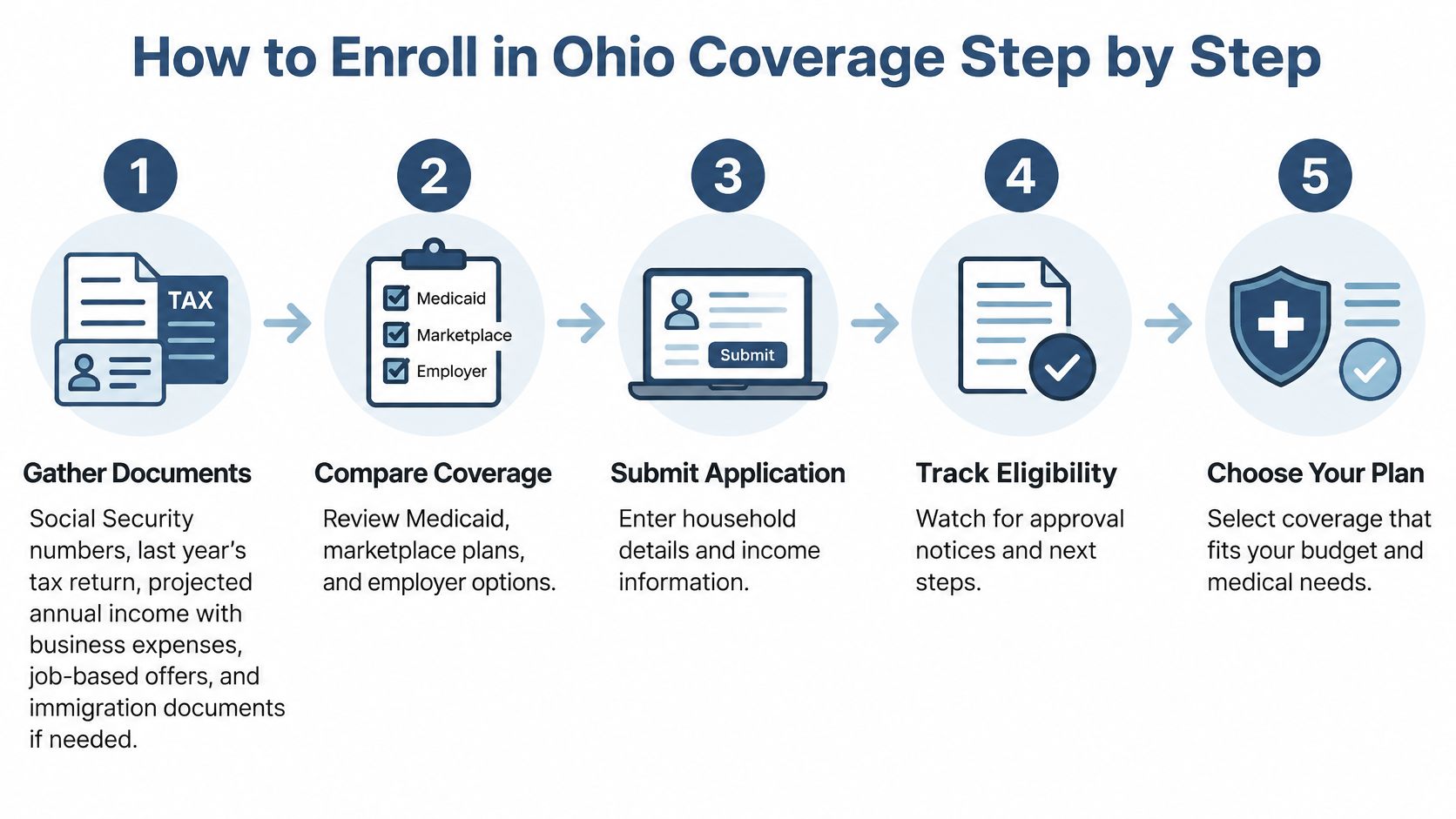
- Gather documents first. Collect Social Security numbers for everyone applying, last year's tax return, your projected annual income with business expenses, any job-based offers, and immigration documents if applicable. A clear income figure speeds approval.
- Create your Marketplace account. Ohio residents apply through the federal Marketplace website. Use an email address you check often, because notices about verification and deadlines land there.
- Enter household details carefully. Report household size, who needs coverage, and your income estimate accurately. Mismatches with tax records are a common trigger for verification requests and delays.
- Compare plans by total cost. Put bronze and silver side by side with your subsidy amount displayed. Run your expected care through each plan instead of sorting by premium alone.
- Choose a plan and pay the first premium. Coverage generally starts only after payment, so note the due date the moment you enroll. Missing it can leave you uninsured despite a completed application.
- Save your confirmation. Keep the enrollment confirmation and expect Form 1095-A the following year for tax reconciliation. Store both with your business records.
- Verify your network before the start date. Confirm your doctors, preferred hospital, and pharmacy are in network while you can still fix a mistake. Then report income changes promptly through the year.
The short video below walks through the enrollment flow if you'd rather watch the sequence before you sit down with your documents.
What a Clean Enrollment Looks Like
You should finish with a confirmed start date, an active premium payment, and an income estimate on file that matches your current business records. Confirm the current enrollment deadline on the Marketplace website, because it changes by year. If you lose other coverage or have a qualifying life change mid-year, ask about a special enrollment period rather than waiting for the next open enrollment.
Don't treat enrollment as a one-day event. Put your payment method on autopay if cash flow allows, and keep the insurer's member number in your phone. The most common avoidable failure is simple. Someone applies, feels done, and never pays the first bill.
Tax Deductions and Records to Keep
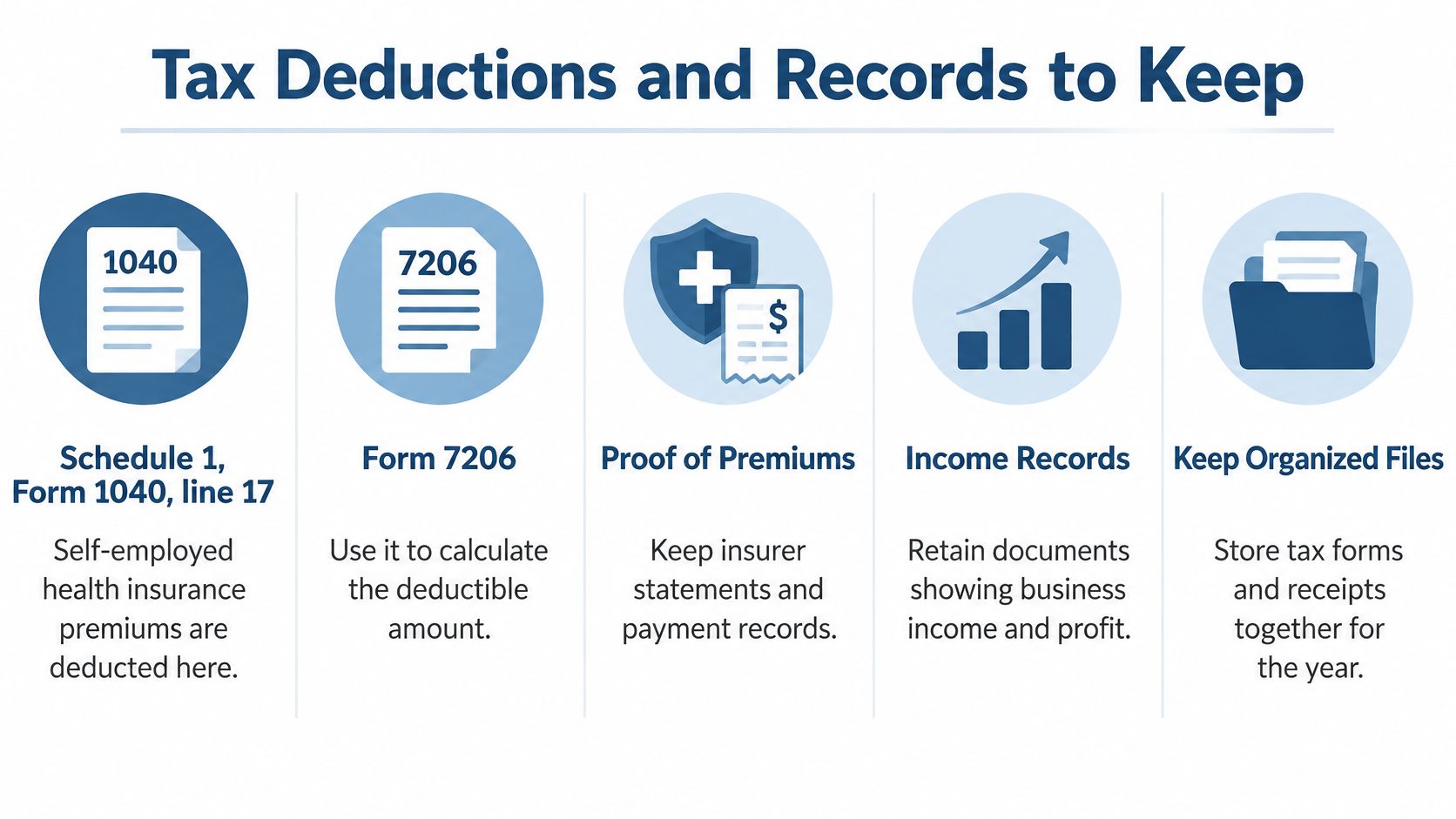
Your health plan and your tax return are connected in two places, and it helps to keep them separate in your mind. First, many self-employed people can deduct health insurance premiums on Schedule 1 of Form 1040, line 17, using Form 7206 to calculate the amount. The deduction can't exceed your net self-employment profit.
Second, there's a limit tied to employer coverage. The deduction isn't available for any month you were eligible to participate in an employer-subsidized plan, including one offered through a spouse's employer. That rule surprises couples who declined the spouse's plan and bought their own. For a fuller walkthrough, see the self-employed health insurance deduction guide before you file.
The checklist below summarizes the forms and records that support both the deduction and your subsidy reconciliation.
Reconciling Your Credit at Filing
Form 8962 reconciles the advance premium tax credit you received against your actual income for the year. You'll need Form 1095-A from the Marketplace to complete it. If your income came in higher than projected, you may repay some advance credit. If it came in lower, you may claim additional credit.
Keep these records together in one folder, physical or digital.
- Form 1095-A: Your Marketplace statement for reconciliation.
- Monthly premium statements: Proof of what you paid and when.
- Forms 1099-NEC and 1099-K: Income reported by clients and payment platforms.
- Profit and loss summary: Revenue and allowable expenses for the year.
- Proof of job-based offers: Any employer offer your household received.
- Invoices and bank statements: Backup if Medicaid or the Marketplace asks for proof of self-employment income.
Gather records early in the year, while client payments are still easy to trace. If your income shifted mid-year and you updated the Marketplace, keep that notice too. Reconciling a change you already reported is routine. Explaining one you never reported takes longer and can cost more.
Confirm Your Plan Before Open Enrollment Closes
Make one decision now. Pick the route with the lowest expected total cost that you're eligible for, not the plan with the friendliest monthly price.
Run three checks before the deadline. First, confirm your income estimate against current business records, including expenses you've already paid. Second, confirm your coverage path given every adult's job offers and income, whether that's the Marketplace, Medicaid, or an employer plan. Third, confirm your total-cost comparison for the care you expect, using premiums, deductible, coinsurance, and the out-of-pocket maximum together.
Waiting until the final week leaves no room to fix an income estimate or a missing document.
Set a quarterly calendar reminder to review income and update the Marketplace when something changes. Remember that quotes shown on our site are estimates based on the information you provide, and we don't guarantee any specific rates, coverage, or that you'll qualify for a particular policy. Confirm final numbers in the Marketplace before you pay. This week, write down your income estimate, household size, and expected care, then compare two plans side by side. That's your next action.
If sorting Marketplace, Medicaid, and employer options for Self Employed Health Insurance Ohio still feels like a second job, our advisors research thousands of plans from hundreds of insurance carriers worldwide at no cost to prepare options matched to your needs and budget, and support continues after enrollment with a licensed insurance agent who understands your plan benefits, premiums, and specific needs. Visit My Policy Quote to compare your Ohio options and get a clear, no-obligation quote before open enrollment closes.