

Your employer coverage is ending, a client has just renewed a contract, and you're trying to work out what you can afford before the next invoice gets paid. The insurance application wants an annual income estimate, but your business doesn't pay you a steady salary. Choosing a plan can feel like making a household budget with half the receipts missing.
Shopping for self-employed health insurance in New Jersey starts with separating three decisions: where to get coverage, how much medical spending you can comfortably handle, and what income to report for financial assistance. The federal and state subsidy rules don't line up neatly, so earning too much for federal help doesn't necessarily mean you're out of options.
Your Coverage Options in New Jersey at a Glance
| Option | Best for | How cost works | Main limit |
|---|---|---|---|
| Get Covered New Jersey (ACA Marketplace) | Self-employed workers without suitable employer coverage | Household income determines eligibility for federal credits and NJ Health Plan Savings | Annual income estimates, networks, and benefit designs need careful review |
| NJ FamilyCare (Medicaid and CHIP) | Households meeting the program's income and eligibility rules | Eligible members may pay little or no premium | Eligibility runs through the state program |
| COBRA continuation | People leaving qualifying job-based coverage | You generally take over the employer's contribution as well as your own, plus an administrative charge | Continuation rights and coverage are time-limited |
| Association or trade group plan | Members offered genuine group medical coverage | The association's insurance arrangement sets the price | Membership alone doesn't establish comprehensive, compliant coverage |
| Catastrophic plan | Applicants who meet age-based or exemption eligibility requirements | Lower premiums generally come with substantial upfront medical costs | Eligibility and local availability must be checked |
| Short-term limited-duration plan | Not a usable New Jersey individual-market route | Don't build a budget around an advertised out-of-state price | New Jersey doesn't permit these plans as an individual-market gap solution |
The marketplace is usually the starting point, not a special program reserved for people who are unemployed. The New Jersey Department of Banking and Insurance reported 513,217 marketplace enrollments for the 2025 plan year, a 108% increase from its first year.
Narrow the choice before comparing premiums
Start with household eligibility rather than an insurer's advertisement:
- Check NJ FamilyCare first. If your household may qualify, have the state evaluate eligibility rather than assuming a marketplace plan is your only choice.
- Examine job-based coverage. Ask whether a spouse's or partner's plan can cover you, what adding you costs, and whether that offer affects marketplace assistance.
- Identify the gap you're filling. Keeping existing doctors during ongoing treatment may make continuation coverage worth examining, even when its premium looks expensive.
COBRA isn't automatically worse than a marketplace plan. Existing treatment arrangements and deductible progress can matter alongside the monthly bill. Association coverage also deserves a close reading: ask for the actual insurance contract, not just the membership brochure.
If you employ people, your purchasing options may differ from those of a solo freelancer. Benely's explanation of SHOP enrollment for New Jersey businesses is a useful starting point for understanding that distinction.
The table's cost descriptions are directional, not quotes. Compare actual offers using your household application and the medical care you expect to use.
Why New Jersey Requires You to Carry Coverage
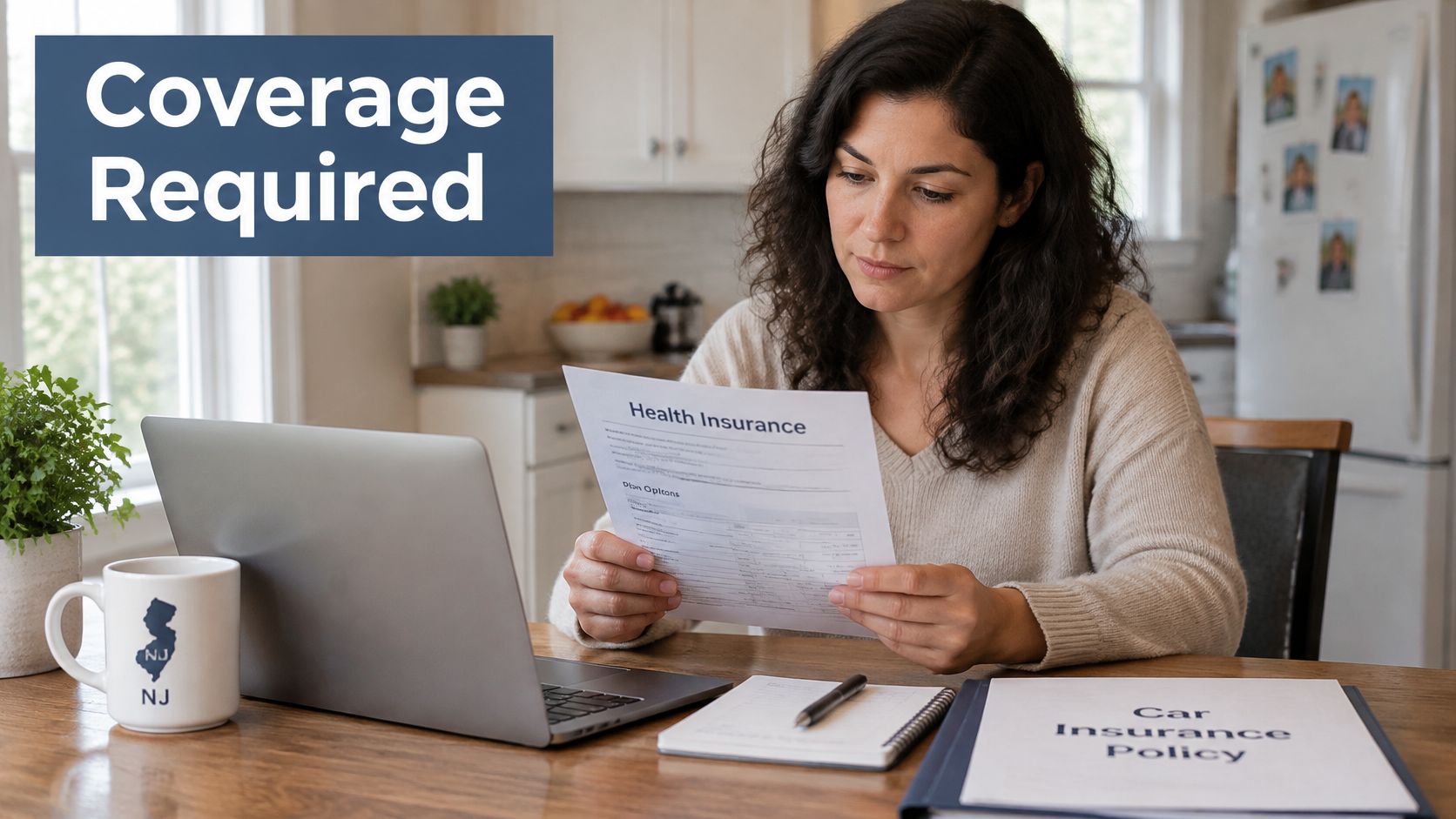
Think of the coverage requirement loosely like car insurance: the state sets an obligation, while you choose a qualifying policy that fits your circumstances. Health coverage has its own exemptions and tax rules, so the analogy stops short of explaining every detail.
Keep coverage paperwork together while you compare your choices.
Under the state's announcement of the New Jersey Health Insurance Market Preservation Act, the requirement took effect January 1, 2019, after the federal individual-mandate penalty was reduced to zero; contemporary descriptions used the greater of 2.5% of household income or fixed amounts of $695 per adult and $347.50 per child, subject to applicable limits.
Those are descriptions of the law's original formula, not a personalized current-year penalty quote. Don't use the historical amounts alone to decide whether remaining uninsured is affordable. Your filing circumstances, uncovered months, exemptions, and applicable limits require a current calculation.
Understand the compliance choices
Residents generally need to do one of the following:
- Maintain minimum essential coverage. This means qualifying health insurance, not any product that pays a medical benefit.
- Qualify for an exemption. An exemption excuses the coverage obligation when the applicable requirements are met.
- Make a Shared Responsibility Payment. This is the state tax payment associated with not meeting the requirement when no exemption applies.
A hospital cash policy or accident benefit shouldn't be mistaken for full medical insurance. A product can help with a particular expense without satisfying the state's coverage requirement.
For a self-employed household, nobody in an employer benefits department is watching the transition for you. You need to establish when the old policy ends, when the new one begins, and who in the household is covered.
Practical rule: Treat proof of coverage as a monthly business-administration task, even though the policy protects your household.
Keep insurer confirmations, premium receipts, and notices showing effective dates. If money is tight, check exemption eligibility and available assistance before deciding to leave a gap.
This video provides another way to review the coverage decision.
Metal Tiers and Catastrophic Plans Compared
| Tier | Premium level | Deductible level | Best fit |
|---|---|---|---|
| Bronze | Generally lower among metal tiers | Often higher | People with limited expected care who can fund substantial upfront expenses |
| Silver | Generally moderate | Plan-specific, with potential reductions for eligible applicants | Households eligible for cost-sharing reductions |
| Gold | Generally higher | Often lower | People anticipating recurring appointments, treatment, or prescriptions |
| Platinum | Generally highest where offered | Often lowest | People expecting substantial care who can manage a higher recurring premium |
| Catastrophic | Often low before assistance | Very high | Eligible applicants seeking protection against major medical expenses |
Metal tiers describe how a plan shares costs, not how good its doctors are. Moving toward a higher tier generally means paying more through premiums and less when using covered care. Actual plan designs overlap, so a tier label isn't a substitute for reading the benefits.
Not every tier or catastrophic option will necessarily appear in your local shopping results. Our explanation of catastrophic health insurance plans can help you understand the design before you check eligibility and availability.
Read the plan summary in spending order
Begin with the net monthly premium, meaning what you'll pay after applicable assistance. That's your recurring expense even during a month when you don't visit a doctor.
Then examine these terms:
- Deductible. The amount you pay for services subject to the deductible before the plan begins sharing those costs.
- Copay. A fixed charge for a covered service, such as an office visit.
- Coinsurance. Your share of a covered charge, expressed as a percentage.
- Out-of-pocket maximum. The plan's limit on qualifying member spending for covered in-network services, excluding premiums.
Don't assume every service requires meeting the deductible first. A plan may handle office visits, prescriptions, and other benefits differently. Read the service-specific rows in its Summary of Benefits and Coverage.
Match the design to your cash flow
Say you're a consultant who rarely needs care but keeps a strong emergency reserve. A lower-premium Bronze plan may fit because you can absorb a larger bill if something unexpected happens.
Now consider a freelancer who fills ongoing prescriptions and attends specialist appointments. A higher-premium plan might make budgeting easier, but only if those prescriptions and specialists are covered on acceptable terms.
Silver deserves particular attention when you qualify for cost-sharing reductions. These reduce eligible members' expenses when they receive care and are distinct from help paying the premium. Choosing a different metal tier can mean missing that benefit.
A cheaper premium isn't a cheaper year if you can't afford the deductible or your regular treatment isn't covered.
Use Bronze as a starting point for low expected use, and examine Silver or Gold closely for recurring care. Before choosing, compare the provider directory, drug formulary, referral requirements, and worst-case household spending, not just the tier.
Subsidies and the 2026 Income Estimate Gap
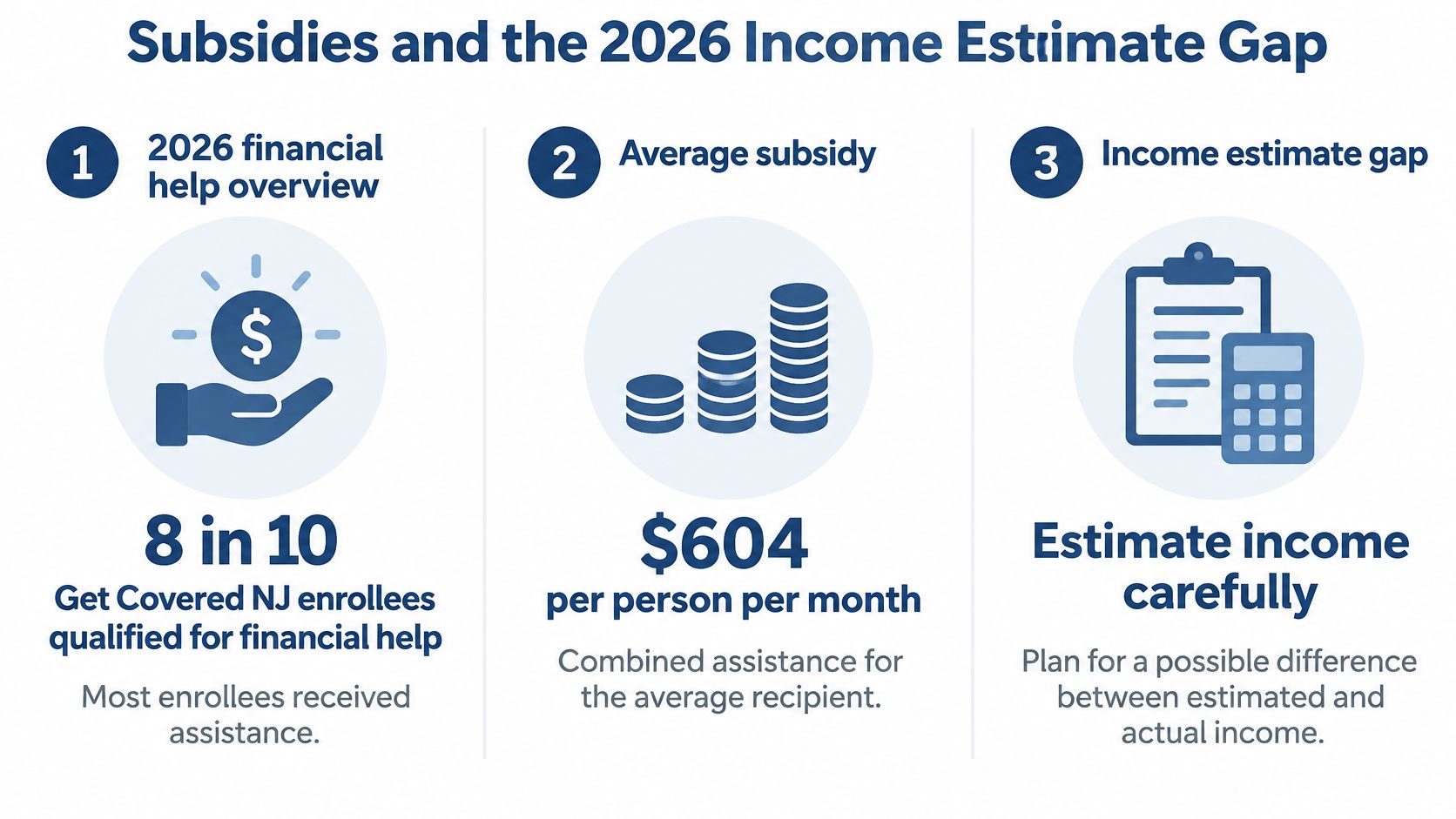
The Get Covered New Jersey enrollment snapshot reports that 8 in 10 enrollees qualified for financial help in 2026, with the average recipient receiving $604 per person per month in combined assistance; after enhanced federal credits ended, the share paying $10 or less monthly fell from 48% in 2025 to 11% in 2026, while state assistance remained available through 600% of the federal poverty level, or $93,900 for an individual and $192,900 for a family of four in 2026.
The important distinction is federal assistance versus state assistance. They aren't interchangeable, and losing eligibility for federal premium help doesn't automatically settle whether you can receive New Jersey Health Plan Savings.
For contractors, this creates a difficult budgeting zone: income can be above the federal subsidy threshold while still within New Jersey's limit. A reassuring statement that you qualify for help doesn't tell you how much help, which program supplies it, or what your final premium will be.
Use the visual summary as a reminder to separate assistance eligibility from the income estimate behind it.
Build an estimate you can explain
Your goal isn't to choose the lowest income the application will accept. It's to make a reasonable annual household projection supported by your business records.
Say you're a designer whose spring work is slow, but you've signed contracts for a busy autumn. Annualizing only the quiet period can understate your expected income. Treating every promising sales lead as guaranteed revenue can overstate it.
Use a repeatable method:
- Start with actual results. Review year-to-date receipts and legitimate business expenses in your bookkeeping software or spreadsheet.
- Forecast the remaining work. Separate signed contracts from uncertain prospects, and account for seasonal patterns.
- Add household income. Don't overlook a spouse's wages or other income the application requires.
- Review adjustments carefully. Ask a tax professional how eligible retirement contributions and self-employment adjustments affect marketplace household income. They don't all reduce Schedule C profit.
- Revisit after business changes. A strong quarter, lost contract, or household change should trigger a fresh estimate.
Protect the household from a tax-time surprise
Advance federal premium credits are based on an estimate, with reconciliation on the federal return. If your actual circumstances support less credit than you received, you may owe money back. Overstating income can leave you paying more during the year than necessary.
If revenue is especially uncertain, ask about using less of the available advance federal credit. That can mean a higher monthly bill, but it may be easier to manage than an unexpected tax balance. Ask separately how state assistance is handled rather than assuming both programs follow identical procedures.
Our guide to calculating a health insurance subsidy can help you organize the inputs.
For each plan, compare premium minus applicable assistance, then rerun that comparison with your revised income projection. A modest income change near an eligibility boundary can materially change the result, which is why updating the application matters as much as choosing the initial plan.
How to Enroll and Gather Your Documents
For solo business owners, the individual marketplace is generally the relevant purchasing channel. HealthCare.gov's self-employed coverage guidance explains that assistance uses estimated household net income for the coverage year, rather than automatically using the previous year's income, and that access to qualifying employer coverage can affect savings even if you decline it.
Follow the application through to activation
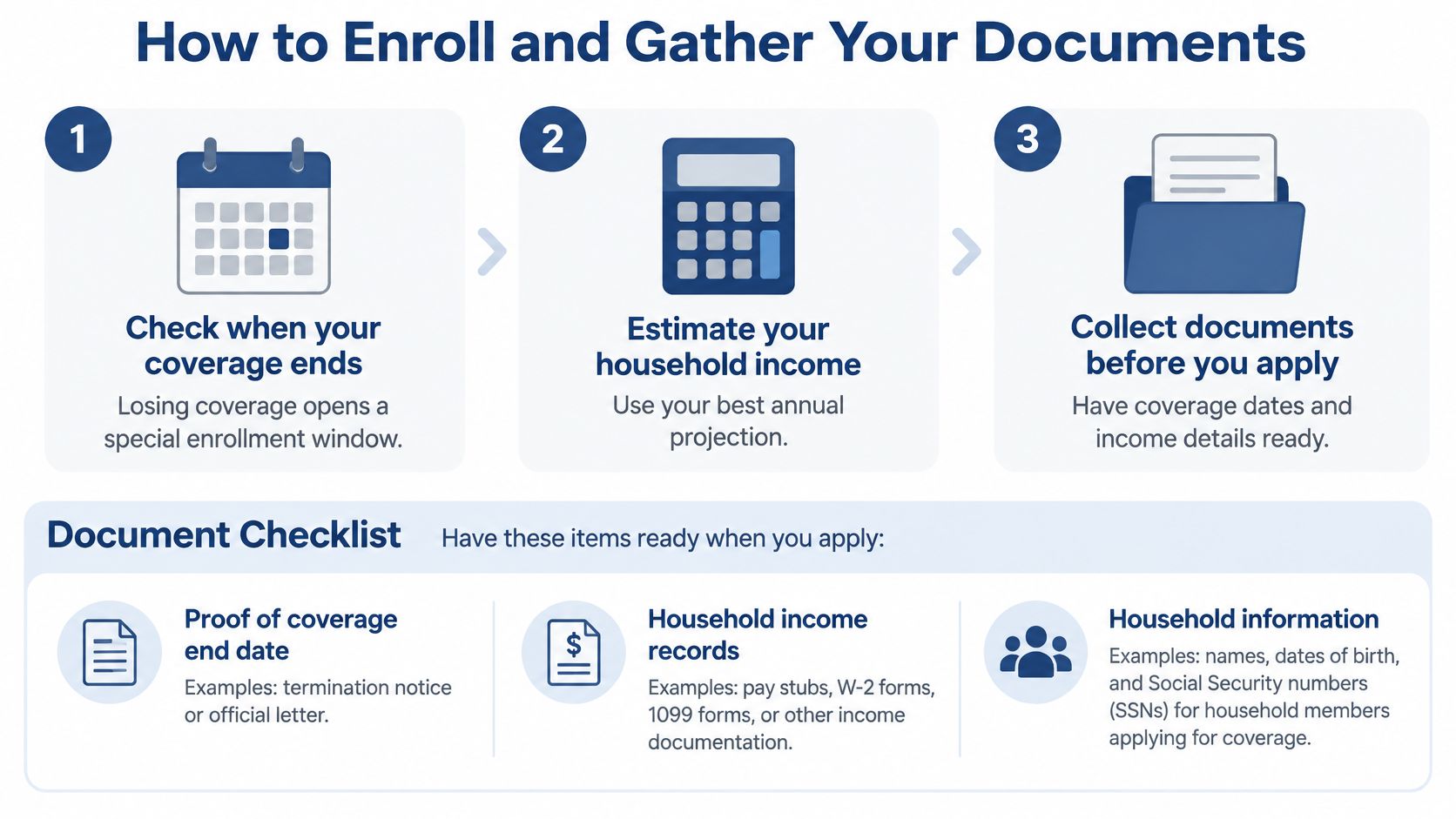
Confirm when existing coverage ends. Obtain the termination notice or benefits statement rather than relying on your final workday. If you're losing qualifying coverage, ask Get Covered New Jersey to confirm your special enrollment eligibility and deadline.
Prepare the annual household estimate. Use projected business profit and the other household information the application requests. Keep a short note explaining your assumptions so you can revise them without starting from scratch.
Gather supporting documents. Have income records, household identification details, and existing coverage information ready. If a document doesn't match current circumstances, prepare an explanation and more recent supporting records.
Start with the appropriate state application. Use Get Covered New Jersey for marketplace shopping, or seek an NJ FamilyCare eligibility review when appropriate. Enter information consistently with your expected tax household.
Check care access before selecting a plan. Verify your doctors, hospitals, prescriptions, and pharmacies against the exact plan name. An insurer's name alone doesn't establish that a particular network includes your clinician.
Complete any required initial payment. Follow the insurer's payment instructions and confirm the effective date. An application confirmation isn't the same as confirmation that coverage is active.
Save the final records. Keep your selection notice, payment confirmation, and insurer communications together. Watch for the marketplace tax statement you'll need when preparing your federal return.
Keep the preparation checklist handy while collecting records.
Assemble a practical document folder
- Household information. Gather Social Security numbers and the identity or residency documents requested for applicants.
- Business income records. Include your prior federal return, Schedule C or Schedule F where applicable, client income statements, payment-platform records, and current bookkeeping reports.
- Coverage information. Save premium statements, termination notices, and details of any household employer offer.
- Medical shopping notes. List your doctors, medications, preferred hospitals, and anticipated treatment so you can compare plans consistently.
Our health insurance application guide can help you prepare before you begin. If you want agent assistance, our My Policy Quote agents are licensed; verify the individual agent's license and ask which application tasks they'll help you complete.
Avoid the common slips: waiting until the deadline, copying an outdated income figure, and selecting a plan solely because its premium is lowest. Each can create a problem that's harder to fix after enrollment than before it.
Deducting Premiums and Keeping Records
A March premium invoice can feel like an ordinary business cost, but on the tax return it enters through a narrower gate. The self-employed health insurance deduction lowers the income used to calculate income tax. It works like a filter placed before the tax rate is applied; it does not erase the premium, and it does not reduce self-employment tax.
The IRS draft instructions for Form 7206 describe potentially eligible medical, dental, vision, and qualified long-term-care premiums for the owner, spouse, dependents, and, in specified circumstances, a child under age 27. The calculation generally runs through Form 7206 and Schedule 1, and qualifying business earned income sets the ceiling. In plain terms, profit is the bucket that holds the deduction, so a weak year can shrink it even if premiums stayed the same.
Use the final instructions for the tax year you are filing rather than relying on a draft. My Policy Quote's guide to the self-employed health insurance deduction can help you prepare questions for your tax professional.
Check eligibility month by month
A profitable business does not make every premium deductible. Months when you were eligible for subsidized employer coverage can be excluded, including qualifying offers through a spouse, dependent, or young adult child's employer. Mark those months on a simple calendar before tax prep, because one forgotten offer can change the answer.
Coordinate the deduction with premium tax credits and New Jersey assistance instead of entering the insurer's full annual premium as though your household personally paid all of it. This matters in 2026 when income can sit above the federal subsidy threshold while still below the state threshold. If your estimate was too low, credits may have to be reconciled back; if it was too high, you may have paid more during the year than necessary. Revisit the estimate after a large contract, a slow quarter, or a household change.
Recordkeeping shortcut: Save evidence when a payment or eligibility change happens, rather than trying to reconstruct the year during tax preparation.
Build a filing folder that explains the claim
For most freelance files, a practical floor is at least three years from the filing date. Keep records longer when a return is amended, a payment is reconciled late, or a tax issue remains open.
| Record | Why it matters | Where it comes from | Keep for |
|---|---|---|---|
| Monthly premium payment proof | Documents what was paid and for whom | Bank statements and insurer receipts | At least 3 years after filing, and through any subsidy reconciliation |
| Schedule C or Schedule F net profit | Supports the business earned-income limitation | Business tax return | At least 3 years after filing that return; longer if amended or open |
| Client and payment-platform income forms | Supports revenue records and estimate revisions | Clients and payment platforms | At least 3 years after filing; longer if income is corrected later |
| Employer-sponsored offer records | Identifies potentially excluded months | Relevant household member's employer | At least 3 years after each affected return; longer if eligibility is questioned |
| Prior-year federal return | Provides a starting point for future estimates | Completed tax filing | At least 3 years after filing; longer while it supports an open matter |
Have a tax professional confirm which premiums qualify, how assistance affects the calculation, and whether your business structure requires additional reporting. Keep the federal deduction calculation separate from the New Jersey coverage review, because meeting a tax rule and meeting the state insurance obligation are different tasks.
Confirm Your Path Before Open Enrollment Closes
Return to the eligibility questions before committing: could NJ FamilyCare cover your household, is suitable job-based coverage available, and what transition are you trying to manage? Use the marketplace when that's the appropriate route, and choose continuation or association coverage only after comparing both cost and benefits.
Put the next decisions on your calendar
- Confirm enrollment timing. Record your coverage end date and the applicable enrollment deadline with Get Covered New Jersey.
- Schedule income reviews. Revisit your projection after each quarter and whenever a major contract or household change occurs.
- Use the right resource. Direct Medicaid eligibility questions to NJ FamilyCare, insurance complaints to the New Jersey Department of Banking and Insurance, and exemption questions to the state's tax guidance.
We don't sell insurance policies or issue coverage directly. My Policy Quote facilitates connections with licensed agents, with support continuing after enrollment for questions about benefits, premiums, and specific needs.
Take one action today: write down your best household income estimate and your enrollment deadline.
Visit My Policy Quote to compare health insurance quotes and connect with a licensed insurance agent. Bring your income projection, coverage end date, and prescription list so you can discuss New Jersey options using your actual household needs.