
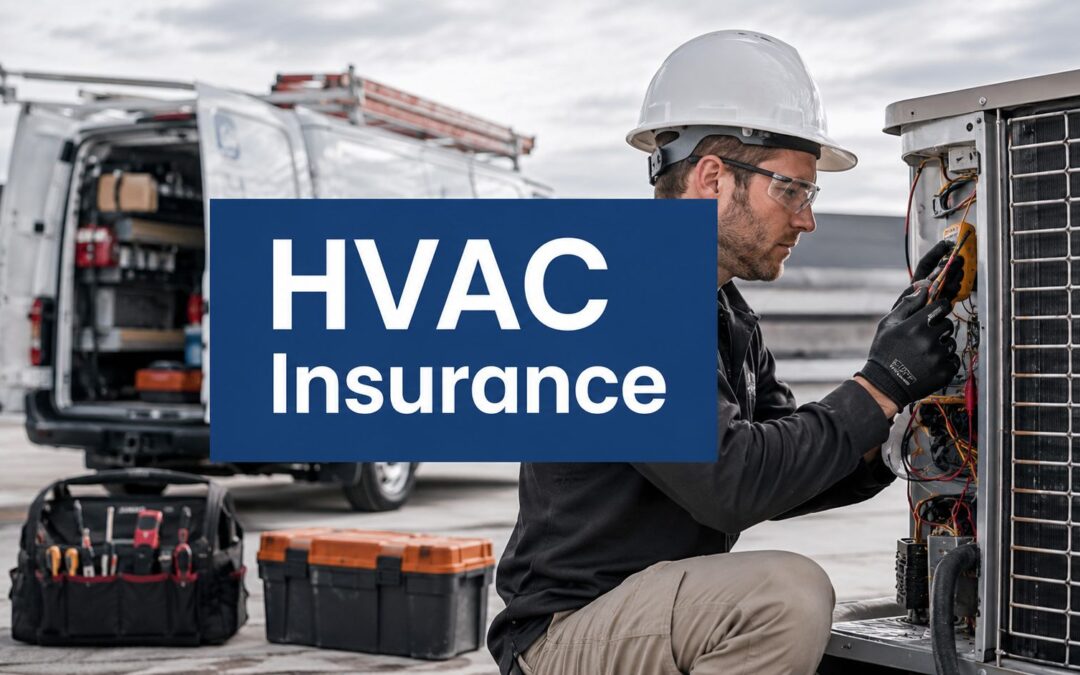
The first time a crew chief called me about a “small” HVAC mistake, it wasn't small at all. A technician had finished a rooftop changeout, the van got clipped on the way back, and the customer was already asking who was paying for the damage around the unit. That's the part most owners learn the hard way, insurance for HVAC contractors isn't there for rare disasters, it's there for the everyday job that goes sideways.
A good policy stack keeps one bad day from turning into a payroll problem, a license problem, or a lawsuit that drags on while the season keeps moving. It also has to match the way HVAC work really happens, with ladders, rooftops, refrigerant, tools in transit, and vans on the road all day. Generic coverage misses too much of that risk.

Why HVAC Contractors Need More Than Basic Coverage
A summer service call can turn ugly fast. A tech climbs onto a roof, slips near the edge, and the job stops before the replacement is even started. A few blocks away, another crew is dealing with a refrigerant release inside a building, and the owner wants answers before the space opens again.
That's why basic business coverage falls short for this trade. HVAC work mixes height, vehicle exposure, heavy tools, and refrigerant handling, so the loss patterns are different from a desk-based business or a retail shop. Standard property coverage might protect the building you own, but it won't automatically solve third-party injury, truck damage, tool theft, or pollution claims.
A policy that looks cheap on paper can be expensive in the field if it doesn't match the job you actually do.
A contractor also has to think about the people on the roof, the people in the building, and the people driving the van. A slip-and-fall in a customer's home, a truck wreck on the way to a call, or a missed refrigerant issue can each trigger a different response, and each one can test whether the business is protected. If you're also sorting out your own health coverage as a contractor, this contractor health insurance resource is worth keeping on hand.
The main mistake is assuming one policy will soak up every risk. HVAC contractors need a layered setup because the trade creates layered losses. The jobsite can be safe and the van can still get hit. The crew can be careful and a refrigerant issue can still become an expensive claim.
The Core Insurance Policies HVAC Contractors Need

The right policy stack starts with the losses that show up most often in the field. A clean quote does not help if the policy leaves a gap where your real exposure lives. I have seen too many HVAC shops learn that the hard way, after a job-site injury, a truck claim, or a refrigerant release exposed weak coverage.
The core packages below are the ones I would treat as the base layer for most HVAC businesses. If you want a broader look at how contractors build coverage around their trade, this guide to business insurance for contractors is a useful starting point.
General liability and workers' comp
General liability covers third-party bodily injury and property damage. That is the policy that comes into play when a customer trips over a hose, a tool scratches flooring, or work around a condensate line turns into a claim. Without it, a routine service call can turn into a direct business expense.
Workers' compensation protects your crew if they get hurt on the job. The risk is not theoretical, HVAC technicians face a nonfatal injury rate of 4.2 per 100 full-time equivalent workers according to a recent benchmark, with injuries driven mainly by contact with objects, falls, and extreme temperatures, as noted in the HVAC contractor insurance cost benchmark. If you skip workers' comp or underinsure it, a single injury can land on the business balance sheet instead of the carrier's.
Commercial auto and inland marine
A lot of HVAC owners underestimate the van until something happens to it. Commercial auto handles accidents involving company trucks and service vehicles, which matters because the vehicle is often both transportation and a mobile workspace. If your crew drives daily, this policy belongs in the operating structure, not on the wish list.
Inland marine, or tools and equipment coverage, protects the gear that makes the call possible. Think gauges, recovery machines, vacuum pumps, and the small tools that disappear fastest when a trailer is broken into. Van coverage does not extend to the equipment stored inside it.
Pollution liability and professional liability
Refrigerant is where many shops get blindsided. Industry claims data says HVAC-related refrigerant releases make up 12% to 15% of contractor pollution claims in the mechanical trades, and a significant indoor release can cost $8,000 to $35,000 to remediate before bodily injury even enters the picture, according to the same coverage benchmark. That is why pollution liability belongs in the conversation for any contractor handling refrigerants.
Professional liability, sometimes called errors and omissions, responds when the mistake is in the design or calculation, not the wrench work. A load calculation error, a sizing mistake, or a bad system recommendation can become a claim long after the install is complete. For contractors doing design-build or consulting work, this line fills a very different gap than general liability. If your estimating process feeds those decisions, tools like Exayard HVAC estimating software can help tighten the numbers before a bid or installation goes out the door.
How Much Does Insurance for HVAC Contractors Cost in 2026
A 2026 industry pricing analysis put the average HVAC business insurance cost at $197 per month or $2,361 annually for firms with one to four employees and $1 million per-occurrence limits across six common coverage types, according to MoneyGeek's HVAC business insurance pricing analysis. That number gives owners a starting point, but it does not tell the whole story. The budget comes from the mix of policies you buy and the state you operate in.
| Coverage Type | Average Monthly Premium |
|---|---|
| General liability | $377 |
| Workers' compensation | $310 |
| Commercial auto | $204 |
| Commercial property | $110 |
| Professional liability | $92 |
| Cyber insurance | $87 |
Those figures make one thing clear. Insurance for HVAC contractors is a risk-priced package, not a flat overhead line item. General liability and workers' comp sit at the top because they are tied to the most common and most expensive loss patterns, while property, professional liability, and cyber sit lower because they cover narrower slices of exposure. The 2026 cost analysis shows that split plainly.
State rules can swing the price sharply. The same analysis showed general liability ranged from $229 per month in West Virginia to $666 per month in California, and workers' compensation for HVAC contractors ranged from $1,219 per month per employee in New York to $166 per month in Indiana. Two contractors with similar revenue can still get very different quotes if their labor mix, driving exposure, and job mix look different to the carrier.
Price is useful, but only if you know what drives it. A cheap quote that ignores your labor mix or your vehicle exposure usually is not cheap for long.
I have seen contractors lose money on the back end because they priced the job without making room for insurance. If your bids do not account for overhead, labor, and risk together, the margin disappears fast when a claim hits. Exayard HVAC estimating software can help contractors keep those costs visible before a bid or installation goes out the door.
A contractor who wants to compare carrier requirements against the limits in a quote should also check HVAC contractor insurance requirements and COI basics. That helps separate a workable policy from one that looks inexpensive only because it falls short of what a client or licensing board will accept.
State Requirements and Contractual COI Obligations
A certificate of insurance is not just a file attachment. Clients, licensing boards, and general contractors use it to decide whether you can start work on site. If the COI does not show the limits they asked for, the job can stop even when the policy itself is active.
Maryland shows how strict that can be. Master, master restricted, and limited HVACR contractors who sign or approve installation and service contracts must carry general liability and property damage insurance with minimum limits of $300,000 and $100,000 respectively, and the certificate has to show a combined minimum of $400,000, according to the Maryland HVACR insurance requirements page. The policy can be in force and still miss the licensing test if the COI does not document it correctly.
That is a common way contractors get burned. A policy that falls under the required limit can block license issuance or renewal, even when the business has the right skills, the right equipment, and a clean record. The core issue is not just whether coverage exists. It is whether the proof of coverage is complete, current, and easy to read on the certificate.
Commercial contracts add another layer of risk. Property managers, schools, and general contractors often ask for limits or endorsements that go beyond the state minimums. COI management is part of every bid, every renewal, and every contract review, because one missing endorsement can hold up a start date or force a last-minute policy change.
Practical rule: If the certificate is not accepted, that policy does not help you on that job.
For a closer look at contractor compliance paperwork and certificate requirements, the contractor insurance requirements guide is a useful reference point. A clean COI file keeps work moving when someone asks for proof on short notice.

How to Shop and Compare HVAC Insurance Quotes
The easiest quote is rarely the best quote. Two policies can cost the same and protect you very differently once you read the exclusions, deductibles, and endorsements. That's why the first comparison should be about fit, not price.
Start with the pollution section. Ask whether refrigerant-related claims sit under a per-incident cap or get trapped in an aggregate limit, because that changes how a single release is handled. Then look at tools coverage and ask whether it follows the gear on the truck, at the jobsite, and in transit, or only protects equipment at a fixed location.
What to check line by line
- Coverage limits: Make sure the limits match the work you perform, not just the minimum the carrier was willing to quote.
- Exclusions: Read the pollution, completed operations, and vehicle exclusions closely, because those are the places HVAC claims usually get stuck.
- Deductibles: A lower premium with a painful deductible can backfire when a van or recovery machine gets damaged.
- Claims process: Ask how fast the carrier responds when the claim is a broken truck, a stolen tool set, or a refrigerant issue that halts work.
Professional liability deserves the same scrutiny. Some policies cover only installation mistakes, while others reach design and load-calculation errors. If your shop does any design-build or consulting work, that difference matters.
A broker who understands contractor risks can help separate useful terms from sales language, especially when the carrier writes a lot of HVAC business and already knows the trade. If you want a framework for comparing offers, the insurance rate comparison guide is a good place to start. The goal is simple, compare the policy that would pay if the refrigerant release, van loss, or tools claim happened tomorrow.
Risk-Reduction Strategies That Lower Premiums and Protect Your Business
Underwriters don't just price the work, they price the habits behind the work. That's why a shop with solid controls usually gets a better conversation than a shop that treats insurance like a checkbox. Risk reduction helps on both sides, fewer claims and a stronger renewal position.
The moves that matter most
- Document refrigerant handling: Keep EPA Section 608 certification current for anyone who maintains, services, repairs, or disposes of equipment that could release refrigerant, because compliance reduces pollution exposure and supports the carrier's view of the shop.
- Tighten vehicle habits: Use driver reviews, route discipline, and telematics if your fleet is large enough to justify it. Commercial auto is one of the most expensive parts of a contractor program because trucks spend so much time on the road.
- Track tool inventory: Keep receipts, serial numbers, and photos for gauges, recovery machines, and other high-value equipment. If a van gets broken into, documentation speeds the claim.
- Write jobsite safety rules: Ladders, roof access, lifting procedures, and hot-work practices should be written down, not left to memory. Those are the daily actions that shape workers' comp experience over time.
The point isn't to become paperwork-heavy for its own sake. It's to reduce the exact claim types the trade attracts. Better refrigerant handling reduces pollution risk. Better vehicle discipline reduces auto claims. Better inventory control reduces tool losses. Better safety rules reduce injury frequency.
HVAC Insurance Purchase Checklist and Final Steps

The cleanest way to buy coverage is to treat it like a working file, not a one-time purchase. Start with the state minimums, then compare them to contract requirements, then make sure the policy file matches what the certificate has to prove.
A practical buying checklist
- Match the policy to the license. Verify that the limits satisfy state requirements before you sign, especially if you work in states that tie licensing to proof of coverage.
- Match the policy to the contract. Read the COI requirements in each commercial agreement before the job starts, not after.
- Match the policy to the crew. Keep EPA Section 608 records for anyone who handles refrigerant, and update them as staff changes.
- Match the policy to the equipment. Maintain a current inventory of tools, serial numbers, and replacement values for inland marine coverage.
- Match the policy to the calendar. Track COI expiration dates and renewal windows so a simple paperwork miss doesn't stop work.
A yearly review is not overkill. When the business adds employees, buys another van, takes on commercial work, or moves into new service areas, the old policy stack may not fit anymore. That's when contractors find gaps that were invisible at renewal time.
The best insurance for HVAC contractors isn't the cheapest line on a quote sheet. It's the one that survives a real claim, clears the licensing desk, and still makes sense when the next busy season hits.
My Policy Quote helps contractors compare coverage with the work in mind, not just the sticker price. If you're trying to sort out HVAC liability, vehicle coverage, tools, or license proof, visit My Policy Quote and start with a quote review that fits the trade.