
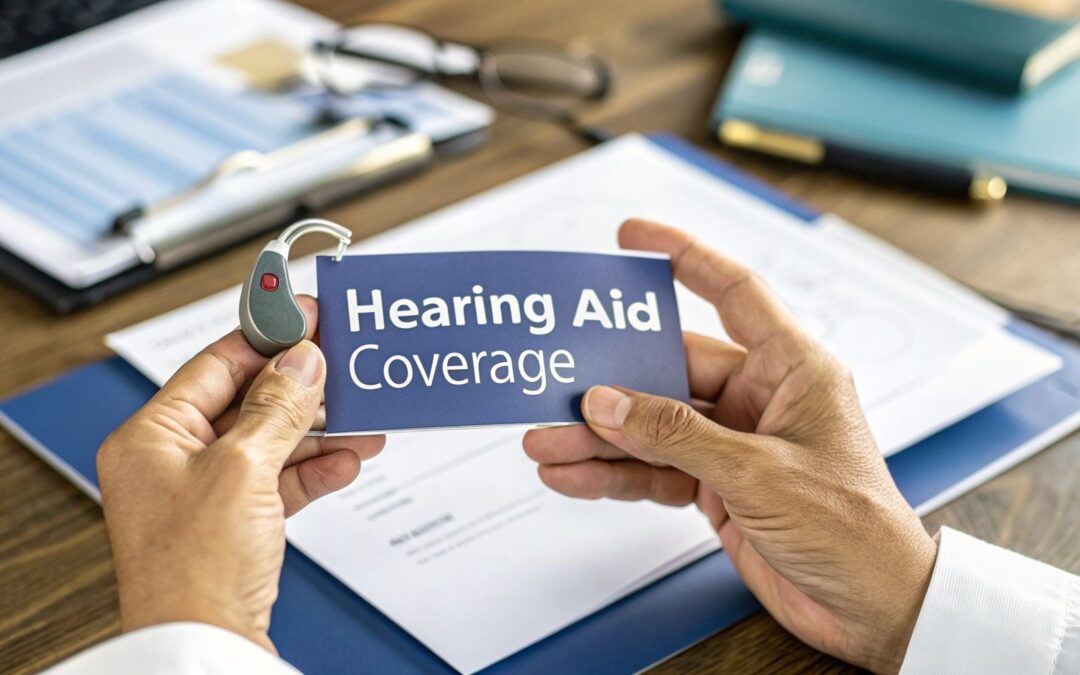
Let's get straight to the point: hearing aids are a major investment. The good news is that hearing aid coverage is available, but it's not a one-size-fits-all solution. Think of it like a puzzle where every piece—your private insurance, Medicare, or VA benefits—fits together differently. Figuring out how they work for you is the secret to unlocking serious savings.
The Real Cost of Hearing Aids and How Coverage Can Help

The high price of hearing aids is often the single biggest hurdle that stops people from getting the help they deserve. Without any assistance, a single pair can easily run you several thousand dollars, putting them out of reach for many families. That initial sticker shock is enough to make anyone second-guess their decision, but it’s so important to look past that retail price and see what your actual cost will be.
This is exactly where hearing aid coverage becomes a financial game-changer. It’s more than just a simple coupon; it’s a structured benefit that can bring your out-of-pocket costs way down. That support can come from a lot of different places, and the first step to making hearing care affordable is knowing which ones you can tap into.
The Financial Impact of Insurance
Having the right plan can slash what you pay by half—or even more. The numbers don't lie.
Take a look at the data below. It shows just how much of a difference insurance makes when you're buying prescription hearing aids.
Hearing Aid Costs With vs Without Insurance (2026 Averages)
| Hearing Aid Tier | Average Cost (Without Insurance) | Average Cost (With Insurance) | Average Savings |
|---|---|---|---|
| Premium | $5,321 | $3,627 | $1,694 |
| Mid-Range | $4,000 | $1,952 | $2,048 |
| Basic | $2,187 | $1,449 | $738 |
As you can see, the savings are significant. Projections for 2026 show that people with insurance save an average of 32% on premium devices, which works out to about $1,694 in savings. For mid-range models, the savings jump to a massive 51%, or around $2,048.
Across the board, insured folks pay an average of $2,567 per pair. Those without insurance? They’re looking at a much steeper average of $4,727. These figures make it clear: getting hearing aid coverage isn't just a nice-to-have, it's a core part of your financial strategy for hearing health.
The difference between paying full price and using your benefits can be thousands of dollars. It’s the single most important factor in managing the long-term cost of hearing health.
Beyond Coverage Exploring Financial Tools
Even with a great insurance benefit, you might still have some remaining costs for the devices themselves, fittings, or follow-up care. Luckily, other financial tools can help bridge that gap. For example, many people turn to tax-advantaged accounts to handle these expenses. You might find our guide on https://mypolicyquote.com/2025/11/25/what-can-you-use-your-hsa-for/ helpful, as it explains how these accounts can be used for medical devices like hearing aids.
In some situations, your doctor might also recommend further diagnostics to understand the root cause of your hearing loss, such as genetic testing for deafness. This kind of deeper understanding can influence your long-term care plan. This guide will walk you through every option, making sure you have a clear roadmap to affordable hearing.
Decoding Your Private Insurance for Hearing Benefits

So many people assume their private health insurance offers zero hearing aid coverage. But more often than not, the benefits are just buried in the fine print. Think of your policy like a treasure map—the prize is there, you just need to know how to read the symbols to find it.
Your first step is to track down your Summary of Benefits and Coverage (SBC). This is a standardized, plain-language breakdown of what your plan covers and what you’ll pay. Insurers almost always have this available in your online member portal, or they can mail you a copy if you ask.
Once you have that document, it’s time to play detective. Look for terms like "hearing services," "audiology," or "prosthetic devices." This is where you'll start to see the real story of your hearing aid coverage.
Finding Your Hearing Aid Benefit
The most direct coverage you’ll find is a specific hearing aid benefit. This is a set amount of money your plan agrees to pay toward the cost of your devices. The trick is that it can be structured in a few different ways, so understanding the exact details is everything.
You’ll typically see one of these common setups:
- A Fixed Dollar Amount: Your plan might offer a straightforward allowance, like $1,000 per ear. This usually renews every few years (think every 36 or 60 months). It's a clear-cut benefit you can apply directly to your purchase.
- Coverage Percentage: Some plans will cover a percentage of the cost, maybe 80%, but only after you’ve met your annual deductible. This can be a huge help with more expensive hearing aids, but you have to know what your deductible and out-of-pocket maximum are first.
- Paired vs. Single Device Rules: Pay close attention here. Does the benefit cover a single hearing aid or a pair? A "$2,000 benefit" could mean $2,000 total, or it could mean $1,000 for each ear. That’s a critical difference.
Even though these benefits are a game-changer, they aren't always considered what are essential health benefits that plans are required to offer.
Watch Out for Common Roadblocks
Finding a benefit is a huge win, but there are almost always a few hoops you’ll need to jump through first. Knowing about these common requirements ahead of time can save you from major headaches and frustrating claim denials.
Understanding your plan's rules is just as important as knowing the benefit amount. A $2,500 benefit is useless if you don't follow the process to unlock it.
Two of the biggest hurdles you’ll likely face are pre-authorization and sticking to in-network providers.
Pre-authorization Requirements
Think of pre-authorization as getting a permission slip from your insurance company before you buy your hearing aids. They want to see proof from an audiologist that the devices are medically necessary. Skipping this step is one of the fastest ways to get your claim rejected, flat out.
Navigating Provider Networks
Most insurance plans have a list of approved "in-network" audiologists and hearing clinics. To get the highest level of hearing aid coverage—or any coverage at all—you must use one of these professionals. Going "out-of-network" can mean a much smaller benefit or, in many cases, no coverage whatsoever. Always check your insurer's provider directory before you book an appointment.
Navigating Medicare and Medicare Advantage Plans
For millions of Americans, turning 65 means it’s time to navigate the world of Medicare. But this major life shift often comes with a costly and frustrating surprise: hearing aid coverage. It's a common belief that Medicare will cover everything, but that's just not the case.
The hard truth is that Original Medicare—the combination of Part A (for hospitals) and Part B (for doctors)—does not pay for hearing aids or the exams needed to fit them. This leaves a huge gap in coverage, especially since hearing loss is so common among older adults. Think of Original Medicare as the foundation of a house; it’s solid and essential, but it doesn't include the extras like plumbing for every fixture or wiring for every light. For hearing, you need something more.
This is where Medicare Advantage plans, also known as Part C, come into the picture. They are the primary solution within the Medicare system for getting help with hearing aid costs.
The Medicare Advantage Solution
Medicare Advantage plans are offered by private insurance companies that have Medicare’s stamp of approval. By law, they have to cover everything Original Medicare does, but they don't stop there. They often bundle in a host of other benefits to create a more complete package.
It’s like upgrading from a basic TV package to a premium one that includes all the movie and sports channels you actually want.
These extra perks frequently include things like:
- Routine dental care
- Vision exams and glasses
- Gym memberships
- And most importantly, hearing aid coverage
Instead of just relying on the government-run Parts A and B, you choose a private plan from a carrier you trust, one that's designed to fit your specific needs. For anyone struggling with hearing loss, a well-chosen Advantage plan can be a game-changer.
Don't fall for the myth that all Medicare plans are the same. When it comes to hearing aids, picking the right Medicare Advantage plan is your most direct path to affordable care.
Of course, the benefits can vary wildly from one plan to another. Some might offer a straight allowance, like $500 to $2,000 every one to three years, that you can put toward hearing aids from an approved provider. Others might have a different structure, requiring a fixed copayment—say, $699 per aid—for a specific model that would normally cost you thousands. You can get a better sense of how these plans work in our guide on Medicare Advantage PPO plans.
What to Look For in a Plan
When you’re comparing Medicare Advantage plans, you have to look past the monthly premium. The cheapest plan isn’t always the best value, especially if its hearing benefit is weak. You need to dig into the details.
Here are the key questions you should be asking:
- What is the benefit amount? Is it a fixed dollar allowance, a percentage of the cost, or a set copay for certain devices?
- Is there a provider network? Most plans will require you to see an in-network audiologist to use your benefits. You need to know who is on that list.
- What does it cover besides the aids themselves? Does the plan also help pay for your initial hearing exam, follow-up fittings, and adjustments?
- Are batteries and repairs included? Some higher-end plans will even provide a supply of batteries or cover the cost of certain repairs.
This isn't just a minor issue; it's a massive public health challenge. Hearing loss affects 1.5 billion people globally, yet far too few get the help they need. In the U.S., a staggering 30.8% of Medicare and Medicaid users with hearing loss have ever used aids, and the number of people who use them regularly plummets to just 17.7%. Contrast that with people on military insurance like the VA, who are over twice as likely to use them. It’s clear proof that coverage is the biggest barrier to access.
Choosing the right Medicare Advantage plan takes some homework, but the payoff is enormous. Finding a plan with a strong hearing benefit can turn a huge, stressful expense into something you can actually manage.
Finding Hearing Aid Coverage Beyond Traditional Insurance
So your private insurance or Medicare Advantage plan came up short on hearing aid coverage. It's easy to feel like you’ve hit a brick wall. But this is often where the real journey to affordable hearing care begins, not ends. Several powerful, government-funded programs are out there specifically to fill these gaps, offering life-changing benefits to millions of Americans.
These aren’t just backup options; for many, they are the best and most direct route to getting top-tier hearing aids and care with little to no out-of-pocket cost. Think of them as primary pathways running parallel to traditional insurance. The two biggest players here are the Department of Veterans Affairs (VA) and Medicaid.
VA Hearing Aid Benefits For Veterans
For eligible U.S. veterans, the Department of Veterans Affairs provides what is arguably the most comprehensive hearing aid coverage in the entire country. We’re not talking about a small discount or a limited allowance—this is a full-service hearing health program. If your hearing loss is connected to your military service or certain other medical conditions, you could qualify for a complete hearing workup and state-of-the-art hearing aids at no cost to you.
To get started, you’ll need to be enrolled in the VA healthcare system. The process usually kicks off with a hearing evaluation at a VA medical center or a VA-approved audiology clinic in your community. If the audiologist confirms that hearing aids are medically necessary, the VA will typically provide them, along with:
- Top-of-the-line devices from the world's leading manufacturers.
- All necessary fittings and any follow-up adjustments you need.
- A steady supply of batteries and other essential accessories.
- Repairs and maintenance for the entire life of your devices.
This program is a true lifeline for veterans. It covers every angle of hearing care, completely removing the financial stress for those who qualify. If you're a veteran exploring your options, this should be your first stop.
Medicaid Coverage For Hearing Aids
Medicaid offers health coverage to millions of Americans, from low-income adults and children to seniors and people with disabilities. While federal law requires every state's Medicaid program to cover hearing services for kids, the rules for adults are a whole different story.
Hearing aid coverage for adults under Medicaid is a patchwork quilt. It varies wildly from one state to the next. Your neighbor in the next state might get a generous benefit, while your state offers nothing at all.
A person's access to hearing care through Medicaid is entirely dependent on their zip code. This makes it crucial to check your specific state's rules to see what benefits may be available to you.
Some states provide full coverage for hearing aids. Others might only cover one hearing aid, have very strict eligibility rules, or offer no adult hearing aid benefit at all. The only way to know for sure is to contact your local Medicaid office directly and ask.
Before we dive into state mandates, here's a quick comparison of the different paths to coverage we've discussed so far.
Hearing Aid Coverage Options at a Glance
This table breaks down the main sources of hearing aid coverage, helping you see at a glance which path might be the right fit for you or your family.
| Coverage Source | Typical Coverage Level | Primary Audience | Key Takeaway |
|---|---|---|---|
| Private Insurance | Varies widely; from no coverage to partial allowance | Employees, self-employed individuals, and families with private health plans. | Often a "hit-or-miss" option that requires checking your specific plan. |
| Medicare | Zero coverage for hearing aids. | Adults 65+ and younger people with certain disabilities. | A non-starter for hearing aids, but covers diagnostic hearing exams. |
| Medicare Advantage | Varies; often an annual allowance ($500-$2,000). | Medicare-eligible individuals who prefer a private plan alternative. | Coverage is becoming more common but usually comes with limits and networks. |
| VA Benefits | Comprehensive; covers devices, services, and supplies. | Eligible U.S. veterans enrolled in VA healthcare. | The gold standard of hearing aid coverage if you qualify. |
| Medicaid | Varies by state; from full coverage to none at all. | Low-income individuals, families, children, and people with disabilities. | Coverage is entirely location-dependent; you must check your state's rules. |
As you can see, the "best" option really depends on who you are—a veteran, a low-income adult, or someone with an employer-sponsored plan. Knowing where to look is half the battle.
State Mandates and How They Help
Beyond direct government programs, some states are taking matters into their own hands. Over 20 states have passed laws that force private insurance companies to provide some level of hearing aid coverage. These laws typically apply to health plans regulated by the state, like individual and small group plans you'd buy on your own.
The details of these mandates are all over the map:
- Some states only require coverage for children.
- Others mandate benefits for both children and adults.
- The required benefit amount can range from $1,000 to $3,000 or more, and it often renews every few years.
These state-level rules create a crucial safety net for many families, forcing insurers to include benefits they might otherwise skip. It's interesting to see how this compares to what's happening globally. Europe, for example, makes up 38% of the global hearing aid market, partly because many countries have systems that make access far easier. The French government now fully covers certain hearing aid models, and countries like Germany and the UK also provide major subsidies. You can learn more about these global hearing aid market trends and see how other nations are working to boost access to hearing care.
Your Step-By-Step Plan to Claim Your Hearing Benefits
Knowing you might have hearing aid coverage is one thing. Actually getting your insurer to pay for it is a whole different ballgame. This is where you put knowledge into practice.
Think of this checklist as your personal roadmap. Follow these steps, and you’ll sidestep the frustrating red tape and administrative headaches that stop so many people cold.
Step 1: Get a Diagnostic Hearing Evaluation
First things first: you need to see a professional. Schedule a hearing test with a licensed audiologist.
It’s crucial to understand this isn't the same as a free “screening” you see advertised at a kiosk or online. A screening just flags a potential problem. A diagnostic hearing evaluation, on the other hand, is a full-blown medical test that pinpoints the exact type and severity of your hearing loss.
This evaluation is the key that unlocks everything else. Insurance companies need this medical proof to justify that hearing aids are a necessity, not just a preference.
Step 2: Call Your Insurance Provider
Once you have your audiogram—the official results from your hearing test—it's time to get on the phone with your insurance company. Don’t just ask if they cover hearing aids. You need the nitty-gritty details.
Try using a script like this to get straight to the point:
"I have a confirmed diagnosis of hearing loss and am looking at hearing aids. Can you please verify my specific hearing aid coverage? I need to know the exact dollar amount or percentage you cover, how often that benefit renews, and whether it’s per ear or for a pair."
Then, follow up with these critical questions:
- Does my plan require pre-authorization before I buy anything?
- Do I have to use an in-network audiologist or can I go to any provider?
- What is the exact process for submitting the claim?
This one conversation can save you thousands of dollars and countless hours of frustration. Knowing the rules of the game upfront is your best move.
This decision tree gives you a great visual of how different routes to coverage, like the VA or Medicaid, can completely change your path.

As you can see, programs like VA benefits or Medicaid aren't just secondary options; for many, they are the primary, most direct path to getting coverage.
Step 3: Obtain Pre-Authorization if Needed
If your insurer said you need pre-authorization (sometimes called prior approval), this step is absolutely non-negotiable. Don’t skip it.
Your audiologist's office will almost always handle this part for you. They’ll send your test results and a letter of medical necessity directly to your insurance company.
Do not, under any circumstances, buy your hearing aids until you get written confirmation that you’re approved. Jumping the gun here is one of the most common—and costly—reasons claims get denied.
Step 4: Choose Your Devices and Submit the Claim
With that approval letter in hand, you're in the clear. Now you can work with your audiologist to pick the right hearing aids for your specific loss, lifestyle, and budget.
The provider will then place the order and manage the final claim submission. They’ll bill your insurance for the covered portion and then send you a bill for whatever is left. If you want to get a better handle on how this back-and-forth works, we recommend you check out our guide on what a health insurance claim is for a simple breakdown.
By following this process, you make sure every "i" is dotted and every "t" is crossed, making your journey to better hearing as smooth as it can possibly be.
What to Do When Your Insurance Does Not Offer Coverage

Finding out your plan offers little or no hearing aid coverage can feel like hitting a wall. It's frustrating, but it’s definitely not a dead end. There are plenty of smart, affordable paths to better hearing that exist completely outside of traditional insurance.
Think of this as your "Plan B." It's about shifting your focus from what your insurance won't do to what you can do. You have powerful tools at your disposal, from new types of devices to tax-advantaged accounts and community support. Let's walk through these practical options.
Consider Over-the-Counter (OTC) Hearing Aids
One of the most significant changes in hearing health is the arrival of Over-the-Counter (OTC) hearing aids. The FDA has approved these for adults who feel they have mild-to-moderate hearing loss, and you can buy them directly—no prescription or audiologist visit required.
OTC devices come with a much lower price tag, often just a fraction of the cost of traditional prescription hearing aids. They empower you to take that first step toward addressing hearing loss on your own terms, affordably and immediately.
Explore Financing and Payment Plans
If a prescription hearing aid is what you medically need, don't let the sticker shock stop you. Most audiologist clinics understand the financial hurdle and offer in-house payment plans, letting you spread the cost over several months or even years.
Beyond that, third-party financing is widely available, created specifically for healthcare expenses.
- CareCredit: This is a well-known healthcare credit card. It often has promotional financing, like 0% interest if you pay off the balance within a set time (say, 12, 18, or 24 months). It lets you get the help you need now and pay for it in a way that fits your budget.
- Clinic-Specific Plans: Always ask your audiologist’s office about their financing partners. They usually have established relationships that can make the whole application process much simpler for you.
These options break a large, intimidating expense down into predictable monthly payments, making it far more manageable.
Use Tax-Advantaged Health Accounts
Do you have a Flexible Spending Account (FSA) or a Health Savings Account (HSA) through work or your health plan? These are fantastic tools for paying for hearing aids and related costs using pre-tax dollars.
Using an FSA or HSA is like getting an automatic discount on your hearing aids equal to your tax rate. If you're in a 22% tax bracket, you save $220 for every $1,000 you spend on eligible hearing expenses.
This tax-free money can be used for:
- The hearing aids themselves (both prescription and OTC)
- Hearing exams and appointments with an audiologist
- Batteries, repairs, and cleaning supplies
This is your money, set aside for your health. Using it for hearing care is one of the smartest financial moves you can make when direct hearing aid coverage isn't on the table.
Seek Support from Foundations and Civic Groups
Finally, never underestimate the power of community. There are a number of national and local organizations dedicated to helping people get hearing aids when they can't afford them.
These groups might offer financial assistance, provide refurbished hearing aids, or give grants to cover the cost of care. Some well-known examples include:
- The Miracle-Ear Foundation
- Lions Clubs International
- Starkey Hearing Foundation
Applying to these programs can take some time and paperwork, but for those who qualify, they can completely remove the financial barrier to better hearing.
Answering Your Hearing Aid Coverage Questions
Even after mapping out the different routes to hearing aid coverage, a few questions probably still pop into your head. That’s completely normal. Let's tackle some of the most common ones we hear, so you can move forward with total confidence.
Are Hearing Aid Batteries and Repairs Covered by Insurance?
This is a fantastic question, because the little ongoing costs really do add up. The answer, not surprisingly, depends on how good your plan is. A more basic policy will likely only help with the initial cost of the hearing aids themselves. That leaves you paying for batteries and upkeep out-of-pocket.
But better plans—especially those higher-tier Medicare Advantage plans or comprehensive VA benefits—often build in coverage for these recurring expenses. You might see a quarterly allowance for batteries or coverage for specific repairs. Always look at the "durable medical equipment" or "prosthetics" section of your plan details to see what’s included for maintenance.
Will Insurance Pay for OTC Hearing Aids?
Right now, the answer is almost always no. Over-the-counter (OTC) hearing aids are set up to be bought directly, just like you’d buy reading glasses at a pharmacy. You don't need a prescription, and the whole system is designed to bypass insurance.
The big draw of OTC devices is their lower upfront price, which avoids the whole insurance process. If you’re planning to use insurance benefits, you’ll be guided toward prescription hearing aids from an audiologist.
What Should I Do If My Claim Is Denied?
Seeing a claim get denied is frustrating, but it’s not always the end of the road. Your first move is to read the denial letter from your insurer very carefully. It will tell you exactly why they rejected it, and that reason is your key to figuring out what to do next.
Here are a few common reasons for a denial and how to respond:
- Missing Pre-Authorization: If you were supposed to get approval beforehand and didn't, you can appeal the decision. It's not a guaranteed win, but it's worth a shot.
- Out-of-Network Provider: You saw an audiologist who isn't on your plan's approved list. Unfortunately, this often means you’re on the hook for the full cost.
- Clerical Errors: Sometimes, it’s just a simple typo or mistake in the paperwork. Your audiologist’s office can usually fix it and refile the claim for you.
If you feel the denial was wrong or unfair, you absolutely have the right to file an official appeal. This is a formal process where you ask your insurer to take a second look, usually with more paperwork and support from your audiologist.
How Often Can I Get New Hearing Aids Through My Plan?
Most plans that offer hearing aid coverage include a renewal period. Think of it as a cooldown—it’s the amount of time you have to wait before your benefit is available again for a new pair of devices.
The most common renewal cycle is once every 3 to 5 years. For example, a plan might offer a $2,000 benefit that renews every 36 months. If you get new hearing aids in 2026, you won't be able to use that benefit again until 2029. Knowing your plan’s specific timeline is crucial for long-term planning.
Navigating the world of insurance can feel like a puzzle, but you don’t have to solve it alone. My Policy Quote is here to help people find health coverage that truly fits their life, including plans with excellent hearing benefits. Explore your options and get a personalized quote today.