

So, you're ready to get health insurance. Where do you even begin? It all comes down to three things: knowing when you can enroll, getting your documents together, and picking the right path to apply. The most popular routes are the government's Health Insurance Marketplace, going straight to an insurer, or getting a helping hand from a broker.
Where to Start Your Health Insurance Application

Starting the application process can feel like you're standing at a crossroads. The good news? Each path is built for different situations. Your life—whether you're self-employed, retiring before Medicare kicks in, or in between jobs—is what will point you in the right direction.
First things first: timing is everything. Most people sign up during the yearly Open Enrollment Period (OEP), which usually runs from November 1 to January 15 in most states. But life happens. If you have a major life event, like getting married or losing other coverage, you might qualify for a Special Enrollment Period (SEP). This gives you a 60-day window to get covered outside the normal timeframe.
Your Three Main Paths to Get Covered
Before you get lost in paperwork, think about how you want to handle this. Each option has its own perks, especially if you're looking for financial help or just want someone to walk you through it.
- The Health Insurance Marketplace: This is the big one—think Healthcare.gov or your state's official website. It’s the only place you can get premium tax credits and other subsidies that make your monthly bill a lot smaller.
- Directly from an Insurer: If you've already picked a company and you know you won't qualify for financial aid, applying on their website can be quick and painless.
- Through a Broker or Agent: Feeling overwhelmed by all the choices? A broker can be your best friend. They'll help you compare plans from different companies, and their help doesn't cost you anything extra.
Sometimes, the simplest first step is reaching out to an insurance agency for one-on-one guidance.
There isn't one "best" way to apply. It’s about picking the route that fits your wallet and your comfort level. For most people, the Marketplace is the smartest place to start, just to see what savings you might get.
Getting All Your Ducks in a Row
Navigating a health insurance application can feel complex, but breaking it down into clear stages makes it much more manageable. The table below outlines the key phases, what each one involves, and a practical tip to help you succeed at every step.
Table: Key Stages of a Health Insurance Application
| Application Stage | What It Involves | Key Tip for Success |
|---|---|---|
| 1. Timing & Preparation | Identifying your enrollment window (Open or Special Enrollment) and gathering all required documents for everyone in your household needing coverage. | Create a dedicated folder (digital or physical) for all documents—like tax returns, pay stubs, and ID cards—before you even start the application. |
| 2. Choosing a Pathway | Deciding whether to use the Marketplace (for subsidies), go directly to an insurer, or work with a broker for personalized advice. | If you're unsure about qualifying for subsidies, always start with the Marketplace. It takes minutes to check and could save you thousands. |
| 3. Submitting the Application | Filling out the online or paper forms with your household, income, and personal information. This step determines your eligibility for plans and financial aid. | Double-check every single number and name for typos. A small error in your income or a misspelled name can cause major delays. |
| 4. Comparing & Selecting a Plan | Reviewing the plans you're eligible for. This means looking beyond the monthly premium to compare deductibles, copays, networks, and drug coverage. | Focus on the total cost, not just the premium. A cheaper plan with a high deductible might cost you more in the long run if you need regular care. |
| 5. Finalizing Enrollment | Officially selecting your plan and making your first premium payment to activate the coverage. | Set a calendar reminder for your first payment due date. Missing it could cancel your enrollment before your coverage even begins. |
Taking the time to understand these stages helps demystify the process and puts you in control of your healthcare journey.
No matter which path you take, the information you'll need is pretty much the same. You’ll have to provide details for everyone in your household who needs coverage. A great way to prepare is by exploring different individual health insurance plans ahead of time to get a feel for what’s out there.
Getting ready also means learning the lingo. Terms like ‘deductible,’ ‘premium,’ and ‘out-of-pocket maximum’ aren't just jargon—they directly impact how much you'll spend on care. A little research now will give you the confidence to pick the right plan later. Think of it as laying the groundwork for a stress-free enrollment.
Finding Your Enrollment Window

Unlike a gym membership or a streaming service, you can’t sign up for health insurance just any old time. Timing is everything. Knowing when you can apply is the first—and most important—step to getting covered and making sure you don't face a gap in your care.
For most people, the main chance to get a new plan is during the annual Open Enrollment Period (OEP). This is a specific time each year, usually from November 1 to January 15, when the doors to the Health Insurance Marketplace swing wide open for everyone.
This period is a lifeline for freelancers, families re-evaluating their coverage, or anyone who doesn't get insurance through a job. It's your one guaranteed shot to enroll, no questions asked. If you want a deeper dive, our guide explains what Open Enrollment is and why it matters. Miss this window, and you’ll likely be waiting a whole year to get covered.
When Life Changes Your Plans
But life doesn’t always follow a neat calendar. What happens if you lose your job in March, get married in July, or have a baby in October? That’s where a Special Enrollment Period (SEP) comes in.
An SEP is a 60-day window to get coverage outside of the normal enrollment timeframe. It’s triggered by what’s known as a Qualifying Life Event (QLE)—a major change that disrupts your current insurance situation. Think of it as a safety net.
Here are a few common life events that will open up an SEP for you:
- Losing Other Health Coverage: This is the big one. It could be losing your job-based plan, turning 26 and having to get off a parent's plan, or no longer being eligible for Medicaid.
- Changes in Your Household: Big family changes like getting married, having a baby, adopting a child, or getting divorced all count.
- A Change in Where You Live: Moving to a new ZIP code or county often qualifies you, especially if your old plan won’t cover you in your new location.
- Other Specific Circumstances: Becoming a U.S. citizen or being released from incarceration are also considered QLEs.
A common point of confusion: just quitting your job doesn't automatically qualify you. It’s the loss of health insurance tied to that job that triggers the SEP. If you leave a job that never offered you a health plan, you probably won't be eligible for a Special Enrollment Period.
Proving Your Eligibility and Acting Fast
To use an SEP, you’ll need to send in some documents proving your life event actually happened. This isn't meant to be a hassle; it's just a way to confirm you’re eligible.
For example, if you lost your job-based plan, you might show a letter from your old company confirming when your coverage ended. If you moved, a new lease or a utility bill with your name and new address usually does the trick. Got married? You'll need a copy of your marriage certificate.
The most important thing is to act fast. That 60-day clock starts ticking the day of your life event. If you miss that deadline, you’re back to waiting for the next Open Enrollment.
Not sure if you qualify? Most marketplace websites, like Healthcare.gov, have a quick screener tool. It asks a few simple "yes or no" questions about your recent life events to tell you instantly if you can sign up for a plan right now. It saves you from starting a whole application just to find out you're not eligible.
Gathering the Right Documents for Your Application
Nothing kills your momentum faster than having to stop an application halfway through to dig for a missing piece of paper. Getting your documents ready beforehand changes the entire experience. It turns a chore into a simple, streamlined process.
The reason is straightforward: the system needs to verify who you are, how many people are in your household, and what your income is. This information is key to figuring out which plans you can enroll in and, just as important, whether you qualify for subsidies that could seriously lower your monthly premium.
Your Essential Document Checklist
Before you log into the Marketplace or sit down with an expert, pull these items together for everyone in your household who needs coverage. Trust me, having them ready saves a ton of headaches.
Here’s what you’ll almost always need:
- Social Security Numbers (SSNs): This is for every person on the application who has one. It’s the main way the government verifies your identity and cross-references income data.
- Employer and Income Info: Grab recent pay stubs, W-2 forms, or your latest tax return. If you're self-employed, you'll want a projection of your net income, which you can figure out from past profit and loss statements.
- Details About Job-Based Coverage: If anyone in your household has an offer of insurance from their job, you need the details on that plan—even if you don't take it. This directly impacts whether you can get a subsidy on the Marketplace.
For a complete rundown, check out our guide on what documents you need to get insurance. A little prep work now means you won't have to save, exit, and restart your application later.
Why Each Document Matters
It helps to know why they’re asking for all this stuff. It’s not just busywork. Each document helps connect you to the right benefits.
Your proof of income, for example, is probably the most important piece of the puzzle. It directly determines if you qualify for the Advanced Premium Tax Credit (APTC)—the subsidy that can make your monthly payments so much more affordable. An accurate income estimate ensures you get all the savings you’re entitled to, without any nasty surprises at tax time.
Key Takeaway: Think of your application as a financial snapshot. The documents you provide paint a clear picture, letting the system accurately calculate your eligibility for specific plans and, most importantly, financial help.
For newcomers to the U.S. who are still figuring out the system—like those mentioned in this helpful guide for Canadians working in the US—understanding the requirements for an SSN or an Individual Taxpayer Identification Number (ITIN) is a critical first step.
Proof of Identity and Citizenship
Finally, you’ll need to prove you are who you say you are and confirm your legal residency. This is just to make sure only eligible people are enrolling through the Marketplace.
You'll typically need documents like:
- Birth certificates
- A driver's license or other government-issued photo ID
- Immigration documents for non-citizens, like a Green Card or work authorization forms
Having these files organized and ready makes applying for health insurance feel much less intimidating. It lets you stop hunting for documents and start focusing on what really matters: comparing your options and choosing the best plan for you and your family.
Choosing Your Health Insurance Application Pathway
Once you’ve got your documents lined up and know when you can enroll, the next big question is where to apply. This isn't about finding one secret website; it's about understanding the different routes available and picking the one that makes the most sense for you and your wallet.
You've basically got three main options. Each one has its own perks, whether you’re hunting for the biggest savings, prefer a simple DIY approach, or want an expert to guide you through it all.
The Official Health Insurance Marketplace
This is ground zero for anyone looking for financial help. The Health Insurance Marketplace, known on the federal level as Healthcare.gov, is the official government platform. Many states, like California with its Covered California exchange, run their own, but they all serve the same vital purpose.
Why is this route so important? Simple: it's the only place you can get financial assistance to lower your insurance costs. If your household income fits within a certain range, you could qualify for:
- Advanced Premium Tax Credits (APTC): Think of these as instant discounts that slash your monthly insurance payment, often by a huge amount.
- Cost-Sharing Reductions (CSR): These are extra savings that kick in if you qualify and choose a Silver-level plan. They lower what you pay out-of-pocket for things like your deductible and copays.
If you’re a freelancer with an unpredictable income, a family on a budget, or an early retiree, starting here is a no-brainer. It only takes a few minutes to see if you qualify, and it could literally save you thousands of dollars a year.
It’s always worth checking your eligibility for subsidies, even if you think your income is too high. The income limits are often more generous than people assume, especially for larger families.
Applying Directly with an Insurance Company
If you’re pretty sure you won’t qualify for any financial help, going straight to an insurer’s website is a perfectly good option. It’s often a more direct and streamlined process.
You can browse plans from a specific carrier you already know and trust—like Blue Cross Blue Shield, UnitedHealthcare, or Cigna—and handle the entire application on their site. The plans you’ll find are fully ACA-compliant, which means they cover essential health benefits and pre-existing conditions, just like the ones on the Marketplace.
The big catch is obvious: you will pay full price. When you go directly to the carrier, you lose access to premium tax credits and cost-sharing reductions. This path is best for individuals and families with higher incomes who value simplicity over subsidies.
This flowchart can help you visualize which path might be the right fit.
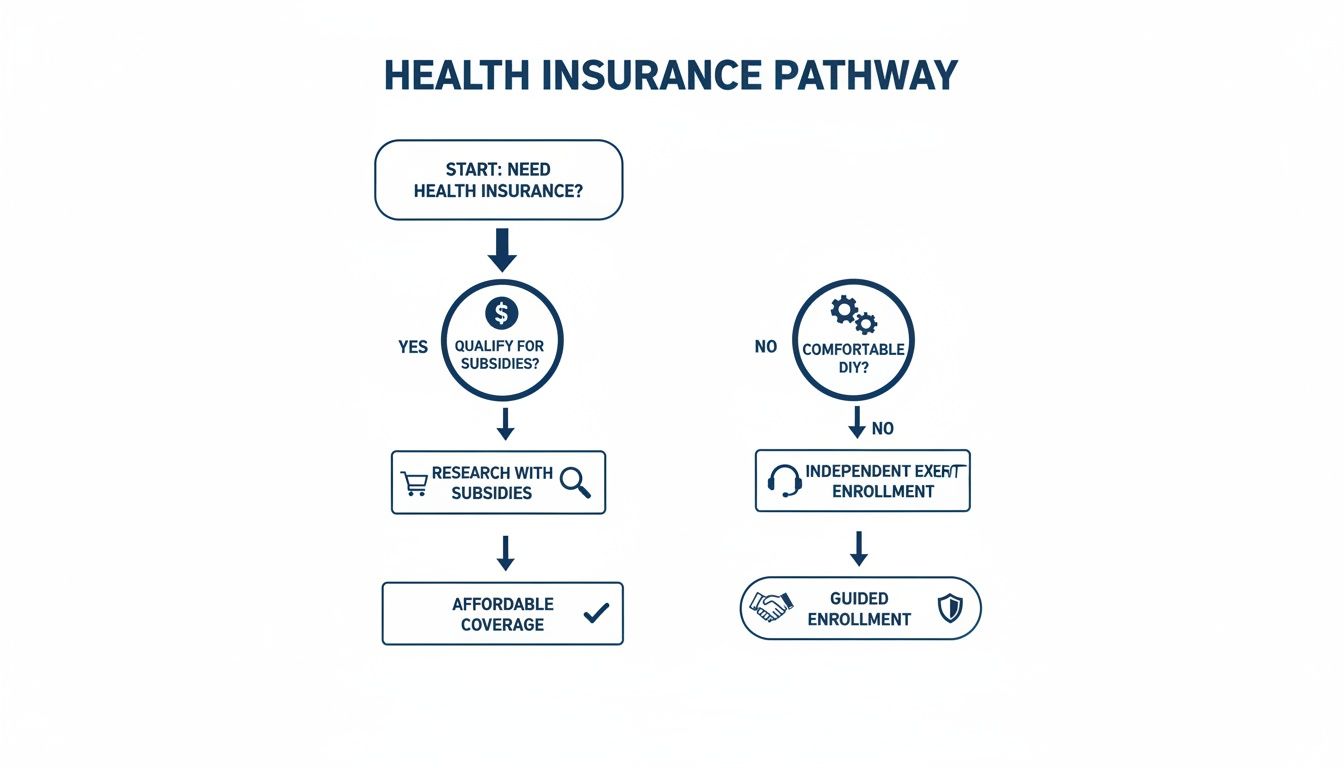
Ultimately, it often comes down to one question: Do you need financial help, or would you rather manage it all on your own?
Working with a Health Insurance Broker or Agent
Feeling a little lost in all the jargon and options? A licensed health insurance broker or agent can be a lifesaver. Their entire job is to help people like you navigate the complex world of health plans, and their services are usually free—the insurance companies pay them, not you.
A great broker brings a lot to the table:
- Personalized Advice: They’ll take the time to understand your unique health needs and budget to find plans that are a genuine fit.
- Marketplace Know-How: Most brokers are certified to help you enroll through the Marketplace, so you won’t miss out on any subsidies you’re entitled to.
- A Simpler Process: They can handle the paperwork and even go to bat for you if any problems pop up.
This route really combines the best of both worlds: you get expert, personalized guidance and access to the same plans and savings you'd find on the Marketplace. It’s a fantastic choice for anyone who wants a professional in their corner to compare options and avoid making a costly mistake.
The global health insurance market is set to hit USD 4.45 trillion by 2032, which means more plans and more complexity than ever before. New tech is helping cut application times by 30%, but that doesn't make the choice any easier. In a world with so many options, having an expert guide is priceless.
Picking your application pathway is a critical first step. By thinking about your finances and how much help you want along the way, you can confidently choose the route that leads to the best possible coverage for you.
Understanding Costs and Comparing Plan Options

Choosing a health insurance plan is one of the biggest financial decisions you'll make all year. It's so easy to get fixated on the monthly premium, but that's just the sticker price. The real cost of your coverage lives in the details.
Getting those details right is the key to protecting both your health and your bank account.
The first number everyone sees is the premium. That’s the fixed amount you pay every month to keep your insurance active. But here’s a classic mistake I see all the time: focusing only on the premium. The true cost of your plan is what you pay each month plus what you pay when you actually need care.
That’s where a few other key terms come into play. Your deductible is what you have to pay out-of-pocket for medical services before your insurance company starts chipping in. A plan with a low monthly premium almost always has a high deductible, and vice versa. It's a trade-off.
Decoding Your Out-of-Pocket Expenses
Even after you've hit your deductible, you don't stop paying entirely. At that point, you start sharing the cost with your insurer. This usually happens in two ways:
- Copayments (Copays): A flat fee you pay for a certain service, like $30 for a check-up or $75 to see a specialist. Simple and predictable.
- Coinsurance: This is a percentage you pay after meeting your deductible. If your plan has 20% coinsurance, you pay 20% of the approved medical bill, and your insurer handles the other 80%.
These costs add up until you hit your out-of-pocket maximum. This number is your financial safety net—it's the absolute most you will pay for covered services in a year. Once you reach that limit, your insurance plan pays 100% of covered costs for the rest of the plan year. You’re protected from catastrophic bills.
It's crucial to remember that your monthly premiums do not count toward your deductible or out-of-pocket max. Think of the premium as your membership fee and the other costs as what you pay when you use the club’s services.
With healthcare costs continuing to climb, understanding this is more important than ever. Global medical costs are projected to jump by 10.3% in 2026. This trend is exactly why you have to look past the premium and analyze how a plan’s deductible and out-of-pocket limit will really affect your wallet.
Two Real-World Scenarios
Let's look at how this plays out in the real world. Imagine you're choosing between a Bronze plan and a Gold plan.
Scenario 1: The Healthy Freelancer
A young, healthy freelancer might lean toward a Bronze plan. The premium is low—say, $300/month—but the deductible is high at $7,000. If they just need a couple of doctor visits all year, they'll pay for those out-of-pocket but keep their fixed monthly costs down. This strategy works great if you don't expect to need much medical care.
Scenario 2: The Family with Ongoing Needs
Now, picture a family with a child who has asthma. They might choose a Gold plan. Their premium is higher, maybe $750/month, but their deductible is only $1,500. They know they'll have regular specialist appointments and prescription refills, so they'll meet that lower deductible fast. After that, their insurance covers a much bigger share, saving them a ton of money over the year despite the higher monthly payment.
The right choice is completely personal. For a deeper dive, our guide on how to compare health insurance plans has more strategies to help you decide.
The Power of Subsidies
Here’s the good news: for millions of people, the sticker price isn't what they actually pay. If you apply through the Health Insurance Marketplace, you might qualify for financial help that slashes your costs.
The most common type of help is the Advanced Premium Tax Credit (APTC). It’s a government subsidy that directly lowers your monthly premium. Your eligibility is based on your household income and family size. The Marketplace application automatically calculates it for you.
This subsidy can be a total game-changer. It can make comprehensive Gold-level plans affordable for families on a tight budget. This is why you should always start your search on the Marketplace. You could be leaving thousands of dollars on the table if you don't.
You've Applied—Now What? Here's What Happens Next
Hitting "submit" on your health insurance application feels like a huge weight off your shoulders. But don't close that browser tab just yet. There are a few small but critical things to do to make sure your coverage kicks in smoothly.
First, keep an eye on your inbox. You should get a confirmation email from the Marketplace or the insurance company almost immediately. This is your proof that they received everything. I always tell my clients to save this email or screenshot it—it’s good to have a paper trail.
Look for Your Welcome Packet
Once you're officially approved and enrolled, your new insurer will send a welcome packet. This might come in the mail, via email, or sometimes both. Whatever you do, don't just file it away. This packet is your user manual for your new health plan.
Inside, you'll find the essentials:
- Your new insurance ID card: This is the golden ticket. Put it in your wallet right away.
- A Summary of Benefits and Coverage (SBC): This document is your cheat sheet, breaking down exactly what your plan covers and what you'll pay.
- Instructions for your online account: Setting this up is a must. It’s how you’ll manage your plan.
- A welcome letter with your official policy number and the date your coverage officially begins.
Take a few minutes to set up your online portal. The global health insurance market is massive—hitting EUR 1,682 billion in 2024—and that's pushed insurers to build some really useful digital tools. These portals make it so much easier to pay your bill, find a doctor in your network, and track your claims. You can see just how much digital tools are transforming the insurance industry in reports like this one.
Don't Forget Your First Premium Payment
This is the most important step of all. Your health insurance isn't actually active until you make that first payment, often called a "binder payment." If you miss it, the insurance company can—and likely will—cancel your enrollment before it even starts.
The due date for this payment is usually non-negotiable, so pay close attention. Most insurers let you pay online, by phone, or with a check. I’d recommend setting a calendar alert so it doesn't slip through the cracks.
Crucial Tip: Your coverage does not exist until that first payment is processed. If you have a doctor's appointment scheduled for day one of your new plan, make sure you've paid your premium well ahead of time. It will save you a world of billing headaches.
Once that payment is made and you have your ID card, you're officially covered. Now you can relax. Get familiar with your online account, know how to find an in-network doctor, and you’ll be ready to use your new insurance without any stress.
Still Have Questions? Let's Clear Them Up
Applying for health insurance can feel like a maze of "what ifs" and worst-case scenarios. Let's tackle some of the most common worries head-on so you can move forward with confidence.
What Happens If I Miss the Open Enrollment Deadline?
It’s an easy mistake to make, but if you miss the Open Enrollment window, your options get pretty slim. Generally, you can't just buy an ACA-compliant plan whenever you want.
Your best bet is a Special Enrollment Period, which is triggered by a Qualifying Life Event—things like losing your job, getting married, or having a baby. If you have one of those, a 60-day window opens up for you to get covered.
If not, you'll likely have to wait for the next Open Enrollment. Some people look at short-term plans as a temporary fix, but be careful. They aren't ACA-compliant, meaning they don't have to cover pre-existing conditions and often lack the consumer protections you get with a Marketplace plan.
How Do I Prove My Income as a Freelancer?
This one trips up a lot of self-employed people. How do you predict your income when it changes month to month?
The Marketplace wants your best guess for your projected net income for the year. That's your total earnings minus your business expenses.
To get a solid estimate, pull out documents like:
- Your most recent tax return, especially your Schedule C
- Any 1099-MISC or 1099-NEC forms you've received
- Your business's recent profit and loss statements
A quick tip from experience: It’s far better to be thoughtful with your estimate than to just throw a number out there. If your income changes in a big way during the year—say you land a massive project or lose a key client—you have to go back and update your application. This keeps your subsidies accurate and saves you from a nasty surprise at tax time.
Can I Get Covered If I Have a Pre-existing Condition?
Yes. A thousand times, yes. This is one of the most important protections from the Affordable Care Act (ACA).
An insurance company can't deny you coverage or charge you more just because you have a condition like diabetes, asthma, or a past illness.
This rule applies to every single ACA-compliant plan, whether you find it on Healthcare.gov, your state's exchange, or buy it directly from an insurer. Your coverage for that condition starts the very first day your plan is active.
Navigating these questions is what we do best. At My Policy Quote, we’re here to give you clear answers and help you compare plans, so you can find the perfect fit without the headache. Start exploring your options at https://mypolicyquote.com.