
Critical illness insurance pays you a lump-sum, tax-free cash benefit if you’re diagnosed with a major illness covered by your plan. Think of it less as a replacement for your health insurance and more as a financial life raft—giving you money to use however you need while you recover.
Your Financial Shield in a Health Crisis
When a serious diagnosis like a heart attack, stroke, or cancer enters your life, the last thing you want to worry about is money. Yet, even with good health insurance, the financial fallout can be devastating.
This is exactly where critical illness insurance steps in. It’s a dedicated safety net designed for a major health emergency.
Unlike traditional health insurance, which pays doctors and hospitals directly, this policy pays cash directly to you. It’s a one-time, lump-sum payment that provides crucial flexibility when your life gets turned upside down.
Bridging the Financial Gaps
Let’s be honest: a serious illness creates expenses that go far beyond medical bills. Your regular health insurance is great for covering treatments and hospital stays, but it leaves a lot of other costs for you to handle on your own.
That’s the gap critical illness insurance is built to fill. The cash payout helps you manage all those other financial pressures, so you can focus completely on getting better.
People use the benefit for all sorts of things, like:
- Replacing Lost Income: If you or your spouse can't work during treatment, the funds can cover your mortgage, groceries, and other daily expenses.
- Covering Out-of-Pocket Medical Costs: Use the money for high deductibles, copayments, and treatments your health plan doesn’t fully cover.
- Paying for Non-Medical Needs: This could be anything from travel for specialized care, to modifying your home with a wheelchair ramp, or hiring in-home help.
- Protecting Your Savings: The last thing you want is to drain your retirement accounts or emergency fund to stay afloat. This insurance helps prevent that.
A critical illness diagnosis shouldn't have to be a financial catastrophe. This insurance gives you the resources to protect your savings, pay your bills, and keep your life on track while you focus on recovery.
The need for this kind of protection is growing. The global critical illness insurance market was valued at USD 350.02 billion in 2022 and is expected to keep expanding, largely due to the high incidence of chronic diseases. You can explore the full research about the critical illness insurance market to see the trends for yourself.
This growth shows a clear and rising awareness among families about just how important it is to prepare for the financial shock of a serious health event.
To give you a quick overview, here’s a simple breakdown of what this coverage is all about.
Critical Illness Insurance at a Glance
| Feature | Description |
|---|---|
| Benefit Type | A one-time, lump-sum cash payment. |
| Payout Trigger | Diagnosis of a specific, pre-defined critical illness. |
| Tax Status | Benefits are typically received tax-free. |
| Use of Funds | Unrestricted; can be used for any purpose. |
| Primary Purpose | To cover non-medical costs and financial gaps. |
| Relationship to Health Insurance | It’s a supplement, not a replacement. |
This table highlights the core purpose of critical illness insurance: to provide fast, flexible financial support when you need it most.
How a Critical Illness Policy Actually Works
Knowing what critical illness insurance is is the first step. But the real confidence comes from understanding how it actually works when you need it most. Think of it as a financial first-aid kit—you hope you never have to open it, but you know exactly how to use it if you do.
It’s a simple process designed to get cash in your hands during a tough time, without hoops to jump through.
The journey starts when you choose a policy. You’ll decide on a benefit amount—the lump-sum payout you’d receive—which can be anything from $10,000 to over $100,000. Once your application is approved through a process called underwriting, you start paying your premiums to keep the policy active. If you want to dive deeper into the approval stage, we explain it all in our guide on what is underwriting in insurance.
Those premiums are your contribution to a safety net, making sure the money is there for you if a covered illness ever strikes.
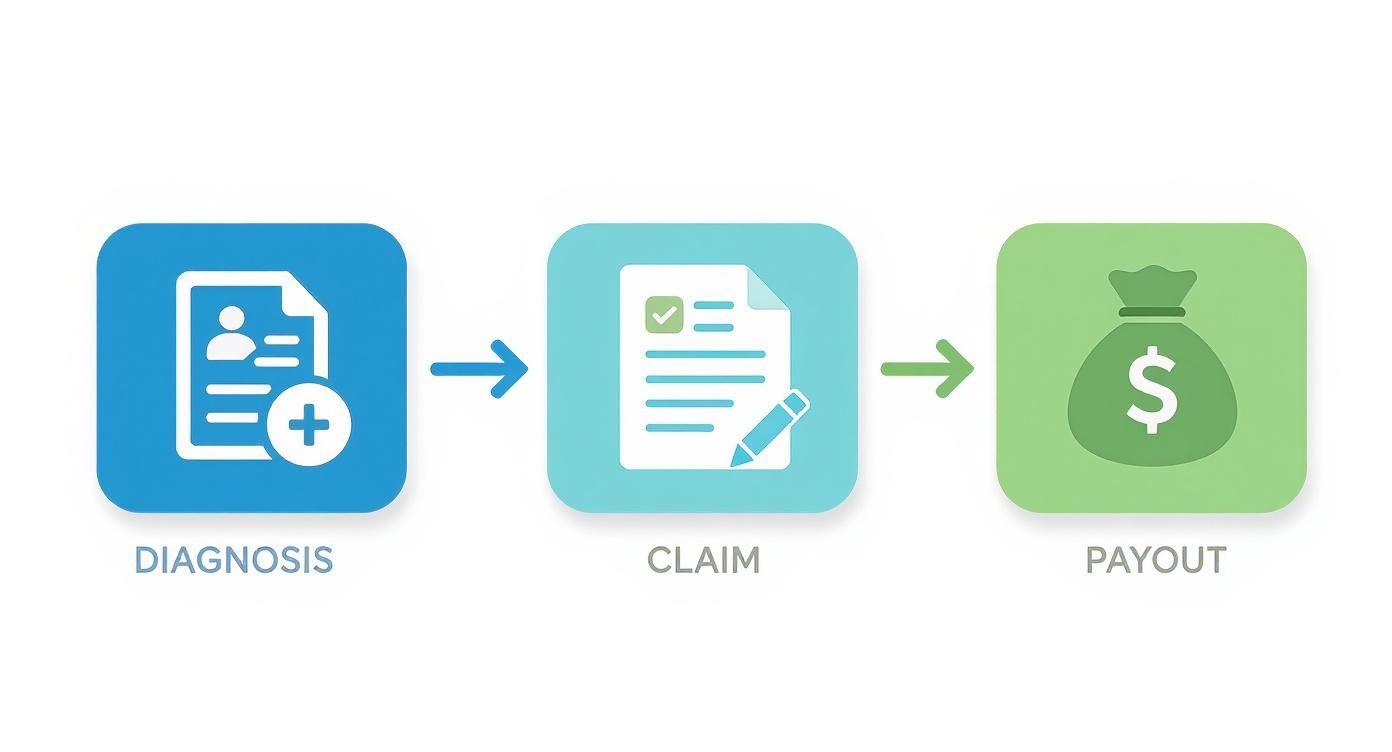
This visual breaks it down into three core steps: your diagnosis kicks things off, you file a claim, and then the lump-sum payment comes your way. Simple as that.
The Trigger: A Diagnosis and Claim
The whole policy hinges on one moment: a confirmed diagnosis of a covered illness. As soon as your doctor provides the official medical documentation, you can get the ball rolling and file a claim with your insurance company.
This part is straightforward. You’ll send in the required paperwork, like your physician’s report and other medical records. The insurer then reviews everything to make sure the illness matches the specific definition written in your policy.
Understanding Key Policy Terms
When you look at a policy, you'll see a few important terms. They aren't there to confuse you; they just set clear and fair rules for when your benefit gets paid.
Two of the most common ones are the waiting period and the survival period.
- Waiting Period: This is a brief window of time, usually 30 to 90 days, right after your policy starts. If you're diagnosed during this period, it won't be covered. It's there to prevent fraud from someone who buys a policy already knowing they're sick.
- Survival Period: This is the number of days, typically 14 to 30 days, you must live after your official diagnosis to receive the payout.
It's important to know these periods are standard across the industry. Understanding them upfront means no surprises later, so you know exactly what to expect during an already stressful time.
Once these periods have passed and your claim gets the green light, the insurance company sends your benefit. This is the moment the policy delivers on its promise.
Receiving Your Lump-Sum Payout
The final step is the best one: you receive a tax-free, lump-sum cash payment. This isn’t like health insurance, where money goes to doctors and hospitals. This cash comes directly to you, and there are absolutely no strings attached.
That flexibility is what makes critical illness insurance such a powerful tool. You can use the money to cover your mortgage, pay for treatments your health plan won't cover, or just replace your income so you can focus 100% on getting better. If you want to dig into the legal specifics, understanding critical illness policies from a legal perspective can offer more insight.
Ultimately, it’s all about putting financial control back in your hands, right when you need it most.
What Conditions Are Typically Covered

This is the big question, isn't it? Knowing exactly which illnesses trigger a payout is the most important part of understanding any critical illness policy. While every plan has its own specifics, most are built around a core group of serious, life-altering conditions.
These policies aren't for the common cold or a minor injury. They’re designed to be a financial lifeline for specific, named diagnoses that are often expensive to treat and can take you out of work for a long, long time.
The good news? The policies are usually very clear about what’s included. Let's break down what you can typically expect to see.
The Big Three: The Foundation of Most Policies
Almost every critical illness policy is built on what those of us in the industry call the "big three." These are the most common reasons people file a claim, and they form the bedrock of nearly every plan out there.
The big three are:
- Heart Attack: A sudden blockage of blood flow to the heart.
- Stroke: When the blood supply to part of your brain is interrupted or reduced.
- Invasive Cancer: The diagnosis of a malignant tumor that has started to spread.
These three conditions are so common that some companies even sell policies specifically for "cancer insurance" or "heart attack and stroke insurance." For many people, just knowing they have a financial buffer for one of these events is a huge source of comfort. When you consider that the American Stroke Association estimates the lifetime cost of a stroke can top $140,000, you start to see the massive financial gap this insurance can fill.
Beyond the Core: What Else Is Covered?
While the big three are standard, most modern policies protect you against a much wider range of health crises. Insurers often include a longer list of severe medical events that would also qualify you for that lump-sum benefit.
A crucial piece of advice: always read the fine print. Each policy has its own specific list of covered conditions and definitions. Before you decide, make sure you review the official documents to see exactly how each illness is defined.
Beyond the core three, you'll frequently find coverage for conditions involving major organs, neurological disorders, and catastrophic physical impairments.
These often include:
- Major Organ Transplant: Like a heart, lung, liver, or kidney transplant.
- Kidney Failure: Also known as end-stage renal disease, requiring regular dialysis.
- Paralysis: The complete and permanent loss of use of two or more limbs.
- Coma: A state of prolonged unconsciousness.
- Severe Burns: Typically covering a significant portion of the body.
- Loss of Sight, Speech, or Hearing: The complete and irreversible loss.
- Multiple Sclerosis (MS): Upon a definitive diagnosis.
- Motor Neuron Disease (ALS): Sometimes called Lou Gehrig's disease.
This isn't a complete list, and some of the more comprehensive plans might cover over two dozen different conditions. When you're comparing policies, the length and specificity of this list is one of the most important things to look at.
Tiered Benefits and Partial Payouts
Life isn't always black and white, and neither are illnesses. To account for this, some newer policies use a tiered structure that pays out different amounts based on the severity of your diagnosis.
For example, a plan might pay out 25% of your total benefit for an early-stage cancer diagnosis (like carcinoma in situ) or for a procedure like a coronary artery bypass. This gives you immediate financial help for a serious but less advanced condition without ending your policy. If that condition were to progress to invasive cancer later on, you could still receive the remaining 75% of your benefit.
This tiered approach adds a welcome layer of flexibility. It recognizes that even less severe diagnoses can bring on a flood of unexpected costs. Managing long-term health issues is tough, and it's vital to explore your options—you can learn more in our detailed guide to finding the right health insurance for chronic conditions. Tiered plans offer a way to get financial support at multiple points in your health journey.
Understanding Policy Exclusions and Limitations
It's one thing to know what your critical illness policy covers. It’s just as important—maybe even more so—to understand what it doesn’t. Every policy comes with its own set of rules and boundaries. Taking the time to read the fine print now is the single best way to avoid a heartbreaking surprise later on.
These rules aren’t there to trick you. They exist to keep policies affordable and focused on their real purpose: giving you a financial lifeline after a specific, life-altering health crisis. When you know the boundaries from the start, you can choose a plan with confidence.
Pre-Existing Conditions and Waiting Periods
One of the most common limitations you'll see involves pre-existing conditions. If you have a known health issue before you buy the policy, that specific condition might not be covered for a certain amount of time, or it could be excluded altogether. This is why being completely honest on your application is so important—it ensures your policy will be there for you when you need it most.
Most policies also have an initial waiting period, which is usually 30 to 90 days right after your coverage kicks in. If you get diagnosed with a covered illness during this short window, the policy won’t pay a benefit. It’s a standard feature that prevents someone from buying a policy only because they already suspect they're sick.
The Importance of Specific Medical Definitions
A critical illness policy doesn't just say it covers "cancer" or "stroke." It gets way more specific. Your diagnosis has to match the policy's exact medical definition to trigger a payout.
For example, a policy might state that a stroke must cause neurological damage that lasts for more than 30 days. Or it might not cover certain early-stage, non-invasive cancers (like carcinoma in situ) for a full payout, though some modern plans are starting to offer a smaller, partial benefit for these less severe diagnoses.
It's essential to realize that your doctor’s diagnosis and an insurance-defined diagnosis aren’t always the same thing. Reviewing these definitions in your policy document is the only way to know exactly what needs to happen for your coverage to activate.
This level of detail is a common reason a claim might be denied, even when you genuinely believe you have a covered condition. If you want to dive deeper into this topic, our guide on common insurance claim denial reasons can shed more light on it.
Other Common Exclusions and Limitations
Beyond the definitions, there are a few other standard exclusions to be aware of. A quick read-through of your policy documents will help you spot what isn't covered.
Typically, you won’t be covered for illnesses or injuries that are:
- Self-inflicted: Nearly all policies will deny claims for injuries or illnesses that were intentionally self-inflicted.
- Caused by illegal activities: If a condition is a direct result of you committing a felony or other illegal act, it won’t be covered.
- Related to high-risk activities: Things like skydiving or professional auto racing might be excluded unless you’ve added a special rider to your policy.
- A result of war: Illnesses or injuries that happen as a direct result of war (whether declared or not) are almost always excluded.
Understanding these boundaries helps you see the complete picture. It ensures the policy you choose is the one that will truly protect your family, with no unwelcome surprises.
Comparing Your Financial Safety Nets
Figuring out where critical illness insurance fits in with your other policies can feel like trying to solve a puzzle. You probably already have health insurance, maybe even life insurance. So, it's natural to ask, "Is this just another policy doing the same job?"
The short answer is a definite no. Each policy is a completely different tool, designed for a very specific purpose.
Think of your financial protection like a team of specialists working together. Your health insurance is the surgeon, paying the doctors and hospitals for direct medical treatments. Your disability insurance is the physical therapist, helping you get back on your feet financially by replacing your income.
Critical illness insurance is the crisis counselor. It hands you a flexible cash fund to manage the immediate chaos and overwhelming stress that a serious diagnosis brings. It’s crucial to see these policies not as competitors, but as collaborators. They work together to build a layered shield, protecting you from every angle of a health crisis.

To make it even clearer, let's break down how these different insurance types protect you.
Critical Illness vs. Other Insurance Types
| Insurance Type | Primary Purpose | When It Pays Out | How It Pays |
|---|---|---|---|
| Critical Illness Insurance | Covers non-medical costs and financial disruption from a major illness. | Upon diagnosis of a covered condition. | A one-time, lump-sum cash payment directly to you. |
| Health Insurance | Pays for medical care, treatments, and prescriptions. | When you receive medical services or fill prescriptions. | Directly to doctors, hospitals, and pharmacies. |
| Disability Insurance | Replaces a portion of your lost income if you can't work. | After a waiting period, once you're unable to work due to illness/injury. | Monthly payments, like a paycheck. |
| Life Insurance | Provides for your loved ones after your death. | After you pass away. | A lump-sum death benefit to your beneficiaries. |
Each one has a unique and vital role. They don't overlap; they complement each other to create a truly comprehensive safety net.
Critical Illness Insurance vs. Health Insurance
The biggest point of confusion is often between critical illness and health insurance. The key difference is simple: who gets the money, and for what?
Your health insurance pays for the medical side of things. The money goes straight to the hospital, the surgeon, or the pharmacy to cover your treatments. It’s built to handle the clinical costs of getting you better. For a deeper look at your options, it's worth checking out a comprehensive private healthcare comparison.
Critical illness insurance, on the other hand, pays cash directly to you. That tax-free, lump-sum payment is yours to use however you need it—no strings attached. It’s designed to cover all the life costs that pop up, like your mortgage, high deductibles, or travel expenses for specialized treatment.
Critical Illness Insurance vs. Disability Insurance
Disability insurance is another essential piece of the puzzle, but it works very differently. Its job is to replace a part of your income—usually 60-70%—if you get sick or injured and can't work. Those payments are typically monthly and continue for as long as you remain disabled.
A critical illness policy isn’t tied to your job status. It pays out that one big lump sum as soon as you’re diagnosed, whether you miss a single day of work or never go back again. This makes it perfect for handling the big, immediate costs, while disability insurance provides a steady income stream to get you through a long recovery.
Think of it this way: Disability insurance helps you pay your ongoing bills month after month. Critical illness insurance gives you a large sum of cash up front to handle the initial financial shock of the diagnosis itself.
Critical Illness Insurance vs. Life Insurance
Finally, let’s talk about life insurance. A life insurance policy is there to provide a death benefit to your family or beneficiaries after you're gone. Its main purpose is to protect them financially when you’re no longer there.
A critical illness policy is all about protecting you while you're still living. It’s a "living benefit" that gives you the financial resources to fight a health battle, focus on recovery, and keep your life on track. While we dig deeper into this in our guide on life insurance vs health insurance, the takeaway is clear: both are vital, but they serve two totally different purposes at different times in your life.
Who Should Consider This Type of Insurance
So, who actually needs critical illness insurance? It’s not a one-size-fits-all policy, but for some people, it’s an absolute game-changer. Think of it as a crucial layer of financial armor. The key is to look at your own life and ask: "What would happen if I got seriously sick tomorrow?"
If a major illness would throw your finances into chaos, this coverage is worth a serious look. For anyone with limited savings or a shaky support system, a lump-sum cash benefit is more than just money—it’s a lifeline. It covers all the things your regular health insurance won’t even touch.
People with High-Deductible Health Plans
High-deductible health plans (HDHPs) are great for keeping your monthly payments low. But there’s a trade-off. If something serious happens, you’re on the hook for thousands of dollars before your main coverage kicks in. A sudden diagnosis could mean you owe your maximum out-of-pocket amount instantly—sometimes $8,000 or more for a family.
A critical illness policy can drop the exact cash you need right into your bank account to cover that huge deductible and any other immediate costs. It stops a medical emergency from becoming a financial one.
Freelancers and the Self-Employed
When you work for yourself, you are your own safety net. There’s no paid sick leave, no employer-sponsored disability plan. If you can’t work, you don’t get paid. Simple as that. A major illness isn’t just about medical bills; it can shut down your entire income stream overnight.
Critical illness insurance gives you a tax-free lump sum to replace that lost income. It allows you to pay your mortgage, cover business expenses, and buy groceries while you focus on one thing: getting better.
For anyone without an employer safety net, this insurance acts as a personal crisis fund. It’s a way to create your own sick leave, ensuring your financial life doesn't collapse while you're focused on getting well.
Single-Income Families and Sole Breadwinners
When one paycheck supports the entire household, the thought of the primary earner getting sick is terrifying. That person's health is the foundation of the family's financial security. A critical illness diagnosis could crumble everything.
A policy payout provides a significant cash infusion right when it’s needed most. It gives the family breathing room to manage bills and daily expenses without having to make heartbreaking decisions during an already stressful time. It’s a trend that’s growing worldwide; the Asia-Pacific region is expected to see the fastest growth in this market as more people understand the risks. You can see how monthly premium plans have become the go-to choice by reading more about market trends on Precedenceresearch.com.
Your Questions, Answered
Alright, we’ve covered a lot of ground. But even after digging into how critical illness insurance works, a few practical questions are probably still bouncing around in your head. That’s completely normal.
Let’s tackle the most common ones right now, so you can move forward with total clarity.
How Much Coverage Do I Actually Need?
This is the big one, and the honest answer is: there's no magic number. The right amount is deeply personal and depends entirely on your financial picture. A great way to start is by figuring out what you’d need to cover your expenses for six months to a year if your income suddenly stopped.
Think through these key areas:
- Your Monthly Must-Haves: Add up your mortgage or rent, car payments, utilities, and grocery bills.
- Health Insurance Gaps: What’s your health plan's maximum out-of-pocket? That’s the most you'd have to pay for medical care in a year, and your policy could cover it.
- Lost Income: If you're a primary earner, how much income would your family lose while you recover?
Tallying these up gives you a solid baseline for a benefit amount that provides real security. For many people, a policy between $25,000 and $75,000 hits the sweet spot, offering a powerful safety net without breaking the bank.
Can I Get a Policy with a Pre-Existing Condition?
Yes, it’s often possible, but with a few "it depends" attached. When you apply, the insurance company will look at your medical history. If you have a pre-existing condition, they might handle it in a couple of ways.
They could offer you a policy but place an exclusion on that specific condition, meaning you couldn’t file a claim related to it. Or, they might approve you but with a higher premium. It all comes down to the specific condition and the insurer’s guidelines, so don’t assume you’re out of the running. It's always worth applying to see what they say.
Are the Benefits Taxable?
Here’s one of the best parts about this kind of coverage. When you buy an individual policy yourself and pay the premiums, the lump-sum benefit you receive is almost always tax-free.
That’s a game-changer. A $50,000 payout is a full $50,000 in your hands—not what's left over after the IRS takes a cut. It ensures the money is there to do exactly what you need it to do: protect your finances without creating a new tax headache.
This tax-free status maximizes the impact of your benefit, giving you every dollar of the funds when you need them most. It's one of the key features that makes critical illness insurance such a clean and effective shield during a health crisis.
Ready to see how affordable your financial safety net can be? At My Policy Quote, we make it simple to find a critical illness plan that fits your life and budget. Get your free, personalized quote today!