
Securing your family’s financial future starts with one simple, clear action: getting a few life insurance quotes. It's the moment you stop wondering and start seeing real numbers. This first step gives you a personalized snapshot of your options, showing potential costs and coverage based on your life, right now.
Why Getting Life Insurance Quotes Is Your First Step

Protecting your family can feel like a massive task, but it all boils down to this one manageable starting point. Getting a quote cuts through the confusing jargon and shows you exactly what it takes to find a policy that fits your family's needs.
Think of it as a financial mirror. Whether you're welcoming a new baby, paying down a mortgage, or saving for college, quotes translate those big life moments into real, understandable numbers. This guide is your roadmap to getting that done.
The Sooner, The Better
When it comes to life insurance, timing is everything. The simple truth is that the younger and healthier you are, the less you'll pay in premiums. Waiting can mean higher costs down the road as you get older or if health issues pop up.
Getting quotes now gives you a clear baseline, even if you're just exploring your options. Our guide on when to buy life insurance dives deeper into making this crucial decision.
The global life insurance market has ballooned to an estimated $3.1 trillion, a significant jump from $1.9 trillion just seven years ago. With the U.S. making up nearly 27% of that, it’s clear families everywhere rely on this as a core financial tool.
Your first quote isn’t a commitment; it’s an education. It's the moment you stop guessing about your family's financial security and start building a tangible plan to protect it.
What Quotes Actually Tell You
Requesting a quote does more than just give you a price. It forces you to sit down and ask the big financial questions that are so easy to put off. It’s not about a monthly payment—it’s about defining exactly what you want to protect.
This initial step helps you get crystal clear on:
- Income Replacement: How many years of your salary would your family need to live comfortably?
- Debt Coverage: What's the total on your mortgage, car loans, and credit cards?
- Future Goals: How much will you need for your kids' education or to secure your spouse's retirement?
By gathering these numbers, an abstract idea becomes a real, actionable plan. This is the foundation you'll need to compare policies apples-to-apples and make a choice you can feel confident about.
Gathering What You Need for an Accurate Quote

Here’s a simple truth: the life insurance quotes you get are only as good as the information you give. Think of this first step like a pre-flight check. Getting your details in order now not only saves you a ton of time but also helps you avoid frustrating surprises down the line.
An insurer’s job is to figure out risk. The clearer the picture you give them, the more spot-on your quote will be. It’s all about setting yourself up for success from the very beginning.
Your Personal and Family Health Profile
This is the big one. Insurers need a solid overview of your health because it’s the number one thing that determines your risk level and, ultimately, your premiums.
You’ll want to have a good handle on your medical history. This means any chronic conditions, past surgeries, and medications you’re currently taking. Be ready to share the diagnosis, treatment, and how things are now for each one.
It can feel a bit like a scavenger hunt, but it’s so important.
- Your Doctor's Information: Grab the name, address, and phone number for your primary doctor and any specialists you see.
- Recent Check-Ups: Jot down the date of your last physical and any key results, like your blood pressure or cholesterol numbers.
- Prescription Details: Make a quick list of all medications you take, including the dose and why you take it.
And don’t forget your family’s medical history—specifically your parents and siblings. Insurers are very interested in hereditary conditions like heart disease, cancer, or diabetes, since that can give them a clue about your own long-term health.
Lifestyle and Financial Information
Beyond your health, your day-to-day habits and financial situation really matter. These details give insurers the full story of the life they’re being asked to cover. Honesty is everything here. If you fudge the facts, it could lead to a claim being denied later on.
For example, smoking or using tobacco is a huge factor and can seriously drive up your premiums. Your driving record will also be looked at, especially any recent DUIs or major violations. Even your hobbies are part of the equation—if you're a rock climber or scuba diver, insurers will see that as a higher risk.
Key Takeaway: Every little detail, from your job to what you do on weekends, helps an underwriter build your risk profile. The more organized and accurate your information is, the more dependable your life insurance quotes for families will be.
Finally, you’ll need to paint a clear financial picture. This isn't about judging your spending; it’s about making sure the coverage amount you’re asking for makes sense.
Be ready to share:
- Your annual income (and your partner's, if you're applying together).
- Your total debts (think mortgage, car loans, student loans, credit cards).
- A general idea of your net worth, including savings and investments.
This information helps the insurer see that the death benefit you want truly matches your family's financial needs. To get a better feel for the kinds of questions that will come up, take a look at our guide on what a life insurance advisor will ask you.
Things like family health history and life expectancy are also key for an accurate quote. For a deeper dive, especially if you're looking at specific policy types, you might find it helpful to review a complete guide to joint life expectancy tables.
Finding and Vetting Your Quote Sources
Now that you have your family’s information organized, you’re ready to start getting actual life insurance quotes. This is where the rubber meets the road, and you have three main paths to choose from. Each one comes with its own pros and cons.
Your main options for gathering quotes are:
- Going directly to an insurance company.
- Working with an independent insurance broker.
- Using an online comparison tool.
Let’s break down how each one works so you can find the best fit for your family’s unique situation, whether you’re a busy parent or someone with a more complex health history.
Going Directly to the Insurance Carrier
Contacting a big-name insurance company is often the first thing people think of. You can go to their website or call one of their captive agents—an agent who only sells products for that single company. The big plus here is that you're dealing directly with the source, and their agents know their specific policies inside and out.
But there's a major catch. A captive agent’s job is to sell their company's product. They have zero incentive to tell you if a competitor is offering a better rate or a policy that fits your family’s needs more closely. You might walk away with a decent policy, but you'll be left wondering if you could have gotten a great one.
The Independent Broker Advantage
Think of an independent broker as your personal shopper for insurance. They aren't tied to any one company. Instead, they work with multiple carriers and can shop your application around to find the best policy at the most competitive price.
This is a game-changer for families with unique circumstances—like a pre-existing health condition, a high-risk job, or the need for a very large policy. A good broker knows which carriers are more forgiving about certain health issues or offer better rates to non-smokers, saving you a ton of time and money.
Insider Tip: When you’re checking out a broker, ask them how many insurance carriers they work with. Someone appointed with a dozen or more companies can offer a much wider net of options than a broker who only represents two or three.
The key is to find a trustworthy broker who puts your family’s needs before their commission. Look for someone with solid reviews who genuinely wants to understand your financial goals before recommending anything.
Using Online Comparison Tools
Online quote tools are, by far, the fastest way to get a ballpark idea of what you might pay. Pop in your basic info, and you can get multiple estimates in just a few minutes. Their biggest selling point is speed and convenience.
The downside? These tools often lack a human touch. The initial quote is just an estimate spit out by an algorithm, and it might not account for the little details of your health or lifestyle. The price you see online can change—sometimes dramatically—after the official underwriting process, where the insurer takes a deep dive into your medical records.
Be careful, too, as some quote websites are just lead-generation machines. They might sell your contact information to a bunch of different agents, and your phone will start ringing off the hook. A reputable tool will be upfront about how they use your data and connect you with licensed pros who can offer real advice.
The life insurance market has been buzzing lately. Following the pandemic, more families than ever started prioritizing financial protection, leading to record-high policy sales in the U.S. not seen in over 40 years. With premium income remaining high, it's a competitive market where families are actively looking for security. You can discover more insights about the evolving U.S. life insurance market and what's ahead for 2025.
How to Compare Quotes Beyond the Price Tag

You’ve got a handful of life insurance quotes for families on your screen. Your eyes probably jump straight to the monthly premium, looking for the lowest number. It’s a natural first step, but stopping there is a huge mistake.
While your budget absolutely matters, the cheapest policy is rarely the best one. The real work starts now: digging into the details to understand what each of those numbers truly means for your family’s future.
Looking at More Than Just the Premium
Think of a life insurance policy as more than just a price—it’s a promise. And not all promises are created equal. Two quotes for the same coverage amount can offer wildly different levels of real-world protection. You need to look at the whole picture.
Grab a piece of paper or open a simple spreadsheet. Lay out the key features of each quote side-by-side so you can compare them apples-to-apples.
This simple step forces you to look past the monthly cost and focus on what you're actually getting. Here’s what to line up:
- Death Benefit Amount: Is it exactly what you asked for in every quote?
- Term Length: Does it cover your family for the right number of years?
- Policy Type: Term, whole, or universal life? Make sure they match.
- Monthly Premium: The price you’ll pay to keep that promise alive.
- Insurer Financial Strength: This is a big one. Can the company actually pay the claim?
This organized approach keeps you from getting lured in by a low price that might hide some serious weak spots in the coverage.
The Importance of Insurer Financial Strength
This is one of the most overlooked—and most critical—parts of comparing quotes. You're buying a promise that could be cashed in decades from now. You need to be sure the company writing that check will still be strong and stable.
Independent agencies like A.M. Best, Moody's, and Standard & Poor's rate the financial health of insurance companies. Think of it as a credit score for the insurer.
An insurer with a high financial strength rating (A+ or A++, for example) offers a powerful layer of peace of mind. It means they have a long, stable history and can meet their promises to families like yours, even when the economy gets rocky.
Don't just assume a big brand name means they're financially sound. It takes just a few minutes to look up the ratings for each carrier you're considering. It’s a quick check that protects your family from a potential nightmare down the road.
Decoding Riders and Policy Features
This is where the fine print can make all the difference. Riders are optional add-ons that let you customize a policy. Often, a slightly higher premium is due to a valuable rider that a cheaper quote left out. Want to dive deeper? Check out our guide explaining what is a rider on life insurance.
For families, these riders can be lifesavers:
- Waiver of Premium Rider: If you become totally disabled and can't work, the insurer pays your premiums for you. Your coverage stays active.
- Accelerated Death Benefit Rider: Lets you access part of your death benefit early if you're diagnosed with a terminal illness.
- Child Term Rider: Adds a small amount of coverage for your kids, which can often be converted into their own permanent policy later on.
A policy with a built-in Waiver of Premium rider might cost a few extra dollars, but it could be the one thing that keeps your family's safety net intact if you ever face a long-term disability.
Sample Life Insurance Quote Comparison for a Family
To see how this plays out in the real world, let's look at two hypothetical quotes for a young family needing a $750,000, 20-year term policy.
| Feature | Quote A (Insurer X) | Quote B (Insurer Y) |
|---|---|---|
| Monthly Premium | $45 | $52 |
| A.M. Best Rating | A (Excellent) | A++ (Superior) |
| Waiver of Premium | Not included | Included |
| Accelerated Benefit | Terminal illness only | Terminal & Chronic illness |
| Conversion Option | Available for first 10 years | Available for entire term |
At first glance, Quote A looks better. It's cheaper. But when you dig in, you see the real story.
Quote B costs $7 more per month, but that extra money buys you coverage from a top-rated insurer, a critical disability waiver, and more flexible options for the future. For most families, that's not just a better deal—it's smarter protection. This is what it means to look beyond the price tag.
Practical Ways to Lower Your Life Insurance Premiums
Finding a great life insurance policy that actually fits your budget is the goal, right? You want solid protection for your family without breaking the bank. While your final premium is based on a whole bunch of risk factors, you have way more control over that number than you might think.
Let’s be honest, the single biggest lever you can pull is time. Insurers absolutely love predictability. When you apply in your late 20s or early 30s, you represent a longer, more predictable timeline, and they reward that with much lower rates. Locking in a policy then is almost always dramatically cheaper than waiting until your 40s, and you get to keep that low rate for the entire term.
Translate Healthy Habits into Lower Premiums
Beyond your age, your current health is your most powerful tool for getting a better rate. Insurers see healthy living as a massive plus, and even small, positive changes can lead to big savings over the life of a policy. Taking charge of your health is one of the best ways to get more affordable life insurance quotes for families.
If you're a smoker, quitting is the most impactful thing you can do. Full stop. Rates for smokers can be two to three times higher than for non-smokers. Most companies want to see you tobacco-free for at least a year to qualify for non-smoker rates, but the savings make it more than worth the effort.
Other health improvements that really move the needle include:
- Managing Your Weight: Getting into a healthy Body Mass Index (BMI) range can bump you into a better, cheaper rate class.
- Controlling Blood Pressure: If you have high blood pressure, showing that it's well-managed with medication tells the underwriter you're on top of it.
- Lowering Cholesterol: Just like with blood pressure, having your cholesterol under control shows responsible health management and can improve your quote.
Think about it like this: a healthy, 35-year-old non-smoker looking for a $500,000, 20-year term policy might pay around $25-$35 per month. A smoker of the same age could get quotes starting at $80-$100 per month for the exact same coverage. That’s a difference of over $15,000 over the life of the term.
Align Your Policy with Your Actual Needs
It’s so easy to fall into the "more is better" trap with life insurance, but over-insuring is one of the most common ways families end up overpaying. The secret is to match your policy's term length and features directly to your real-life financial obligations.
Take a look at your biggest debts. If your mortgage will be paid off in 22 years and your youngest kid will be done with college in 18, a 20-year term policy is probably a perfect fit. Choosing a 30-year term in that situation means you'd be paying for a full decade of coverage you might not even need.
And don't forget to be selective with riders. While some add-ons, like the waiver of premium, can be a lifesaver for families, others might just be unnecessary costs. Go through each optional feature and ask yourself if its benefit truly justifies the extra monthly premium. This thoughtful approach ensures you're not paying for bells and whistles you'll never use. For more tips on finding a budget-friendly policy, check out our guide to affordable life insurance.
More and more families are seeing the value in this kind of planning. The global life insurance market saw 10.4% growth in a recent year, with North America leading the pack at 14.4%. That surge just goes to show how critical this financial safety net has become. You can learn more about the global insurance market trends from Allianz.
Answering Your Top Questions About Family Life Insurance
You've done the research and compared the quotes. Now what? It's completely normal to have a few last-minute questions bubbling up before you commit. These are the practical, "what-if" thoughts that help you know you're making the right call. Let's clear up those final uncertainties so you can move forward with total confidence.
How Much Life Insurance Does My Family Actually Need?
You’ve probably heard the old rule of thumb: get 10-12 times your annual income. While it’s not a bad place to start, it’s far from precise. Your family is unique, and your coverage should be too. A much better approach is to figure out your family’s specific financial needs so you’re not paying for too much or, worse, leaving them with too little.
Think of it as a simple math problem. First, add up all the big financial responsibilities your family would face without you. Then, subtract the assets they could use to cover those costs. What's left is your real coverage gap.
Here’s how to break it down:
- Tally Your Obligations: Start with the big ones—your mortgage, car loans, credit cards, and any student debt. Then add in future costs like your kids' college tuition and, most importantly, the income your family would need to replace for a certain number of years.
- Subtract Your Assets: Now, look at what you already have. Subtract your savings, investments (outside of retirement funds), and any current life insurance you might have through work.
That final number is a personalized, realistic coverage target built around your family’s actual life.
Should Both My Partner and I Get a Policy?
For most families with two parents, the answer is a resounding yes. It’s a classic mistake to only insure the primary earner. That thinking completely misses the massive economic value a stay-at-home parent or a lower-earning spouse contributes every single day.
Just imagine the new expenses a surviving parent would suddenly have to cover: childcare, cleaning, cooking, driving kids around. A policy for the non-working or lower-earning partner is designed to cover these exact costs, preventing a double-hit of emotional and financial turmoil.
The chart below shows just how much a few smart choices can affect what you’ll pay for this critical protection.
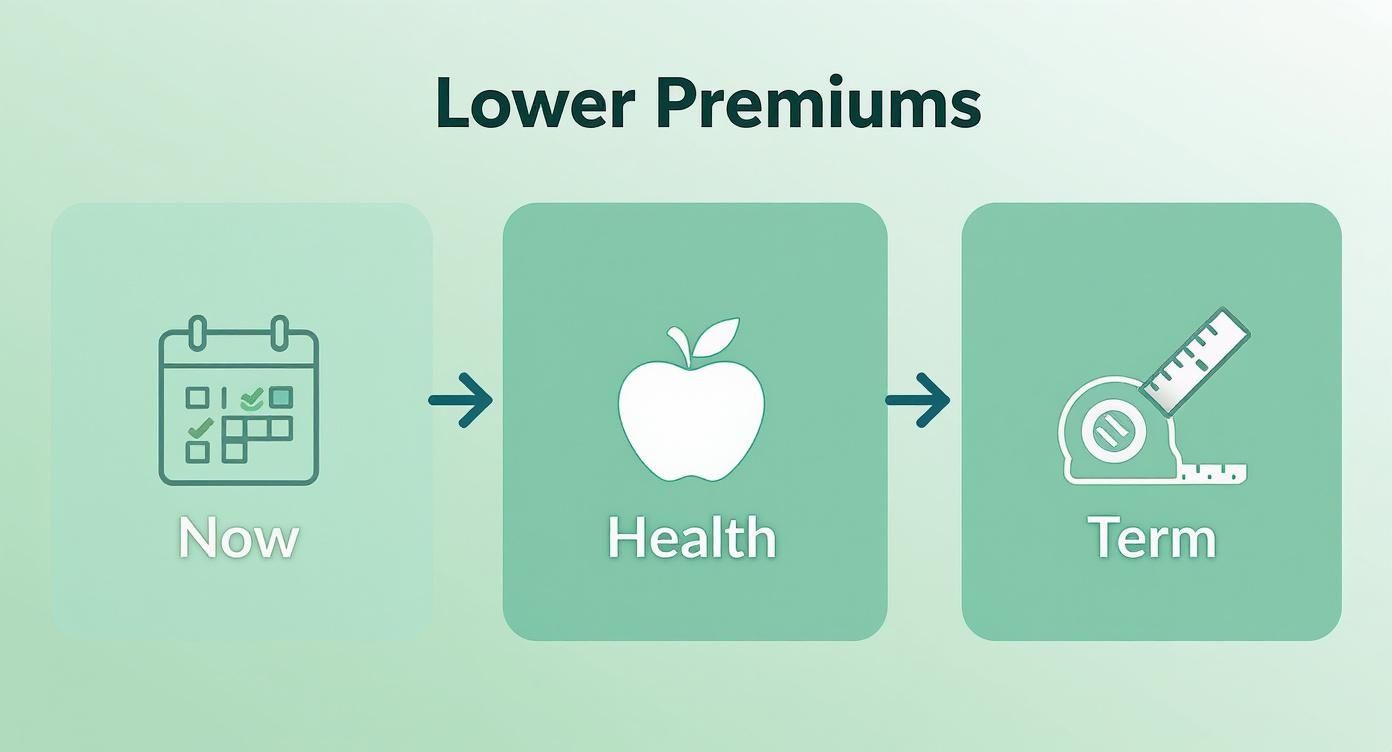
As you can see, acting sooner rather than later, focusing on your health, and picking the right term length are the clearest paths to making your premiums more affordable.
Is Term Life or Whole Life Insurance Better for Families?
For the vast majority of families, term life insurance is the clear winner. It's straightforward, affordable, and designed to cover you for a specific amount of time—like 20 or 30 years. This lines up perfectly with the years your financial burdens are the heaviest.
Think about it: your biggest financial needs are while you’re paying off a mortgage and raising your kids. Term life is built to protect you during that exact window.
Whole life insurance is a different beast entirely. It’s a permanent policy that mixes a death benefit with a cash-value savings account. Because of that, it's far more expensive and is usually better for complex estate planning or situations involving lifelong dependents—not the income replacement most families need.
Can I Get a Policy with a Pre-Existing Health Condition?
Yes, you often can. The most important thing is to be 100% honest on your application. Insurers deal with applicants who have managed conditions like diabetes, high blood pressure, or past health issues all the time.
The process will be more thorough, and your premiums will probably be higher than they would be for someone in perfect health. This is where an independent broker becomes invaluable. They know which insurance companies are more lenient with certain conditions and can shop your specific case around to find you the best possible rate.
As you finalize your plans, it's also smart to think about the bigger picture, like understanding how guardianship impacts life insurance policies if you have minor children. Making sure all these pieces work together is key to truly protecting your loved ones.