
In most cases, you don’t have to do a thing. Your doctor or hospital sends claims directly to Medicare for you, and that’s that. Simple.
But every now and then, you might find yourself in a situation where you need to know how to submit a claim to Medicare on your own. This usually happens if you see a provider who doesn’t accept Medicare assignment or if you have a medical emergency while traveling abroad.
Your Quick Guide to Submitting a Medicare Claim

The whole Medicare claims process can feel a bit intimidating, but it really just boils down to one question: who’s filing the paperwork? For almost everything you do, the answer is your healthcare provider. The system is designed to keep you out of the administrative weeds.
When you visit a doctor, hospital, or any other provider who "participates" in Medicare, they are legally required to file the claim for you. It’s part of their agreement with Medicare. The entire process is handled electronically behind the scenes. The first you’ll hear of it is when your Medicare Summary Notice (MSN) arrives in the mail after it’s all been processed.
When You Have to Take the Lead on Filing
So, when does the ball land in your court? There are a few specific, though less common, scenarios where you’ll need to step in and file the claim yourself to get reimbursed.
- Non-Participating Providers: Some doctors are enrolled in Medicare but are considered "non-participating." This just means they haven't agreed to accept the Medicare-approved amount as full payment. They might ask you to pay the entire bill upfront, leaving you to file a claim with Medicare to get your portion back.
- Providers Who Have Opted Out: A very small number of doctors decide to opt out of the Medicare system entirely. If you see one of these providers, you’re responsible for the full bill. In this case, neither you nor the doctor can submit a claim to Medicare for the service.
- Foreign Travel Emergencies: Original Medicare sometimes covers emergency care you get outside the U.S., but it’s a special case. You will always have to pay the foreign hospital or clinic first, then submit an itemized bill to Medicare yourself for reimbursement.
Navigating these exceptions is key. Knowing whether your provider participates in Medicare directly affects not only your out-of-pocket costs but also your role in the whole claims process. It pays to ask before you get treated.
Beneficiary vs. Provider Filing: A Quick Comparison
To make it easier, think of it this way: providers handle the routine claims, while you handle the exceptions. Getting a handle on your specific situation is the first step. For a broader view, our comprehensive Medicare planning guide can help you understand these nuances as part of your overall healthcare strategy.
This table breaks down the two main filing paths so you can see the differences at a glance.
Medicare Claim Submission At a Glance Beneficiary vs Provider
| Aspect | Beneficiary-Submitted Claim | Provider-Submitted Claim |
|---|---|---|
| Typical Scenario | Provider doesn't accept Medicare assignment; foreign medical emergencies. | Provider participates in Medicare or accepts assignment. |
| Required Form | Patient's Request for Medical Payment (CMS-1490S). | CMS-1500 (for professional services) or UB-04 (for facility services). |
| Filing Responsibility | You, the beneficiary. | Your doctor, hospital, or medical supplier. |
| Payment Flow | You pay the provider upfront, then seek reimbursement from Medicare. | Medicare pays the provider directly; you are billed for any remaining costs. |
Ultimately, understanding who is responsible for what will save you a lot of time and potential headaches down the road.
When You Might Need to File a Medicare Claim Yourself
Most of the time, Medicare works quietly in the background. Your doctor's office submits the bill, Medicare pays its share, and you just handle the co-pay or deductible. Simple. But every once in a while, you'll find yourself in a situation where the paperwork lands squarely in your lap.
It’s not the norm, but knowing when and how to file a claim yourself is a powerful skill. It can save you from big headaches and even bigger out-of-pocket costs.
The most common reason this happens? You see a doctor who doesn’t “accept assignment.” In simple terms, this means they’re enrolled in Medicare but haven’t agreed to accept Medicare's approved amount as full payment.
They might legally charge you more than the Medicare rate, and they’ll almost always ask you to pay the entire bill upfront. That means you pay the doctor, and then it’s on you to file a claim with Medicare to get reimbursed for their share.
Navigating Different Provider Relationships
Who files the claim—and how much you’ll end up paying—all comes down to the kind of relationship your doctor has with Medicare. It’s crucial to understand the difference.
- Participating Providers: These doctors are the easiest to work with. They always accept Medicare assignment, which means they file the claim for you and only bill you for your standard coinsurance and deductible. No surprises.
- Non-Participating Providers: This is the middle ground. These providers are in the Medicare system but can decide whether to accept assignment for each service. If they don’t, you're paying upfront and filing the claim yourself.
- Opt-Out Providers: A small handful of doctors opt out of Medicare entirely. If you see one, you pay for everything yourself. You can’t file a claim, and neither can they. It’s a completely private transaction.
My best advice? Before you even make an appointment with a new provider, ask one simple question: "Do you participate in Medicare?" This can save you a world of hassle later on.
This same logic applies to durable medical equipment (DME). If you buy a walker or get oxygen from a supplier who isn’t enrolled in Medicare or won’t accept assignment, you’ll be paying the full cost and submitting the paperwork for reimbursement.
Special Cases That Require Your Action
Beyond your doctor's status, a few other oddball situations can put you in charge of filing. They don't come up often, but you need to know what to do if they do.
A big one is getting emergency care while traveling outside the U.S. Original Medicare rarely covers foreign travel, but in a few very specific emergency scenarios, it might. If your situation qualifies, you must pay the foreign hospital directly and then submit a detailed, itemized bill to Medicare to get reimbursed.
Certain services can also put you in the driver’s seat. For instance, it’s vital to understand the rules for Medicare home care eligibility and coverage to ensure your services are covered. If there’s any gray area, you might end up managing the claim to make sure it gets processed the right way.
The Role of Medicare Advantage Plans
If you have a Medicare Advantage (Part C) plan, the rules change completely. These are private plans, and they operate with their own provider networks, like HMOs or PPOs.
Step outside that network for non-emergency care, and you’ll likely pay more. You might also have to file the claim yourself directly with your insurance company—not with Original Medicare.
And these plans are becoming incredibly common. In 2025, an estimated 54% of Medicare beneficiaries will be enrolled in an Advantage plan. That’s a massive leap from just 19% back in 2007. This shift makes it more important than ever to know your specific plan's rules, because their claims process is often very different from Original Medicare.
Always keep your plan’s "Evidence of Coverage" document handy. It’s your rulebook and will tell you exactly how, when, and where to submit a claim.
Filing Your Own Medicare Claim: A Practical Walkthrough

So, you’ve found yourself in a situation where you need to file your own Medicare claim. At first glance, the official paperwork can look intimidating, but don't let it throw you. It’s much more straightforward than it seems.
The main tool for this job is the Patient's Request for Medical Payment form, also known as CMS-1490S. Think of this form as your way of telling Medicare exactly what happened: who you are, what service you got, why you needed it, and what you paid. Your goal is to fill in the details clearly and attach the right proof. Let’s break down how to do it, without all the confusing jargon.
Getting Your Hands on the CMS-1490S Form
First things first, you’ll need a copy of the CMS-1490S form. The easiest way to get it is by downloading it directly from the Medicare website. I always recommend grabbing the most current version right before you start—it helps avoid any frustrating processing delays.
Once you have it, you'll see it’s broken down into a few main sections. Part one is all about you. This is where you’ll put your personal information, and you need to make sure it matches your Medicare card exactly.
- Your Medicare Number: This is the most important piece of the puzzle. Double-check every letter and number. You’ll find it on your red, white, and blue Medicare card.
- Your Name and Address: Use your full legal name and your current mailing address. This is where they’ll send your Medicare Summary Notice (MSN) and, hopefully, a reimbursement check.
- Signature and Date: Don't skip this! An unsigned form is a guaranteed rejection, which means you have to start the whole process over.
Here’s a little tip from experience: fill out the form on your computer if you can. Typing everything ensures it’s easy to read, which can seriously speed things up and cut down on errors from someone misreading your handwriting.
Explaining the Medical Service You Received
The next part of the form is where you get into the nitty-gritty of the medical care you paid for. This is where that bill from your doctor or supplier comes in handy. Be precise—it’s your best friend here.
You’ll need to list each service or supply separately. Yes, if you had multiple appointments or got different pieces of equipment, each one needs its own line. It feels tedious, I know, but it’s crucial for an accurate review.
For every service, you have to include:
- The date of the service.
- The location (doctor’s office, clinic, etc.).
- A clear description of the illness or injury that made the service necessary.
- The name and address of the doctor or supplier.
- The total amount you paid.
This is where knowing the basics of what a health insurance claim is really pays off. You’re essentially just giving Medicare structured proof so they can process your request for payment.
Putting Together Your Supporting Documents
The form itself is just one part of the equation. You also need to back up your request with evidence. This means sending copies of all the relevant paperwork. Never, ever send your originals.
Here’s a quick checklist of what you’ll need:
- The Itemized Bill: This is critical. It’s not just a statement with a total balance. A proper itemized bill lists every single service, procedure, or supply you got, along with the specific cost for each one.
- Proof of Payment: You have to show Medicare you’ve already paid the bill. A copy of a canceled check (front and back), a credit card receipt, or a provider statement showing a zero balance will do the trick.
Before sealing the envelope, make one final set of copies—of the completed form and all the documents you’re attaching—for your own records. Trust me, having a backup gives you peace of mind in case anything gets lost in the mail.
Finally, mail the whole package to the Medicare contractor for your state. The right mailing address is conveniently listed on the second page of the CMS-1490S form, so there’s no need to hunt for it.
A Provider’s Guide to the Medicare Claim Process
While patients sometimes have to file their own claims, the reality is that the overwhelming majority of Medicare claims come straight from you—the healthcare provider. In your practice, submitting a claim to Medicare isn’t just an administrative chore. It’s the very heart of your revenue cycle.
Get it right, and you get paid quickly. A clean, accurate claim sails through the system. But a flawed one? That leads to delays, denials, and a direct hit to your bottom line.
Unlike the simple CMS-1490S form for beneficiaries, providers use much more detailed forms. The one you need depends entirely on the service you provided.
- The CMS-1500 Form: This is the workhorse for individual physicians, practitioners, and suppliers handling professional services. Think office visits, specialist consultations, and outpatient procedures.
- The UB-04 Form (CMS-1450): This one is for institutions. Hospitals, skilled nursing facilities, and ambulatory surgery centers use it to bill for their facility charges—things like room and board, operating room time, and equipment usage.
But just filling out the form is the easy part. The real make-or-break moment comes down to the details you put inside it.
The Critical Role of Accurate Coding
Every single service you perform has to be translated into the universal language of medical codes. This isn't just important; it's non-negotiable.
A simple coding error isn't just a mistake—it can trigger audits or even accusations of fraud. To give you an idea of the stakes, in 2024, the Department of Justice's settlements and judgments under the False Claims Act topped $2.9 billion. That number underscores the serious financial risk of improper billing.
Your claims will rely on three main code sets:
- CPT (Current Procedural Terminology) Codes: These describe the specific medical, surgical, or diagnostic services performed.
- HCPCS Level II Codes: These cover things CPT codes don't, like ambulance services, prosthetics, or durable medical equipment.
- ICD-10-CM Codes: These are the diagnosis codes. They answer the crucial question: why was the service medically necessary?
A mismatch between the procedure (CPT) and the diagnosis (ICD-10) is one of the fastest tickets to a denial. For example, if you bill for a complex cardiac stress test but list the diagnosis as a routine check-up, you've created a red flag that will stop your claim in its tracks.
The codes must tell a logical, consistent story. The diagnosis justifies the procedure. If that story doesn't make sense to the Medicare Administrative Contractor (MAC) reviewing it, the claim will be rejected.
Meeting the Timely Filing Deadline
Medicare plays by a strict clock. You have exactly one calendar year—12 months—from the date of service to get your claim submitted. This is the Timely Filing Limit.
Miss that deadline by even one day, and the claim is automatically denied. There’s no appeal. This rule is absolute, with almost no exceptions. Missing this window means you can’t bill the patient, either. It’s a complete loss of revenue for that encounter.
Navigating Secondary Insurance and Coordination of Benefits
Many of your Medicare patients will have a secondary insurance plan, like a Medigap policy, a company retiree plan, or Medicaid. When they do, you must follow the correct Coordination of Benefits (COB) rules.
For beneficiaries aged 65 and older, Medicare is almost always the primary payer. That means you send the claim to Medicare first. After Medicare processes it and pays its share, the claim is either automatically "crossed over" to the secondary insurer or you’ll get a Remittance Advice to forward to them yourself.
Billing the secondary plan before Medicare has paid is a classic mistake. It guarantees an instant denial and a mess of paperwork to untangle.
Setting Up a Flawless Front-End Process
The best way to guarantee clean claims is to stop errors before they even start. Your front-end process—what happens the moment a patient checks in—is your first and best line of defense.
- Verify Eligibility Every Single Time: Check a patient’s Medicare eligibility and any secondary coverage at every visit. Don't assume anything. Coverage can and does change.
- Capture Accurate Demographics: A misspelled name or a typo in the Medicare Beneficiary Identifier (MBI) is enough to cause an immediate rejection. Double-check it all.
- Secure All Necessary Authorizations: Before performing a service, confirm if it requires prior authorization. If it does, get it squared away beforehand.
Finally, remember that every piece of claims documentation is loaded with Protected Health Information (PHI). When you're submitting these claims, you're handling sensitive data. It’s crucial to know how to ensure HIPAA compliance when faxing healthcare documents or transmitting files electronically. Strong internal protocols aren't just good for getting paid—they’re essential for your legal protection.
What to Do After You Submit Your Claim
Filing your Medicare claim is a huge step, but it's really just the beginning. Once the paperwork is sent, you enter a waiting game. Knowing how to track your claim’s progress is the key to staying in control and avoiding any unwelcome financial surprises.
For beneficiaries, your best friend in this process is your MyMedicare.gov account. This online portal is a direct window into your claim's journey. Log in, and you can see a running list of your claims, their status, and the final decision. It’s hands-down the fastest way to stay in the loop.
Providers have a slightly different path. They usually rely on an electronic clearinghouse or specialized practice management software to keep an eye on things. These tools give them real-time updates as a claim moves through the system, from "received" to "paid" or, sometimes, "denied."
Decoding Your Medicare Summary Notice
Sooner or later, you'll get the official word in a document called a Medicare Summary Notice (MSN). If you have Original Medicare, this will land in your mailbox every three months. It's important to remember: the MSN is not a bill. Think of it as a detailed report card for all the services and supplies billed to Medicare in your name during that quarter.
Learning to read your MSN is a crucial skill. It clearly breaks down:
- What the provider originally billed.
- The amount Medicare approved for that service.
- What Medicare actually paid out.
- The amount you might still be responsible for.
If a claim gets denied, the MSN will include a reason code and a short explanation. This is your first and most important clue for figuring out what went wrong and what to do next.
This diagram shows the first few steps a provider takes. Getting these right from the start is essential to prevent a denial later on.
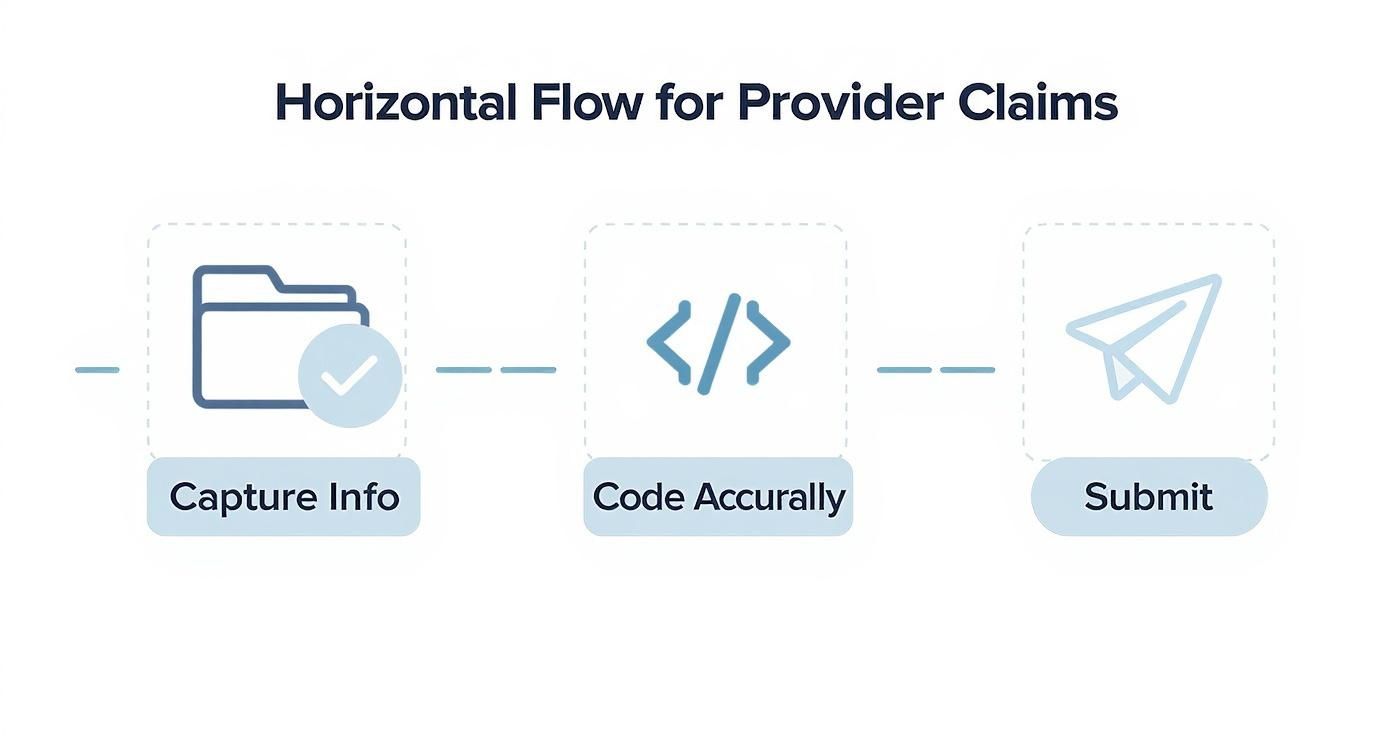
As you can see, accurate info and correct coding are everything. Small mistakes made here are often the primary reason claims get rejected.
What to Do When Your Claim Is Denied
Seeing "denied" on your MSN is frustrating, but don't panic. It’s definitely not the end of the road. In fact, a denial is often just the beginning of a new conversation—the appeals process.
Even with today's automated systems, denials are common. A 2025 report found that 41% of healthcare providers see at least one in ten claims denied. And get this: 10% of those denials are caused by simple data entry mistakes made when a patient first checks in. It just goes to show how tiny errors can create big headaches.
Common reasons for a denial include:
- The service wasn't deemed "medically necessary."
- The provider used the wrong codes.
- The claim was missing documents or a required prior authorization.
If you believe the denial was a mistake, you have every right to appeal. The Medicare appeals process is a formal, five-level system designed to give you several chances to make your case.
Don't let an initial denial discourage you. A surprising number of denials are overturned on appeal, especially when you can provide strong evidence that the service was necessary for your health.
Your first move is to request a Redetermination. You must file this request within 120 days of the date printed on your MSN. You’re essentially just asking your Medicare Administrative Contractor (MAC) to take a second look. Be sure to include any new evidence you have, like a letter from your doctor explaining why the treatment was so important.
If that doesn't work, you can move on to the next level. You can get familiar with every stage by reading our comprehensive guide on the Medicare appeals process. The most important thing is to stay persistent and never miss a deadline.
Common Questions About Submitting Medicare Claims
Even with a solid grasp of the basics, filing a Medicare claim can throw you a curveball. The process has its quirks, and sometimes you just need a straight answer to handle things with confidence. Let's dig into some of the most common questions people run into.
One of the biggest concerns is always about timing. You’ve got a decent window to get your claim in, but it’s not endless. For Original Medicare, you must submit your claim within one calendar year (12 months) of the date you received the service. If you miss that deadline, Medicare will deny the claim, period.
Can I Submit My Medicare Claim Online?
This is a huge point of confusion, and the answer depends on who you are.
If you’re a beneficiary filing your own claim with the CMS-1490S form, the answer is still no. You have to go the old-school route: fill out the paper form, attach your itemized bills, and mail everything to the correct Medicare Administrative Contractor (MAC). You can always find the right mailing address on the form itself.
Providers, on the other hand, live in the digital world. The vast majority of professional claims are sent electronically through secure online portals. It’s faster, cuts down on errors, and allows for real-time tracking, which is why it’s become the standard.
For a deeper look into other common questions, you can explore our comprehensive FAQ about Medicare for more detailed answers.
What Is the Most Common Reason a Claim Is Denied?
Claim denials are a frustrating reality, but they almost always happen for a specific reason. Unfortunately, with the growing complexity of healthcare billing, the average denial rate has recently climbed past 15%. A staggering 38% of those denials are due to simple coding errors, while another 22% come from missing prior authorizations. You can get more details on this trend from a great analysis on why medical claims are denied more often in 2025.
Here are the top culprits that get a claim kicked back:
- Coding Errors: Using the wrong CPT or ICD-10 code—or a mismatch between the diagnosis and the procedure—is an instant red flag for Medicare.
- Missing Information: A claim that’s missing a Medicare number, date of service, or provider details will be rejected right away.
- No Prior Authorization: Many procedures and services require pre-approval. If you skip this step, it’s an automatic denial.
- Filing Too Late: Submitting the claim more than one year after the service date guarantees it will be rejected.
Assigned vs Non-Assigned Claims
Understanding the difference between an "assigned" and "non-assigned" claim is one of the most important things you can do to manage your healthcare costs. It all comes down to whether your doctor has a formal agreement with Medicare.
An assigned claim is the ideal scenario. It means your provider agrees to accept the Medicare-approved amount as their full payment. They bill Medicare for you, and you’re only on the hook for your deductible and coinsurance. Simple and cost-effective.
A non-assigned claim, however, happens when you see a "non-participating" provider who doesn't accept Medicare's rates. When this happens:
- You'll probably have to pay the entire bill upfront.
- The provider can legally charge you up to 15% more than the Medicare-approved amount. This extra fee is called a "limiting charge."
- It's now your job to file the claim yourself to get reimbursed for whatever portion Medicare covers.
Before you see a new doctor, always ask one simple question: "Do you accept Medicare assignment?" It can save you from a surprise bill and the headache of filing your own claim.
Navigating the complexities of Medicare claims is just one part of managing your healthcare. At My Policy Quote, we provide clear, reliable information to help you make the best decisions for your insurance needs. Explore your options with us at https://mypolicyquote.com.