When you start looking into term life insurance, one of the first questions is always, "How much is this going to cost?" The short answer: for a healthy 40-year-old, a 20-year, $500,000 policy often lands somewhere around $25-$35 per month.
But that's just a ballpark figure. Your final premium is entirely personal, shaped by your age, health, and how much coverage you decide on.
Understanding Your Term Life Insurance Cost

Before we get into the nitty-gritty, it helps to see some real numbers. Think of these as a starting point—a way to frame your expectations. While every quote is unique, seeing the averages can be a relief. It often shows just how affordable it is to protect your family’s future.
At its core, a term life policy is there to create a financial safety net for your loved ones if you pass away unexpectedly. It's the go-to choice for covering big responsibilities, like paying off the mortgage or funding your kids' college education.
A Quick Look at Average Monthly Term Life Insurance Premiums
To give you a clearer picture, here’s a snapshot of what a non-smoker in excellent health might pay for a $500,000, 20-year term policy. This is one of the most common setups people choose.
| Age Group | Average Monthly Premium (Male) | Average Monthly Premium (Female) |
|---|---|---|
| 30 | $24 | $21 |
| 40 | $32 | $28 |
| 50 | $78 | $61 |
Note: These are sample rates. Your actual quote will be different.
These numbers tell a simple story: the younger and healthier you are, the less you'll pay. Insurers price their policies based on risk, and age and health are the biggest factors they look at. For a closer look at how these numbers are put together, you can explore the various costs of term life insurance.
The key takeaway? Locking in a rate when you're young saves you a ton of money over the long run. Even waiting a few years can mean a noticeable jump in your monthly payments for the entire policy term.
As of September 2025, the average 40-year-old buying a 20-year, $500,000 term policy pays around $26 a month. This happens to be the most common policy type sold in the U.S. You can find more data on these rates from sources like NerdWallet.
Now, let's break down exactly why these costs can vary so much and what underwriters are looking for when they put together your final quote.
The Core Factors Driving Your Insurance Premium
Ever wonder how an insurance company comes up with your final quote? It's not a number pulled out of thin air. It’s the result of a detailed risk assessment called underwriting, where an insurer looks at your life to figure out how long you're likely to live.
Getting a handle on these core factors is the first step in making a smart term life insurance cost comparison. While some are obvious, others are more subtle and can make a huge difference in your final rate.
Your Age and Health Profile
Age is the easiest one to understand—the older you get, the higher the statistical risk, and the higher your premiums. Even if two people are in perfect health, a 50-year-old will always pay more than a 30-year-old. It's just a matter of time.
But your overall health profile is where things get much more personal. Insurers look deep into your medical background, including:
- Medical History: This covers everything from past surgeries and chronic conditions like diabetes to any medications you’re currently taking.
- Current Health Metrics: During your medical exam, they’ll check your height, weight, blood pressure, cholesterol, and look for any signs of nicotine use. These numbers carry a lot of weight.
- Family Medical History: If conditions like cancer or heart disease run in your immediate family, it can affect your rates, even if you’re perfectly healthy today.
All this information lands you in a specific health classification. These tiers usually range from Preferred Plus (for the super healthy) down to Standard or even lower ratings for people with more significant health issues. The cost difference between a Preferred and Standard rating can be massive.
Here's a key insight: Every insurance company sees health factors differently. One might not mind well-managed high cholesterol, while another is more concerned with your family's medical history. This is exactly why you need to shop around and compare quotes.
Lifestyle Choices and Personal Habits
Your day-to-day habits give underwriters a glimpse into your risk level beyond just medical charts. The biggest one? Tobacco use. Smokers often pay two to three times more than non-smokers for the exact same coverage. That includes cigarettes, vaping, cigars, and chewing tobacco.
Other lifestyle factors they’ll look at include:
- Driving Record: A history of DUIs or a lead foot tells an insurer you might be a high-risk person in other areas of your life, too.
- Alcohol Consumption: They'll ask about your drinking habits, so be honest and reasonable.
- Occupation and Hobbies: What you do for work and fun matters. A software developer with a desk job is seen as a lower risk than a commercial pilot. Likewise, if you love skydiving or rock climbing on the weekends, expect to pay more than someone who prefers hiking.
At the end of the day, the underwriter is just trying to build a complete picture of you. You can get a much deeper look into how they do this by reading about what underwriting in insurance entails.
Policy Structure and Its Impact on Cost
Finally, we get to the parts of the policy you actually control. These choices are what let you dial in your coverage to match your budget.
- Coverage Amount (Death Benefit): This is the payout your family would get. A $1,000,000 policy is going to cost more than a $250,000 one simply because the insurer’s potential payout is much bigger.
- Term Length: This is how long your coverage lasts. A 30-year term is more expensive than a 10-year term because there’s a greater chance the insurer will have to pay out over that longer timeframe.
Once you see how your age, health, habits, and policy choices all work together, you can start to see where you might find some savings. This knowledge is what turns a basic search for a quote into a strategic, informed comparison.
A Detailed Cost Comparison Across Key Demographics
Knowing what factors into your premium is one thing, but seeing the numbers laid out side-by-side is what really brings it all into focus. A true term life insurance cost comparison shows just how much your rates can change based on a few key details about you. It’s not about getting a random quote; it’s about understanding how your life story translates into real monthly costs.
To show you what I mean, let’s break down some estimated premiums across different ages, term lengths, and coverage amounts. This gives you a much clearer picture of what you can expect to pay, helping you find that sweet spot between solid coverage and a price that feels right.
The Impact of Age and Term Length
Your age is the biggest factor you can’t change. As you get older, the statistical risk goes up, and so do the costs. But the length of the term you choose multiplies that effect. A 30-year-old who locks in a 30-year term gets to keep those low rates for three whole decades. On the other hand, a 50-year-old will pay a higher premium for even a short 10-year term.
The chart below lays out the core things underwriters look at. Age, health, and lifestyle are the big three that drive your final premium.
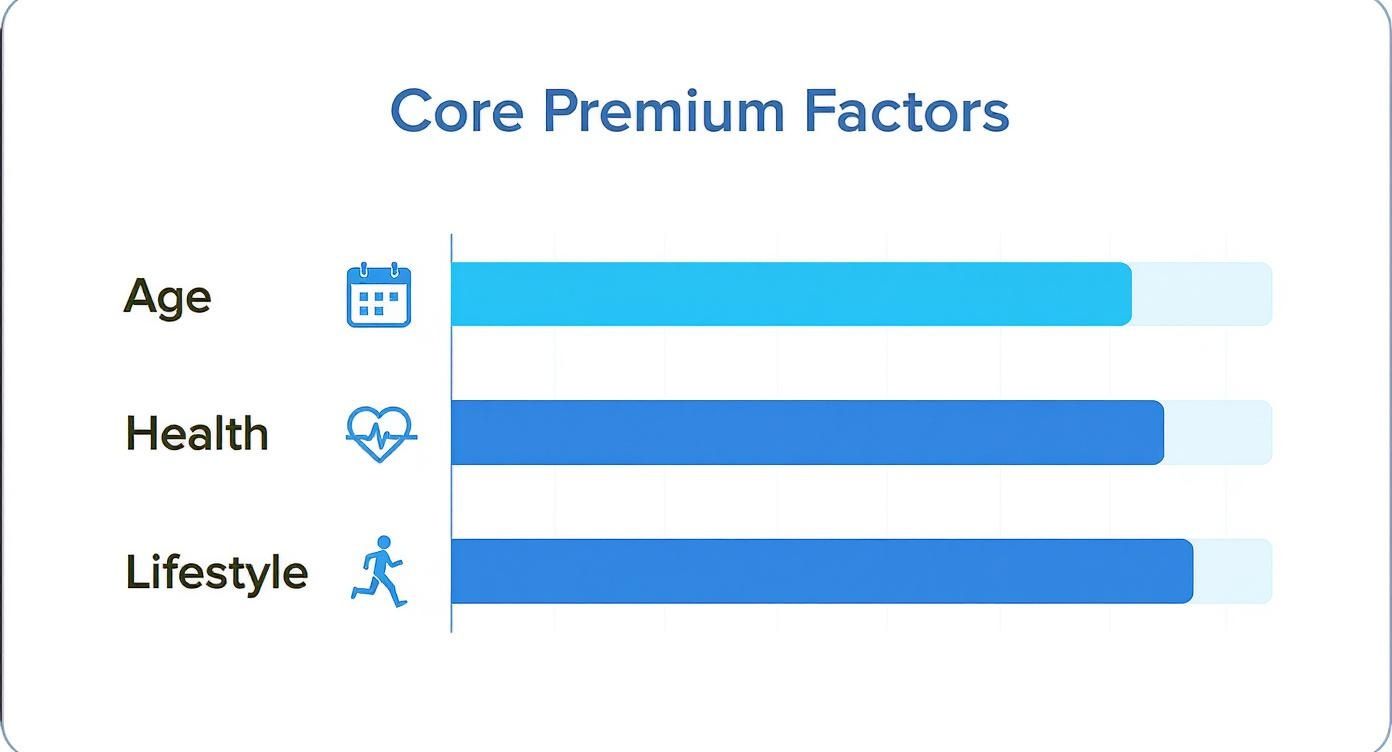
This just goes to show that while your birthday is fixed, you have a say in how insurers see your health and lifestyle—and that directly impacts your wallet.
Now, let's see how this all comes together in the real world. The table below gives you a look at sample monthly premiums for non-smokers in excellent health (what insurers often call "Preferred Plus").
Term Life Insurance Monthly Premium Comparison
| Age | Term Length | Coverage Amount | Estimated Monthly Premium (Male) | Estimated Monthly Premium (Female) |
|---|---|---|---|---|
| 30 | 20 Years | $250,000 | $15 | $13 |
| 30 | 30 Years | $500,000 | $29 | $25 |
| 40 | 20 Years | $500,000 | $32 | $28 |
| 40 | 20 Years | $1,000,000 | $55 | $47 |
| 50 | 10 Years | $250,000 | $38 | $30 |
| 50 | 20 Years | $500,000 | $78 | $61 |
Note: These are just sample rates to give you an idea. Your actual quote will be specific to you.
As you can see, a 30-year-old man could lock in a $500,000 policy for 30 years for just $29 per month. Fast forward to age 50, and that same man looking for the same coverage (but for only 20 years) might be looking at $78 per month. That's nearly triple the cost for a shorter term, which really drives home the huge financial upside of buying coverage when you're young.
How Much Coverage Do You Need?
The size of your death benefit is another big lever. It makes sense that more coverage costs more, but the price doesn't always scale up in a straight line. Doubling your coverage from $500,000 to $1,000,000 won't necessarily double your premium.
For example, a 40-year-old woman might pay $28 for a $500,000, 20-year policy. If she bumps that coverage up to $1,000,000, her premium only goes up to $47. It’s a jump, sure, but it’s less than double the price. Insurers often give you a better deal per dollar on higher coverage amounts.
The most important thing to see here is the incredible financial power you get by buying a policy when you're young. Getting a long-term policy in your 30s can literally save you thousands—or even tens of thousands—of dollars over the years compared to waiting until you're in your 40s or 50s.
This is a huge deal for young families who need to lock in affordable protection for the long haul. That’s why we’ve put together a guide specifically on life insurance for parents to help make those decisions easier.
Your Health and Lifestyle Seal the Deal
All the numbers above assume you're in great health and don't smoke. But those two things can change your quotes more than anything else. A healthy 40-year-old who smokes could easily see their premium jump by 200-300%.
Let’s look at a quick scenario:
- Scenario A: A 40-year-old non-smoking man in excellent health gets a quote for $32/month for a $500,000, 20-year policy.
- Scenario B: A 40-year-old man who is identical in every way except that he smokes might get a quote closer to $95/month for the same policy. Over 20 years, that’s an extra $15,120.
Things like high blood pressure or being overweight can also raise your premiums, though usually not as dramatically as smoking. Every insurance company looks at these factors a little differently, which is why a broad term life insurance cost comparison is so critical. Getting quotes from multiple carriers isn’t just a good idea—it’s the best strategy for saving money.
Comparing Costs Through Real-World Scenarios
Raw data tables are a great starting point, but let’s be honest—numbers on a spreadsheet don’t really tell the whole story. A real term life insurance cost comparison only makes sense when you see how it applies to actual people with real responsibilities.
Abstract figures don’t pay off a mortgage or send a kid to college. A well-chosen policy does. So let's step away from the charts and walk through a few common situations. You’ll see exactly how personal circumstances shape coverage needs and, ultimately, what you’ll pay.
Scenario One: The Young Family with a New Mortgage
Meet Mark and Sarah. They’re both 32, in excellent health, and don’t smoke. They just bought their first home with a $400,000, 30-year mortgage and are chasing after their one-year-old child. Their biggest worry? Ensuring the surviving partner wouldn’t have to sell the house and could still handle childcare and future education costs if the unthinkable happened.
They sat down and looked at the numbers. Here’s what they landed on:
- Coverage Amount: They chose a $750,000 policy. This is enough to wipe out their mortgage, replace a few years of lost income for day-to-day life, and start a college fund for their little one.
- Term Length: A 30-year term was the clear winner. It lines up perfectly with their mortgage and ensures their child will be a grown, independent adult when the policy expires.
- Estimated Cost: For two individual policies, their combined monthly premium comes out to around $65 – $75. It's a small price to pay to protect their biggest asset and their child’s future.
For a family like theirs, that long-term security is easily worth the modest monthly cost.
Scenario Two: The Small Business Owner Securing a Loan
Now let’s look at David, a 45-year-old small business owner. He’s in good health but quit smoking about five years ago. He’s applying for a $250,000 Small Business Administration (SBA) loan to expand his company, and the bank requires him to have a life insurance policy as collateral.
David’s need is very specific and temporary. He isn’t thinking about long-term family protection right now—he just needs to satisfy the lender to get the loan.
- Coverage Amount: The bank told him he needs $250,000, so that decision was made for him.
- Term Length: The loan has a 10-year repayment schedule, so David smartly chose a 10-year term policy to match it. No reason to pay for coverage he doesn't need.
- Estimated Cost: Because of his age and smoking history, his rate is a bit higher. He can expect to pay around $40 – $50 a month. It’s a necessary cost of doing business to unlock the capital his company needs to grow.
This is a perfect example of how term life insurance isn't just for families. It’s a critical tool for business owners who need to secure financing and protect their assets.
Scenario Three: The Pre-Retiree Planning for Final Expenses
Finally, there’s Susan. She’s 62 and in average health with managed high blood pressure. Her kids are grown, the house is paid off, but she wants to make sure her passing doesn't become a financial headache for her family. She’s focused on covering funeral costs, any lingering medical bills, and leaving a small gift behind.
Susan doesn't need a huge policy. She just needs enough to tie up loose ends.
- Coverage Amount: She figures $50,000 will be plenty to cover all final expenses and still leave a little something for her grandkids.
- Term Length: She goes with a 15-year term. This gets her through her early retirement years, giving her peace of mind without the high cost of a permanent policy.
- Estimated Cost: Considering her age and health, a $50,000, 15-year policy will likely cost her between $70 – $90 per month.
These stories show that the "right" policy is deeply personal. Globally, term life insurance rates vary, but trends show premiums are on the rise due to inflation and updated risk models. In the United States, for instance, the average annualized premium for new term life policies rose by 8% in 2025, reaching $3.9 billion. You can find more of these life insurance statistics on Bankrate.com.
This just highlights how important it is to lock in a rate that fits your specific needs—sooner rather than later.
Actionable Strategies to Lower Your Premium

Knowing how premiums are calculated is one thing, but actually lowering them? That’s where you take back control of your term life insurance cost comparison. With just a few smart moves, you can cut your monthly payments down significantly without ever compromising on your coverage.
These aren't just generic tips. They are specific, proven actions you can take to make yourself look like the lowest possible risk to an insurer. From how you time your application to the way you prep for your medical exam, every little detail counts.
Shop Around for the Best Rates
This is the single most important thing you can do to save money. Every insurance company has its own secret sauce for assessing risk. One insurer might see your slightly high cholesterol as a major red flag, while another will be far more forgiving if it’s well-managed with diet or medication.
You should never, ever accept the first quote you get. Make it a rule to get quotes from at least three to five different carriers. That’s the only way to see how their underwriting philosophies differ. This one step can easily save you hundreds of dollars a year for the exact same policy.
Working with a pro can unlock even more savings. Consider finding a qualified insurance broker who can shop the market for you and pinpoint insurers that are more favorable to your unique health profile.
Prepare for Your Medical Exam
Your medical exam is a make-or-break moment. It’s what directly determines your health class and, by extension, your premium. While you can't change your medical history, you absolutely can take steps to make sure your results are as accurate and positive as possible on exam day.
Here’s a quick checklist for the days leading up to your exam:
- Hydrate Well: Drink plenty of water for 24-48 hours before. It helps with the blood draw and ensures everything is flowing smoothly.
- Avoid Strenuous Exercise: An intense workout can temporarily spike your protein levels and blood pressure readings. Take a rest day.
- Limit Certain Foods: Steer clear of salty, fatty foods and too much caffeine. They can throw your cholesterol and blood pressure numbers off.
- Fast as Directed: Your examiner will likely ask you to fast for 8-12 hours. This is crucial for getting an accurate read on your blood sugar and cholesterol.
These small adjustments can help you lock in a better health rating, which means a lower premium for the life of your policy. It’s a no-brainer.
An applicant who moves from a "Standard" to a "Preferred" health class can see their premiums drop by 25% or more. Preparing for your medical exam is one of the highest-impact actions you can take to reduce your costs.
Consider a Policy Laddering Strategy
Let's be realistic: do all of your financial responsibilities last for 30 years? Probably not. That's where laddering comes in. It involves buying multiple term policies with different lengths and coverage amounts to match your shrinking financial needs over time.
For instance, a 35-year-old might need $1 million in coverage right now to protect a mortgage and young kids. Instead of buying one massive 30-year policy, they could ladder it:
- A 10-year, $250,000 policy to cover the expensive daycare and early childhood years.
- A 20-year, $500,000 policy to see the kids through college and pay down most of the mortgage.
- And a 30-year, $250,000 policy to cover the last of the mortgage and provide final income replacement.
This strategy ensures you aren't over-insured—and overpaying—in those later years when your financial obligations have dropped off. For more powerful tips, our guide on how to reduce insurance premiums dives even deeper. Each of these steps gives you more power to find affordable, high-quality protection.
Got More Questions About Insurance Costs?
Even after you've compared a few term life insurance quotes, some specific questions almost always pop up. These are the little details that can make a big difference, not just in your final price but in how confident you feel about the policy you choose. Let's clear up some of the most common things people ask during the application process.
Answering these final questions will give you the complete picture, so you can move forward and protect your family’s future without any lingering doubts.
How Do Insurers Really Look at Common Health Conditions?
This is a big one. So many people worry about how a pre-existing condition will affect their rates. Let’s take something super common, like high blood pressure. If you're on top of it—taking your medication, keeping your readings in a healthy range, and following your doctor's advice—many insurers will still offer you a great rate. You might even land in a "Standard Plus" health class.
But if that same condition is unmanaged, or if it's combined with other red flags like smoking or being overweight, that’s when you’ll see much higher premiums.
Here’s what you need to know: Underwriters care more about how well you're managing a condition than the fact that you have it. Proving you're proactive about your health can get you a much better rate than you might think.
Every insurer has its own rulebook for specific conditions. This is exactly why getting quotes from several companies is so important. One company might barely blink at an issue that another penalizes heavily.
Can I Get a Lower Premium After My Policy Starts?
Once your term life policy is active, your premium is locked in for good. But there's a little-known way you might be able to lower it down the road: a process called reconsideration.
If you’ve made some major positive changes to your health since you first got the policy, you can ask your insurer to take a second look at your health class. This could be things like:
- Quitting smoking for at least a full year.
- Losing a significant amount of weight and keeping it off.
- Getting your cholesterol or blood pressure down into a healthier range.
The insurance company will want to see proof, which usually means a new medical exam. If you pass with flying colors, they may drop your premium for the rest of the term. Not all insurers offer this, so it's a fantastic question to ask right when you first apply.
Why Are Quotes for the Same Coverage So Different?
Ever get two quotes for the exact same $500,000, 20-year policy and see a huge price difference? It can be baffling, but there's a simple reason for it. It all comes down to each company's unique underwriting guidelines and who they consider their ideal customer.
For example, one company might have tons of data on people with well-managed diabetes, so they offer them better rates. Another might be more relaxed about your family’s medical history but much stricter about your travel habits.
These internal risk models are their secret sauce. There's no way for you to know which company will see your profile in the best light without actually shopping around. This is the whole point of a good term life insurance cost comparison—it's not just about finding the cheapest price, but about finding the insurer that's the best fit for your life.
Ready to see how different insurers view your unique profile? At My Policy Quote, we make it easy to compare quotes from top-rated companies in minutes. Find the best rate and the right coverage for your family today by visiting https://mypolicyquote.com.