When you start comparing term life insurance costs, you quickly realize one simple truth: your premium is a direct reflection of the risk you represent to the insurer.
This means two people of the exact same age can get wildly different quotes. Why? Because things like your health, gender, and lifestyle choices all play a huge role. Understanding these key factors is the first step toward finding coverage that actually fits your budget.
Why Term Life Insurance Costs Differ
Trying to compare term life insurance quotes without knowing the "why" behind the numbers can feel confusing. Insurers aren't just pulling premiums out of a hat; they use a detailed risk assessment process called underwriting to figure out your rate. This process looks at several key personal details to predict your life expectancy.
The lower the risk you represent, the lower your premium will be. It’s that simple. This is why a healthy, non-smoking 30-year-old will always pay a lot less than a 50-year-old smoker for the same exact policy. Each piece of information tells a part of your story and adds up to your final cost.
Core Factors Driving Your Premium
Every insurance company has its own underwriting rulebook, but they all focus on the same fundamental data points. These are the building blocks of any quote you’ll ever receive.
Four main things set the starting point for your premium:
- Age: This one’s the biggest. The younger you are when you lock in a policy, the lower your rate will be. It's just a matter of statistics—you’re further from your life expectancy.
- Health: Your current health and medical history are critical. Insurers look at everything from your blood pressure and cholesterol levels to past illnesses and even your family's medical history.
- Gender: Statistically, women live longer than men. Because of this, women generally pay lower premiums than men of the same age and health.
- Lifestyle: Do you have high-risk hobbies like skydiving? Or a dangerous job? Those can bump up your premium. But the biggest lifestyle factor by far is smoking, which can easily double or even triple the cost of a policy.
The Underwriting Process at a Glance
Underwriting is just the fancy term for how an insurer verifies your information and assigns you a health classification. This classification is what directly determines your final premium.
Insurers use health classes—like Preferred Plus, Preferred, Standard Plus, and Standard—to sort people by risk. Landing in a better health class is one of the most powerful ways to lower your term life insurance costs.
The huge range in premiums out there shows just how personal this process is. For example, some U.S. insurers advertise rates anywhere from a few dollars to over $1,500 a month, all depending on an applicant's unique risk profile. This is exactly why getting personalized quotes is so important. One person might pay a tiny fraction of what someone else their age pays, all because of different health or lifestyle factors.
To get a true term life insurance cost comparison, you have to give each insurer the same, accurate information. That’s the only way to ensure you're getting an "apples-to-apples" look at your options and can make a smart, informed decision. For a deeper dive into the specifics, check out our guide on the costs of term life insurance.
Comparing Costs By Age And Gender
When it comes to term life insurance, two of the biggest factors that you can't change are your age and gender. But understanding just how much they influence your premiums is the key to getting the best deal. Insurers work with massive sets of data, and these two details give them the clearest statistical snapshot of your life expectancy, forming the very foundation of your quote.
The principle is really simple: the younger you are when you buy a policy, the cheaper it will be. Every year you put it off, your premium for the exact same coverage goes up. Why? Because, statistically speaking, you’re one year closer to the end of your life. It’s why you’ll hear financial advisors say, time and time again, to lock in your life insurance sooner rather than later.
The Financial Impact Of Waiting
Putting off buying term life insurance isn't just a small delay—it can cost you thousands of dollars over the life of your policy. And the price increases aren't gradual. They tend to jump quite a bit as you cross into a new decade. A 30-year-old will get a much better rate than a 40-year-old, and the gap between 40 and 50 is even more dramatic.
The magic of term life is that your rate is locked in and stays level for the entire term. If you buy a 20-year policy at age 30, you get to pay that low 30-year-old rate for the next two decades. But if you wait until 40, you’re stuck paying a higher 40-year-old’s premium for the whole 20 years.
This infographic really breaks down what goes into your insurance costs.
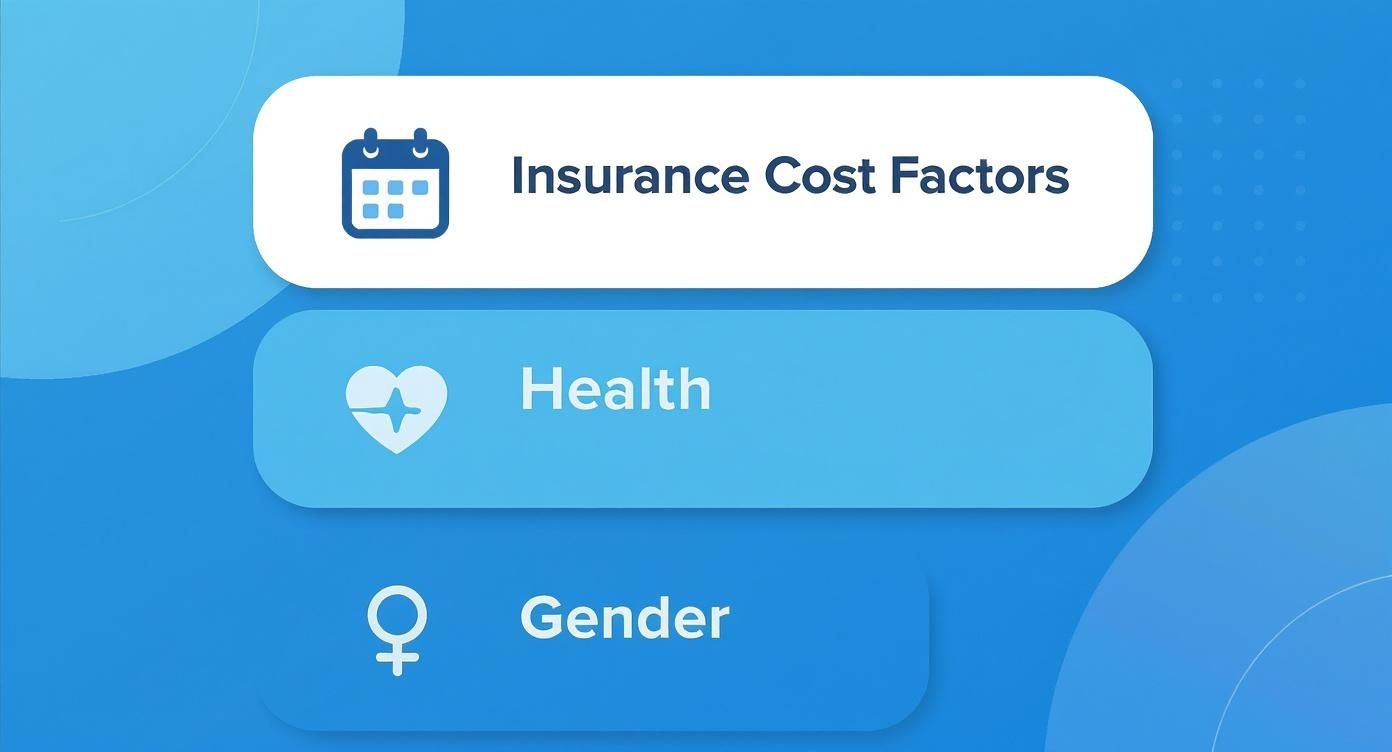
As you can see, your age, health, and gender are the three pillars that insurers build your quote on. They’re using this information to calculate risk, which translates directly into what you pay.
Sample Term Life Rates By Age And Gender
To see what this looks like in the real world, let's look at some numbers. The table below shows some estimated monthly premiums for a $500,000, 20-year term policy. These are for non-smokers in excellent health. You’ll notice two very clear patterns: women consistently pay less, and the rates climb sharply as you get older.
Average Monthly Term Life Rates By Age And Gender ($500,000 / 20-Year Term)
| Age | Average Monthly Premium (Male) | Average Monthly Premium (Female) |
|---|---|---|
| 30 | $26 | $21 |
| 40 | $39 | $32 |
| 50 | $95 | $73 |
| 60 | $280 | $195 |
Heads up: These are just illustrative estimates for non-smokers in a Preferred health class and can vary.
Look at those numbers. A 30-year-old man might pay around $26 a month. If he waits until he's 40, that same policy could cost him $39 a month—that's a 50% increase! Over the 20-year term, that delay just cost him an extra $3,120. The jump from 40 to 50 is even bigger, more than doubling his premium.
Gender makes a difference, too. At every single age, women pay less than men for the same amount of coverage. This is because, on average, women live about five years longer. To an insurer, that means less risk, which means lower premiums for you. If you want to dive deeper into pricing, check out our full guide on https://mypolicyquote.com/2025/11/21/how-much-does-life-insurance-cost/.
It's interesting how this mirrors other parts of your financial life. Just as your age heavily impacts insurance costs, it also shapes your investment strategies. You can learn more about how financial planning evolves with age.
The takeaway here is pretty clear: age is the single most powerful factor in determining what you'll pay. Getting a policy while you're young and healthy is the smartest financial move you can make, locking in a low rate that protects your family for years to come. Every year you wait has a real, measurable cost.
How Your Policy Choices Affect Premiums
Beyond your personal details, the two biggest levers you can pull on your term life insurance cost are the coverage amount and the term length. These choices directly shape the financial safety net you're building for your family. Understanding how they work together is the key to comparing term life insurance costs effectively and finding a policy that's both adequate and affordable.
Think of it this way: the coverage amount is the "how much" and the term length is the "how long." A bigger safety net held for a longer time will naturally cost more. But the relationship isn't always what you'd expect, and finding that sweet spot between protection and price is where you can make some really smart moves.

The Impact Of Coverage Amount
The coverage amount, also called the death benefit, is the tax-free lump sum your loved ones receive if you pass away during the term. People typically choose amounts like $250,000, $500,000, or $1,000,000 to cover big financial obligations—things like replacing lost income, paying off the mortgage, or funding a child’s college education.
A common myth is that doubling your coverage will double your premium. Thankfully, it doesn’t work like that. Insurers actually offer volume discounts, which means the cost per thousand dollars of coverage goes down as you buy more.
Key Insight: Bumping your coverage from $500,000 to $1,000,000 will raise your premium, but it will likely be far less than double the cost. This economy of scale makes higher coverage amounts more accessible than many people realize.
For instance, a healthy 35-year-old might pay $30 per month for a $500,000 policy. Jumping up to a $1,000,000 policy might only increase their premium to around $50 per month, not $60. That makes getting the right amount of coverage a lot more manageable.
The Influence Of Term Length
The term length is simply the period your policy is active and your premium is locked in. The most common options are 10, 20, or 30 years. The trick is to align your term with your longest financial responsibility.
Here’s a quick look at how people typically use them:
- 10-Year Term: This is often a good fit for covering shorter-term debts. It's also great if you're nearing retirement and just need to bridge that final gap in your working years.
- 20-Year Term: A very popular choice for families. It can cover the time until kids are financially independent and a good chunk of the mortgage is paid off.
- 30-Year Term: Ideal if you just bought a home with a 30-year mortgage or have very young children. This ensures you're protected through your most financially demanding decades.
Longer terms cost more because the insurer is on the hook for a longer time, which increases the statistical chance they'll have to pay out. The price difference between a 20-year and a 30-year term can be pretty big, so it’s important to match the term to your actual needs to avoid overpaying.
Comparing Premiums By Policy Choices
To see how these two factors play off each other, let’s use a consistent example: a healthy, non-smoking 40-year-old male. The table below shows just how much monthly premiums can change based on different coverage amounts and term lengths.
Sample Monthly Premiums For a 40-Year-Old Male
| Coverage Amount | 10-Year Term | 20-Year Term | 30-Year Term |
|---|---|---|---|
| $250,000 | $16 | $24 | $38 |
| $500,000 | $22 | $39 | $65 |
| $1,000,000 | $35 | $70 | $118 |
These are sample rates for an applicant in excellent health and can vary.
Notice how a $1,000,000 policy for 10 years ($35/month) is actually cheaper than a $250,000 policy for 30 years ($38/month). This really highlights the powerful influence term length has on your premium.
You might also add optional features to your policy. Our guide on what is a rider on life insurance can help you understand how those customizations affect your plan and cost. At the end of the day, balancing these policy choices is how you design protection that fits your family’s needs without breaking your budget.
The Impact Of Health Classifications On Your Cost
That online quote you just got? It’s a great starting point, but it's not the final number. Think of it as a well-educated guess. The real, locked-in premium only comes after the insurance company does its homework—a process called underwriting—and gives you a formal health classification.
Honestly, this rating is the single most important factor that decides what you’ll actually pay. Understanding how it works pulls back the curtain on the whole process. It puts you back in the driver's seat, letting you get a much better sense of your final costs before you even apply.

Decoding The Health Class Tiers
Insurers sort applicants into different tiers based on their overall health and lifestyle. While the names might change a bit from one company to the next, the idea is the same everywhere. Landing in a top tier can save you a serious amount of money over the life of your policy.
Here are the most common classifications you'll see, from best to worst:
- Preferred Plus (or Super Preferred): This is the gold standard. It’s for people in truly exceptional health—think ideal height and weight, a squeaky-clean medical history, no family history of major diseases at a young age, and perfect results from the medical exam.
- Preferred: This is for folks in great shape who might just miss the super-strict criteria for the top tier. Maybe your cholesterol is a little high but it’s managed perfectly with medication. You're still in excellent health.
- Standard Plus: This is for the average, healthy person. You might be carrying a few extra pounds, have a minor health issue here or there, or have some family history of illness, but overall, you're doing just fine.
- Standard: This is the baseline for most applicants. It’s designed for people with common, well-managed conditions like high blood pressure or those who are more significantly overweight.
This whole evaluation is part of the underwriting process. If you want to dive deeper into how that works, you can check out our guide on what is underwriting in insurance. Knowing the steps helps you see exactly why your health plays such a huge role in your final rate.
How Health Class Affects Your Premium
The price difference between these tiers is no small thing. Two people who are the exact same age and want the exact same policy can walk away with wildly different monthly premiums, all because of their health class.
Key Takeaway: Your health classification can easily swing your monthly premium by 50-100% or more. An applicant who gets a Preferred Plus rating might pay $35 per month, while someone just like them who gets a Standard rating could be looking at $75 per month for the very same coverage.
Let’s put some real numbers to it. The table below shows how the monthly cost for a 40-year-old male wanting a $500,000, 20-year policy can change depending on his health rating.
Premium Comparison By Health Class ($500,000 / 20-Year Term for a 40-Year-Old Male)
| Health Classification | Estimated Monthly Premium |
|---|---|
| Preferred Plus | $34 |
| Preferred | $39 |
| Standard Plus | $58 |
| Standard | $67 |
These are illustrative estimates and actual premiums will vary by insurer and individual profile.
See that? Just dropping from a Preferred to a Standard Plus rating adds almost $20 a month to the bill. Over 20 years, that’s an extra $4,800 out of your pocket.
Special Considerations For High-Risk Factors
Some lifestyle choices or health conditions automatically put you into a different bucket. The biggest one? Tobacco use.
Smokers are always given their own ratings (like Preferred Smoker or Standard Smoker), and their premiums are dramatically higher—often two to three times more than what a non-smoker would pay. Other things like high-risk hobbies (think scuba diving or rock climbing) or a history of DUIs will also push your rates up, and in some cases, could even lead to being denied coverage.
Practical Strategies To Lower Your Premium
Knowing what drives your premium is one thing. Using that knowledge to your advantage is where the real savings happen. With a few smart moves during your application process, you can turn a basic cost comparison into a serious money-saving strategy.
You don't need complicated tricks, either. By making a few small but meaningful adjustments, you can present yourself as a lower-risk applicant. Insurers reward that directly with a lower monthly bill. It's really just common sense that pays off.
Get Healthier Before You Apply
If you aren't in a huge rush for coverage, taking a few months to dial in your health can make a massive difference. Underwriters look very closely at your height-to-weight ratio, cholesterol numbers, and blood pressure. It's a huge part of their calculation.
Making real progress here could bump you up to a better health class, which is one of the most powerful ways to slash your costs. For example, losing just 10-15 pounds to get into a better BMI category or lowering your blood pressure with diet and exercise could easily be the difference between a Standard and a Preferred rating.
Quit Smoking For Good
This is it. This is the single biggest thing you can do to lower your insurance costs. Premiums for smokers are consistently two to three times higher than for non-smokers. It’s a staggering difference.
Most insurance companies require you to be completely tobacco-free for at least 12 months to even qualify for non-smoker rates. Some will give you even better rates after five years. The savings are huge—a 40-year-old male smoker might pay over $100 a month for a policy that costs a non-smoker closer to $35. Quitting isn't just a great health decision; it's a major financial one.
Shop Around With An Independent Broker
Every single insurance company plays by its own rules. One might be more forgiving of a specific health issue, while another gives better rates to a certain age group. You’ll never know who has the best deal for you unless you compare them.
Pro Tip: Working with an independent insurance broker is a game-changer. Instead of filling out endless applications yourself, a good broker shops your profile across dozens of carriers at once to find the one that will give you the most competitive rate for your specific situation.
Pay Annually, Not Monthly
This is such a simple tip, but most people miss it. We all love the convenience of monthly payments, but insurers often tack on small administrative fees for the trouble. If you choose to pay your premium once a year, those fees disappear.
While it might only save you a few bucks a month, that adds up over a 20 or 30-year term. You could easily save 5-8% on your total premium just by switching to an annual payment. It's an easy win that requires zero changes to your health or lifestyle.
Consider Laddering Your Policies
Think about it—your need for life insurance probably won't stay the same for 30 years. As you pay down your mortgage and your kids grow up and leave the nest, you just don't need as much coverage. So instead of buying one massive 30-year policy, you can "ladder" a few smaller policies with different term lengths.
Here’s a quick example of how it works:
- Policy 1: A $500,000, 30-year term policy to make sure your mortgage is covered no matter what.
- Policy 2: A $500,000, 20-year term policy to replace your income until the kids are financially independent.
This approach gives you maximum protection when your financial responsibilities are at their peak, but it stops you from paying for coverage you don't need later on. More often than not, layering policies this way is cheaper than getting one huge policy for the longest possible time.
We Get It, You Have Questions
Diving into term life insurance can feel like a lot at first. As you start comparing quotes and policies, questions are bound to pop up. Getting clear, straightforward answers is the key to feeling confident in your choice.
This isn't just about finding the cheapest monthly premium. It’s about understanding how a policy really works and if it fits into your life for the long haul. Let's tackle some of the most common questions we hear every day.
Is a 20-Year or 30-Year Term Policy Better?
Honestly, there’s no single “better” option here. The right choice comes down to your personal timeline and what you're protecting. It’s all about matching the term length to your biggest financial responsibilities.
A 30-year term is a great fit for people taking on new, long-term commitments. Think about situations like:
- Buying a home with a brand-new 30-year mortgage.
- Having a baby or very young kids who will be financially dependent for decades.
- Launching a business that needs a long runway before it can sustain itself.
On the other hand, a 20-year term is a smarter, more affordable choice if your biggest financial hurdles will be behind you in two decades. This might be perfect if you have 20 years left on your mortgage or if your kids will be out of college and on their own by then. The goal is to avoid paying for more insurance than you actually need.
Will My Term Life Premium Go Up Over Time?
One of the best things about standard term life insurance is the stability. With a level term policy—which is what most people get—your premium is locked in. It is guaranteed not to increase for the entire length of your term.
So, if you get a 20-year policy at age 30 for $25 a month, you'll pay exactly $25 a month for all 20 of those years. That predictability makes budgeting for the future so much easier.
Heads Up: Once your initial term is over, you might be able to renew your policy, usually year by year. But be warned: those renewal premiums will be much higher because they're based on your new, older age. Always double-check that you're buying a level term policy to lock in that fixed rate.
What Happens When My Term Life Policy Ends?
If you're still living when the policy's term runs out, the coverage simply ends. You stop paying, and the insurance company no longer has an obligation to your beneficiaries.
For a lot of people, this is exactly what they planned for. By the time a 20 or 30-year policy expires, the mortgage is paid off, the kids are on their own, and the original need for that big safety net just isn't there anymore.
Some policies do give you a few choices before the term ends, like:
- Converting it: Many policies have a conversion feature that lets you switch part or all of your term coverage into a permanent policy (like whole life) without another medical exam.
- Renewing it: As we mentioned, you might be able to renew annually, but it's going to be expensive.
For most people, though, the term finishes, and the contract is complete. Mission accomplished.
Can I Get Term Life Insurance Without a Medical Exam?
You bet. "No-exam" or "simplified issue" policies are everywhere these days. They let you skip the full medical exam (no needles!) and get covered fast—sometimes in just a few days—by just answering health questions.
But that convenience comes at a cost. Insurers are taking on more risk without all your health data, and they pass that risk back to you through higher premiums. A no-exam policy can be a good move if you need coverage right now or you're truly terrified of needles.
However, if you're in decent health, a fully underwritten policy with a medical exam will almost always get you the best, most affordable rates. Taking an hour for the exam could save you thousands over the life of the policy.
Finding the right policy is about balancing what you need with what you can afford. At My Policy Quote, we make it simple to compare quotes from top insurers, so you can find a plan that protects your family without breaking the bank. Explore your options with My Policy Quote today.