

Trying to make sense of your health insurance policy can feel like you’re decoding a secret language. But when it comes to managing your out-of-pocket costs, two terms are absolutely essential to understand: copay and deductible.
At first glance, they might seem similar—they’re both money you pay for care. The real difference, though, is in how and when you pay them.
Your Quick Guide to Copay vs Deductible
Think of it this way: A copay is a simple, predictable fee you pay for routine services. A deductible, on the other hand, is the larger financial threshold you have to meet before your insurance starts covering the big stuff. One is for the everyday, the other is for the unexpected.

Let's break down exactly what sets them apart so you can feel confident every time you use your insurance.
At a Glance Copay vs Deductible
To make it even clearer, here’s a quick table that puts the key differences side-by-side.
| Key Feature | Copay | Deductible |
|---|---|---|
| Payment Type | A fixed dollar amount (e.g., $25) you pay per service. | A total amount you must pay out-of-pocket before insurance pays. |
| When It Applies | Usually for routine services like doctor visits or prescriptions. | Typically for major services like hospital stays, surgeries, or lab work. |
| Frequency | Paid each time you receive a specific service. | Paid until the annual accumulated total is met. |
| Predictability | Highly predictable, making it easy to budget for common care. | Less predictable; you only pay it when significant care is needed. |
Knowing these distinctions is the first step to truly understanding how your health plan works for you—and your wallet.
How Your Health Insurance Deductible Really Works
Think of your health insurance deductible as a spending threshold you have to meet each year before your insurance company starts paying its share for the bigger medical services. It's the total amount you’re responsible for covering out-of-pocket first. This usually applies to things like surgeries, hospital stays, or serious lab work.

Unlike a copay, which is that small, fixed fee you pay for a specific visit, the deductible is a running total. Every time you pay for a covered service (that isn’t a simple copay visit), that expense chips away at your deductible for the year.
This cost-sharing model has become incredibly common. In employer-sponsored plans, the number of workers with deductibles shot up from 59% to 85% between 2007 and 2017. During that same period, what employees spent on deductibles more than tripled, while spending on copayments actually went down. You can dig into more data on this trend from the Peterson-KFF Health System Tracker.
Individual vs. Family Deductibles
Knowing which type of deductible your plan has is crucial for managing your family's budget. Health insurance plans generally come in one of two flavors:
- Individual Deductible: Each person covered by the plan has their own separate deductible. Once someone hits their individual amount, the insurance starts helping with their costs—even if others on the plan haven't met theirs yet.
- Family Deductible: This is one big, single deductible that applies to everyone on the plan. Many family plans also have an "embedded" individual deductible. This means that once one person hits their individual limit, their care gets covered, but the overall family total must still be met before coverage kicks in for everyone else.
A high deductible can be a serious financial hurdle, especially when unexpected medical needs pop up. It’s there to protect you from catastrophic costs, but it also means you shoulder the initial financial risk each year.
A higher deductible usually comes with a lower monthly premium. This creates a trade-off between what you pay every month and what you might have to pay unexpectedly. Understanding how your plan's deductible for health insurance is structured is the first step toward avoiding surprise bills and making confident decisions about your care.
Understanding the Role of Your Copay
Your copay, or copayment, is that simple, fixed fee you hand over every time you get a specific healthcare service. Think of it as the upfront cost for a routine doctor’s visit or picking up a prescription. You pay it right at the front desk or pharmacy counter, and that’s it.

This predictability is the whole point. It gives you cost certainty, so you can actually budget for regular medical needs without dreading a massive, surprise bill for common services. This is one of the biggest differences between a copay and a deductible.
How Copays Vary
Not all copays are the same, though. Your insurance plan will set different flat fees for different services, usually based on how complex or expensive the care is. It's a tiered system designed to help manage costs.
For instance, your plan might look something like this:
- Primary Care Visit: A lower fee, often $25 to $35, for a standard check-up.
- Specialist Visit: A higher fee, maybe $50 to $75, to see someone like a cardiologist.
- Emergency Room Visit: A much higher copay, sometimes $150 or more, to encourage you to only use the ER for true emergencies.
The most important thing to remember about a copay is that it often applies right away, even before you’ve met your annual deductible. This means you can get the essential, routine care you need without having to pay a huge amount out-of-pocket first.
This structure makes sure that for most of your day-to-day health needs, your costs are clear and manageable from the very first day of your plan. To get a better handle on the specifics, you can dig deeper into our guide on how do copays work and see how they fit into your big-picture coverage.
Copay vs. Deductible: When Do You Pay?
Trying to figure out when you owe a copay versus when a bill goes toward your deductible can feel like a guessing game. But once you get the hang of it, it's actually pretty straightforward. Think of them as two different tools in your financial toolkit—they work together, but you use them for very different things.
Your copay is that predictable, fixed fee you pay for routine services. It’s like the cover charge for a doctor's visit or the set price for a prescription refill. You’ll usually pay this amount right at the counter, whether you’ve met your deductible or not.
On the other hand, your deductible is the bigger number that comes into play for significant, less common medical events. It’s the full amount you have to pay out-of-pocket for things like a hospital stay, surgery, or an MRI before your insurance company starts paying its share.
Scenario 1: Managing an Ongoing Condition
Let’s imagine you’re managing a chronic condition that requires regular trips to a specialist.
Each time you go for a check-up, you hand over a $50 copay. It’s a fixed, expected cost that helps you budget for your care throughout the year. Simple enough.
But then, your doctor orders a series of expensive lab tests that cost $800. Since this isn't a simple office visit, the full $800 bill goes toward your annual deductible. You pay that entire amount yourself, and that payment gets you $800 closer to meeting your deductible. Your copays, however, don’t count toward it.
Scenario 2: An Unexpected Emergency
Now, picture someone who is perfectly healthy and rarely goes to the doctor. One day, they have an accident and need emergency surgery.
The total bill for the procedure and hospital stay comes to $12,000. Their health plan has a $5,000 deductible.
In this situation, they are responsible for the first $5,000 of that bill. Once they've paid that amount and met their deductible, their insurance plan’s other benefits—like coinsurance—kick in to help cover the remaining $7,000. This is a totally different scenario from how a coinsurance vs copay works, where costs are split differently after the deductible is met.
The real difference is what triggers the payment. Copays are tied to specific, routine services. The deductible is the total you have to hit before your insurance takes over for the big stuff.
Unfortunately, high deductibles can put a serious dent in your finances. The Commonwealth Fund reports that some ACA marketplace plans have deductibles that climb past $7,500—which can be up to 21% of a person’s entire yearly income.
Choosing a Health Plan Based on Your Needs
Figuring out how copays and deductibles play into your choice of a health plan really boils down to one thing: balancing what you pay each month with what you might have to pay later. There’s no single right answer. It’s all about what makes sense for your health, your family, and your wallet.
If you’re generally healthy and don’t see the doctor often, a high-deductible health plan (HDHP) could be a smart move. Sure, the deductible is high, but your monthly premium is low. This saves you money month after month, and you only face a bigger bill if something unexpected and serious happens.
This decision tree gives a great visual of when a copay usually kicks in versus when you’re chipping away at that deductible.
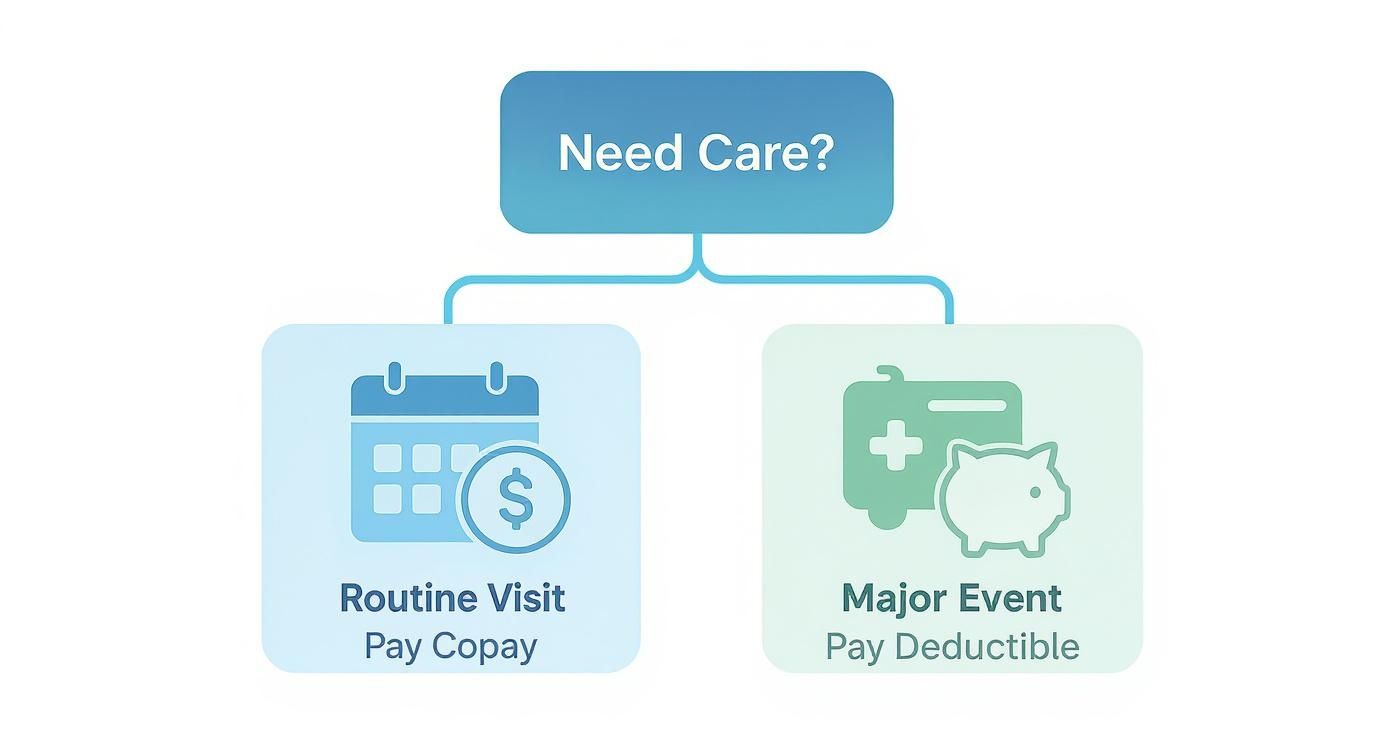
It’s pretty clear: routine, predictable visits typically mean a straightforward copay. Major, unplanned medical events are where your deductible comes into play first.
Finding the Right Balance for Your Life
On the flip side, if you're managing a chronic condition or have a family that needs regular medical care, a plan with a lower deductible and predictable copays offers much-needed stability. The higher monthly premium is the price you pay for peace of mind, knowing you won't be hit with a massive, sudden medical bill. This is a huge piece of the puzzle as you figure out https://mypolicyquote.com/2025/10/18/how-to-choose-the-right-health-insurance/.
As you weigh your options, it's also worth looking into different types of plans. For example, you might want to delve into specific details about Medicare if you're approaching eligibility age or meet other criteria.
Choosing a plan is about anticipating your future. A low-premium, high-deductible plan bets on good health, while a high-premium, low-deductible plan prepares for consistent medical needs.
Government policies can also shift these costs. A 2022 analysis, for instance, found that the median Marketplace deductible dropped from $1,000 to $750 between 2017 and 2021. This change was largely thanks to policies designed to ease the financial burden on consumers, showing how much bigger trends can affect your bottom line.
A Few Common Questions
Even when you know the difference between a copay and a deductible, things can still get a little confusing. Let's clear up some of the most common questions people ask. Getting these details straight is the key to avoiding those surprise bills everyone dreads.
Do My Copays Count Toward My Deductible?
This is easily one of the most frequent questions, and the answer is almost always no.
Think of your copay as a separate fee for a specific service, like your ticket to get in the door. The $35 you pay for a routine doctor's visit is its own cost and doesn't chip away at your larger deductible. You'll satisfy your deductible with other covered costs, like bloodwork, a hospital stay, or surgery.
So, What Happens After I Meet My Deductible?
Hitting your deductible is a big moment for your health plan. Once you've paid that full amount out-of-pocket for the year, your insurance company starts sharing the cost in a much bigger way. This is where coinsurance usually kicks in.
It doesn't mean everything is suddenly free. Instead, it means your insurer starts paying the lion's share of your bills (maybe 80%), and you're responsible for the smaller portion (the remaining 20%). This cost-sharing continues until you reach your plan's out-of-pocket maximum. After that, your insurer typically covers 100% of your in-network care for the rest of the plan year.
Meeting your deductible is like unlocking the next level of your insurance benefits. It's the point where your insurer really steps up to shoulder most of the financial weight.
Can I Actually Get a Plan with No Deductible?
Yes, you can. It's definitely possible to find a health plan with a $0 deductible for services you get from in-network doctors and hospitals. These are most common with HMO plans or some of the more premium PPO options.
But there's a trade-off. Plans with no deductible almost always come with higher monthly premiums. You're basically paying more each month for the peace of mind that comes with predictable costs and not having to worry about a large, lump-sum deductible.
Understanding the difference between a copay and a deductible makes you a smarter healthcare consumer. At My Policy Quote, we’re here to give you clear, straightforward guidance to help you find an insurance plan that fits your life and your budget. https://mypolicyquote.com